
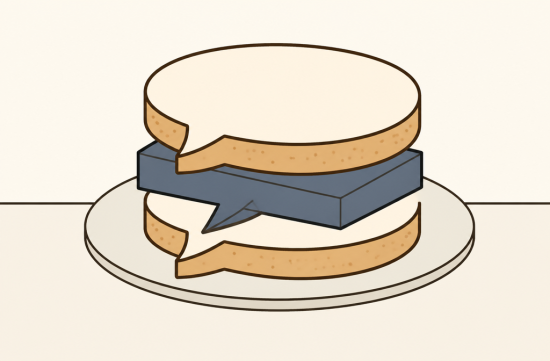
When working in an American company, you may notice that the way bad news is delivered is quite formulaic. During performance reviews, managers often start with praise, briefly address issues in the middle, and then conclude with more compliments.
In practice, it usually flows like this: "You did really well last quarter and are an indispensable part of the team. However, we need to address the deadlines you missed a few times. Still, I believe you will do well moving forward." The sequence of praise, criticism, and praise fits perfectly.
The first time I experienced this kind of conversation, I thought something was off. Even though I received criticism, I often left feeling more praised, which sometimes made me confused about what the actual issue was.
This communication style even has a name; in English, it's called the compliment sandwich or feedback sandwich. It's named for the structure of stacking criticism between two layers of positive remarks.
Looking into its origins, this method has been used in counseling and psychotherapy since the 1940s. The form we know today became widespread in workplace culture in the 1980s, when Mary Kay Ash, the founder of the cosmetics company Mary Kay, advised in her management book in 1989 to sandwich criticism between two thick layers of praise.
Interestingly, this method is not only used in companies. In schools, teachers often use a similar approach when commenting on student assignments, starting with a positive point, addressing areas for improvement, and then concluding with encouragement.
Considering why this method has taken root in American culture, it seems to be a compromise that allows for necessary conversations without damaging relationships. It's a way to address issues while not touching on personal self-esteem, creating a buffer even if it's just a formality.
For someone raised in Korea, this communication style can feel unfamiliar. When elders or superiors point out issues, they often get straight to the point, so the structure of starting and ending with compliments feels quite novel.
Personally, I don't think this buffer is always applied fairly. While such consideration is necessary for recoverable issues like performance reviews, packaging irreversible notifications like layoffs in compliments can lead to confusion, ultimately harming the employee.
However, recent studies suggest that this sandwich method may not be effective. It indicates that recipients may not take the compliments seriously, viewing them as mere formalities, which can obscure the important critical feedback.
Research in organizational behavior has also shown that this buffered feedback can reduce improvement effectiveness. Researchers from Canada's Ivy Business School recently found that sincere directness builds more trust than formality.
Over time, people will catch on to the pattern. When you open with a compliment, the listener prepares for bad news, making the initial praise sound like just a polite greeting.
Personally, I don't agree with the argument that this communication style should be completely eliminated. However, I do resonate with the idea that if the praise is insincere, it's better not to say it at all.
In summary, it seems that what truly matters is not the order but whether the message is sincere. You can borrow any form, but if the words inside are empty, no matter how good the structure, it's ultimately useless, which is what I've been thinking lately.
 RapidPeak83








 Giant Squid and Sweet Potato Soup |
 Lol Life |
 lavender |
 logger |
 Conflite Teacher |
 Western US Medical Student Association |
 DOCTOR MED |

 Koreab Date |
 good thinking |
  An ant castle |
  Haha and Bomi Blog |
  glenview 89 |
  Valley Hong |
  novapixel |
  Idaho's Sumi's House |
  Mr. Midwest America |
  wildfire |
  legalway |
  postcard |
  cheesecake07 |
  My Miami Stories |
  windylotus |
  Mia Flori |
  velaro29 |
  velaro |
  foxtrot83 |
  moname |
  mapleline |
  US Legal Consultation on Trials |