
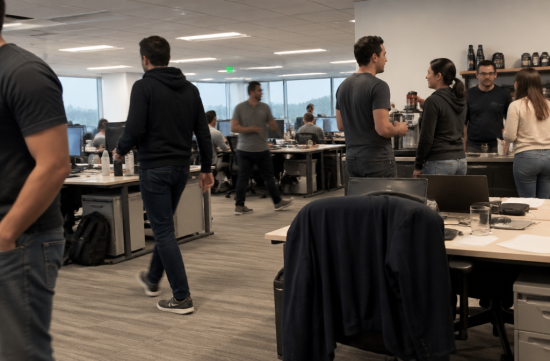
A few days ago, I joined a video conference and was taken aback when I saw the other person wearing a hoodie. I wondered if it was disrespectful, but upon reflection, it was clear that this was no longer unusual. In fact, such attire is now seen as a natural approach.
It has been quite some time since there were more people wearing jeans and sneakers than those dressed in formal business attire.
In the past, there was a saying, "Friday is Casual Day." However, these days, that phrase feels somewhat foreign. Casual attire has become the norm throughout the week.
Curious about when and where Casual Friday started, I looked into its origins. It turns out, it has a longer history than I expected.
Surprisingly, it began in Hawaii. In the 1960s, the Hawaii Clothing Association launched a campaign to promote local shirts. There were also complaints from people who had to wear ties even in the hot weather.
They initiated a movement to encourage wearing Aloha shirts to work on Fridays. This campaign was surprisingly successful. By around 1965, businesses in Hawaii had adopted this culture year-round.
At the same time, there was a different trend on the mainland. Hewlett-Packard in Silicon Valley was at the forefront. Back then, Silicon Valley was not the glamorous place it is today; it was a neighborhood of companies that started in garages.
To foster creativity among engineers, they allowed casual clothing on Fridays starting in the 1950s, meaning the roots of Casual Friday had two branches.
However, there was a pivotal moment that helped it spread nationwide.
This was the story of Dockers, a khaki brand from Levi's. Dockers was introduced in 1986 but was initially seen as clothing only suitable for golf courses. Then, in the 1990s, it successfully transformed its image into office wear.
In 1992, Levi's made a significant move. They sent a pamphlet titled "Casual Business Wear Guide" to 25,000 HR managers.
By showing photos of employees dressed in Dockers khakis instead of suits, they set a standard that indicated this level of attire was acceptable in the workplace.
This single pamphlet effectively rewrote the standards for office attire in the U.S.
The timing was perfect. For companies experiencing a recession in the early 1990s, Casual Friday was a cost-free perk.
While they couldn't raise salaries, relaxing the dress code certainly improved employee morale.
The problem was that many people didn't know what to wear. There are records of companies being confused as Hawaiian shirts, shorts, and sandals made their way into the office. From a management perspective, while the atmosphere improved, there were concerns about the company's image being compromised.
Thus, Dockers' guide gained more traction, drawing a line between extreme casualness and formal wear.
From the late 1990s to the early 2000s, as the internet industry grew, this trend solidified further.
It became more common to see developers in t-shirts rather than ties starting from this period.
During this time, it also became less unusual for CEOs to appear on stage in casual attire instead of suits. The way to demonstrate capability shifted entirely from appearance to results.
In recent years, this trend has crossed new boundaries. A survey of 501 office workers in North America found that 53 percent reported dressing more casually than before the pandemic. This survey was particularly notable as it was conducted long after the pandemic had ended.
Many respondents even expressed that every day feels like Casual Friday now.
Interestingly, specific increases were noted: 43 percent reported wearing more jeans, and 28 percent said they wore more t-shirts.
There was also a 20 percent increase in responses indicating that shoes like Crocs or slippers were more common, and 16 percent noted an increase in athleisure wear.
Even 7 percent reported working in pajamas, highlighting the lasting impact of remote work.
Among today's young professionals, it's not uncommon to find individuals who don't own a single suit. I've seen many instances of people transitioning to casual attire for interviews or their first day at work.
It seems a bit unfair to view this change simply as laziness.
For those who want to be evaluated based on their abilities and performance, the reduction of formal dress codes could be seen as a step toward fairness.
Of course, there is a counter-trend. More companies are tightening dress codes again as they require employees to return to the office.
Personally, I still appreciate the trust that comes from someone dressed in a suit. However, I hope that trust stems from their work ethic rather than their clothing.
Ultimately, Casual Friday began as a discussion about clothing and has evolved into a conversation about work styles. Comfort has taken the place of formal attire.
What about your company? Is there still a difference between Friday and weekday attire, or has every day become casual?
 coastalvibemaker1994







 Florida King |
 AH LALA |
 Victory 1988 |
 Panorama Kstar |
 Giant Squid and Sweet Potato Soup |
 US Regional Information Local News |


 Sarah's Blog |
 dewyo |
  Casa Mia |
  Asparagus Blog |
  dorange |
  hiddenkong |
  some fame |
  Godory Life |
  Lime Juice |
  French fries |
  Rynex |
  Caribbean |
  Let's Be Like a Salt-like City Person |
  Belgray Miscellany |
  sweetvan |
  Augusta Univ |
  Round and Round Children's Song Kingdom |
  butter 90 |
  Lando Mao |
  Washington Denzel DJ |
  LIZ Legal Information Blog |