
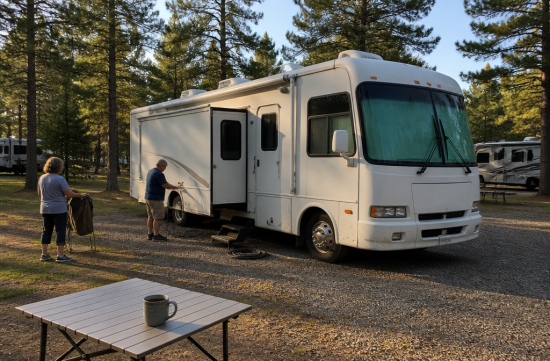
When I see RVs lined up at highway rest stops, I can't help but linger and gaze at them.
Looking at the small curtains hanging in the windows and the folding chairs set up outside, I often imagine what a day living inside would be like.
However, when I see people getting out of the driver's seat, I notice that many of them have gray hair. It's much more common to see couples traveling together than young couples.
At first, I thought it was just a hobby for retirees, but as I kept observing, I became curious. Why at this time, and why RVs specifically?
I looked up a recent owner survey from the RV Industry Association, commonly known as RVIA, and it provided some answers. The data is published annually, so it seemed reliable.
42 percent of owners of the large bus-style RVs, known as Class A motorhomes, were retirees.
The percentage of those over 55 was 66 percent, and among them, 74 percent were households without children living at home.
Just looking at the numbers shows that RVs are not just leisure items but are tied to specific life stages. This indicates that they are often purchased right after raising children or just before or shortly after retirement.
When children start leaving home one by one, it can feel like the house suddenly becomes much larger. It's also a moment when you might feel lost about how to fill the silence left by the absence of footsteps that used to echo in the morning and evening.
Even though the rooms remain, the lack of people in them makes the emptiness more noticeable. Yet, getting rid of that room feels oddly disappointing.
However, many Americans at this stage are choosing not to downsize their homes but to invest in a wheeled space instead. It's a choice for mobility rather than settling down, and at first, this idea felt strange to me.
The reasons are not particularly grand. They simply find the routine of packing up for the airport and booking hotels tedious.
The ability to take my bed, my bathroom, and my kitchen with me seems to be a significant attraction for older travelers.
I've read several times that reducing the number of restless nights in unfamiliar accommodations makes traveling less exhausting.
In fact, according to the annual camping report from the KOA campground chain, the proportion of baby boomers among campers in 2023 was 26 percent, a jump of 19 points from the previous year.
This rapid increase suggests that this generation has suddenly turned to RVs.
In the same survey, 34 percent of travelers in the retirement age group said they plan to take an RV trip within the next year.
Interestingly, the purchase of RVs is also increasing among younger people. Many analyses suggest that this trend has become more pronounced since remote work became established during the pandemic.
According to RVIA, 84 percent of new buyers in 2022 were millennials and Generation X, with the average age of first-time buyers being 32.
This means that RVs are no longer just for retirees, but the reasons older generations are drawn to them seem to differ from those of younger people.
For younger individuals, RVs symbolize remote work or a new lifestyle, while for older people, they seem to be a means to accomplish tasks they've postponed while they are still able to move around.
Long trips visiting national parks often appear on retirement bucket lists for the same reason. Trips that require several weeks of time would have been difficult to attempt while working.
The weather is also a significant factor. The snowbird lifestyle of leaving cold areas every winter to move to warmer southern regions becomes much easier with an RV.
Avoiding seasons that cause joint pain becomes more pronounced as one ages. As one reaches an age where visits to the doctor become more frequent, it seems natural to choose options that are less physically demanding.
Small events like potluck gatherings or game nights at campgrounds also play a role. While it might seem cumbersome to greet strangers every evening, many people actually enjoy it.
In reality, opportunities to meet people decrease significantly after retirement, but the RV community tends to fill that gap quite well.
Some even live as so-called work campers, taking short jobs at national parks or campgrounds each season. It seems like a practical choice for life after retirement, as it allows them to earn travel expenses while meeting new people.
I once considered this lifestyle and looked into estimates, but I ultimately gave up when faced with fuel and maintenance costs.
After hearing that larger motorhomes have significantly lower fuel efficiency, I kept wondering if this was the right choice for the environment.
Perhaps that's why more people are now turning to smaller camper vans or lightweight trailers instead of large motorhomes. Reducing size means using less fuel and making parking easier, which seems like a more rational direction.
Ultimately, buying an RV doesn't mean escaping somewhere; it feels more like a declaration to open a chapter that has been postponed for as long as the body allows.
If it were me, I would probably rent a large vehicle for a few days first to see if that lifestyle truly suits me.
 ChocoExplorer


 Florida King |
 AH LALA |
 Victory 1988 |
 Panorama Kstar |
 Giant Squid and Sweet Potato Soup |
 Macon Boy |




 Park M.Y. |
  tredon |
  Poppin News |
  metsoo |
  dewyo |
  Casa Mia |
  Asparagus Blog |
  dorange |
  hiddenkong |
  some fame |
  Godory Life |
  Lime Juice |
  French fries |
  Rynex |
  Caribbean |
  Let's Be Like a Salt-like City Person |
  Belgray Miscellany |
  sweetvan |
  Augusta Univ |
  Round and Round Children's Song Kingdom |