
When a sale notification pops up, there's that moment when your heart suddenly races.
Even if you had no intention of buying something, the moment you see that it's only available for a few hours, your hand instinctively reaches for the checkout button.
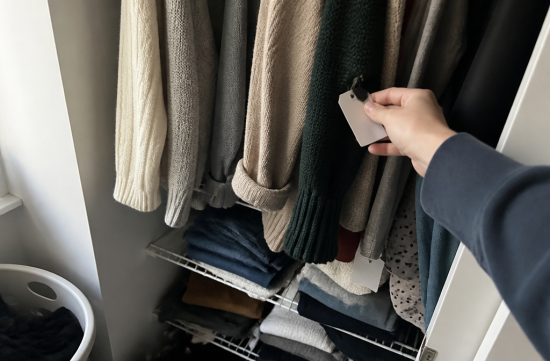
Then, a few days later, when you open your closet, you find clothes with tags still attached hanging there. You definitely had a reason for buying them, but when you look back, you can hardly remember why.
This isn't just something I experience.
In a survey, 62 percent of respondents reported feeling regret after making impulse purchases.
Interestingly, 45 percent of those items remain untouched at home.
It's hard to throw them away because you feel like you wasted money, so you just keep them.
A study involving 2,000 American adults found that the average value of clothes that have never been worn is $268.
In a similar survey, female respondents reported that about 20 percent of the clothes in their closets had never been worn.
Seeing these numbers is somewhat comforting, but at the same time, it's a bit bittersweet.
When I hear my friends talk about their closets, they all have similar stories.
It's not just clothes; kitchen gadgets and exercise equipment often end up in the same situation. For instance, a yoga mat bought on sale can end up collecting dust in storage. Home workout equipment that becomes trendy each season often ends up as a drying rack after a few months.
Why does the word "sale" cloud our judgment?
When you see a $100 item marked down to $60, you immediately feel like you've saved $40. In reality, that $60 could have stayed in your pocket if you hadn't spent it, but in that moment, you completely forget about that.
The original price is the benchmark, but what really matters is whether you need that item right now.
When you add the urgency of a limited-time offer, it creates a sense of panic that makes you skip the process of evaluating whether you truly need the item.
If the store sign says "no restock," that urgency multiplies.
I've heard that the feeling of happiness while shopping comes not from using the item but from the moment you make the purchase. The satisfaction is mostly over by the time you hit the checkout button.
So, by the time you open the delivery box, that excitement has often faded. Many times, you just take it out, try it on once, and then hang it back up.
I've repeated this pattern several times during seasonal sales. I've often bought clothes in sizes that are uncertain or colors I'm not sure will suit me, all just because they were on sale. Eventually, those clothes just take up space in the corner of my closet until I notice them again during the next clean-out.
Some stores don't allow refunds or exchanges on sale items, making it hard to return them once you've bought them. When this policy is in place, you end up having to keep items you don't like, especially for items labeled as final sale.
When it comes to online shopping, the situation can be even worse, with studies showing that 40 percent of online consumer spending comes from impulse purchases.
It's hard not to think that sale notifications coming multiple times a day are not a coincidence. Sometimes, when you casually check a notification, you find your cart filled within minutes. Plus, if different apps have overlapping sales, there are days when you end up making three or four purchases.
So, how can we reduce the chances of regrettable spending later?
I usually let items sit in my cart for a day or two. If my interest fades during that time, it means I didn't really need it in the first place.
On the other hand, if I still think about it after a day, it's likely something I genuinely needed. I also check to see if it overlaps with colors or uses of items I already have at home. I ask myself if I'm buying another item on sale when I already have three similar sweaters in the same color.
It's better to ask whether I would buy the item at its original price rather than deciding based on the sale price. Just making this one question a habit can significantly reduce the number of items in my cart.
Of course, sales aren't inherently bad, and buying what you need at a lower price is actually a smart purchase. The problem lies in the habit of buying things just because they're cheap. I often remind myself of this.
I think it's much better for my wallet to ask whether I truly need something in this moment rather than just focusing on the word "sale."
On days when I find clothes with tags still attached while organizing my closet, I think it's best to give my wallet a break for the day.
 KingOfHanta


 Silent Sea |
 Pointy |
 Idaho's Sumi's House |
 holy cheese |
 Michigan Enthusiast |
 Investment Information News Update |
 tooto |

 colo colo |
 Iri Jori Missouri |
 tredon |
  Poppin News |
  metsoo |
  dewyo |
  Casa Mia |
  Asparagus Blog |
  dorange |
  hiddenkong |
  some fame |
  Godory Life |
  Lime Juice |
  French fries |
  Rynex |
  Caribbean |
  Let's Be Like a Salt-like City Person |
  Belgray Miscellany |
  sweetvan |
  Augusta Univ |
  Round and Round Children's Song Kingdom |
  butter 90 |