
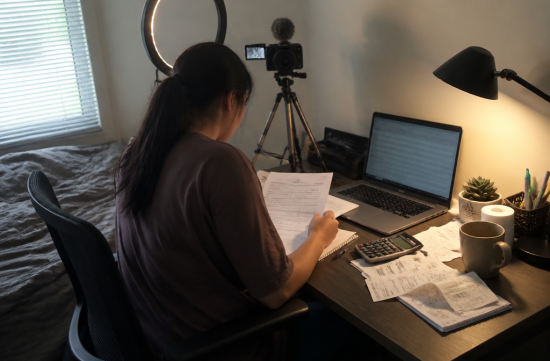
These days, many people run a YouTube channel as a hobby. They start for the fun of gaining subscribers and views, and then one day they receive their first payment notification from AdSense.
In that moment, everyone has a similar thought: Can I spend this money like pocket money, or do I need to report it for taxes?
To cut to the chase, the answer is clear. According to the IRS, YouTube earnings are classified as self-employment income and are subject to reporting regardless of the amount.
Whether it's a few dozen dollars or a few hundred, the principle remains the same. Regardless of whether you received tax documents from Google, the obligation to report income has already arisen once you earn it.
One common misconception is that if you didn't receive a 1099 form, you don't have to report it, but that's the wrong order of thinking.
Starting in 2026, the criteria for issuing the 1099-NEC form has changed. The threshold that used to be $600 has been raised to $2,000.
However, there's a point that can be confusing. AdSense advertising revenue is typically reported under the royalty category on the 1099-MISC form, which still has a threshold of $10 for issuance.
This means that if your channel receives both advertising revenue and brand sponsorships, you might receive two different types of forms. I found this a bit surprising when I first learned about it.
Actual reporting is done using the individual income tax return form 1040 along with a document called Schedule C. Here, you will list the total income generated by your channel by category.
Fortunately, this form allows you to deduct expenses as well as report income. Costs for equipment like cameras or microphones, subscription fees for editing software, and background music licensing fees are typical deductible items.
If you have a separate space used only for filming and editing, it's worth considering the home office deduction. However, if you're using just a corner of a room for this purpose, it may be difficult to qualify, so you need to carefully check the conditions.
The issue doesn't end there. On top of income tax, there's also a self-employment tax that applies to net income.
The self-employment tax combines Social Security and Medicare taxes, with a rate of 15.3 percent. For employees, the company covers half of this, but self-employed individuals must pay the full amount themselves.
When people first encounter this number, they are often surprised. After calculating income tax, to find out that there's an additional 15 percent or more can feel like a significant burden.
The good news is that as of 2026, the income cap for Social Security tax is $184,500. If your YouTube channel is at a hobby level, you likely won't have to worry about hitting this cap.
Once your net income exceeds $400, you also need to fill out a Schedule SE form. Many people unknowingly overlook this threshold.
While we're on the topic of how much you need to pay, when you need to pay is also important. Unlike salaried employees, there's no withholding for self-employment income.
That's why there's a quarterly estimated tax payment system where you pay taxes in installments throughout the year instead of settling everything at the end of the year.
For 2026, the quarterly payment deadlines are April 15, June 15, September 15, and January 15 of the following year. You can think of it as making four payments throughout the year.
If you expect that your withheld taxes will exceed $1,000, you will be subject to these quarterly payments. If your channel's revenue is steadily increasing, it's worth calculating this at least once.
If you miss this, you may incur penalties later. Trying to settle everything at once can lead to losses, so it's much better to stay ahead of it.
I've seen cases like this happen often. A channel that started as a side project might earn a few hundred dollars in six months, but the owner delays reporting and only scrambles to get it sorted out after receiving a notice from the IRS.
This isn't just bad luck. Google submits a copy of the payment records to the IRS, so if the amount you report doesn't match, the system automatically flags it.
So, it's best to develop good habits from the start. I recommend setting up a separate account for your earnings and setting aside about 20 to 30 percent for taxes each time you receive a deposit.
It's also important to get into the habit of keeping receipts as you go. Trying to find all the receipts for equipment purchases or software payments later can be quite a hassle.
I don't think it's necessary to rush to find a tax professional just because your channel is still small. However, once you start seeing consistent income, I recommend consulting with someone at least once.
In my personal opinion, once you start earning money from a channel that began as a hobby, you should shift your mindset to that of a business owner. It's ultimately more comfortable to recognize it as income and keep things organized from the start rather than delaying reporting just because the amounts are small.
Tax reporting can be a hassle, but if you prepare in advance, it's not as difficult as it seems. Make sure to familiarize yourself with the basic structure before your channel grows.
 WaveMedia


 coloradoman |
 pintos |
 mapsina |
 Mr. Largo |
 Victory 1988 |
 Mr Cleveland |

 peace |


 intact |
  Always Dreaming of Big Success |
  happy 9 |
  Park M.Y. |
  tredon |
  Poppin News |
  metsoo |
  dewyo |
  Casa Mia |
  Asparagus Blog |
  dorange |
  hiddenkong |
  some fame |
  Godory Life |
  Lime Juice |
  French fries |
  Rynex |
  Caribbean |
  Let's Be Like a Salt-like City Person |
  Belgray Miscellany |