
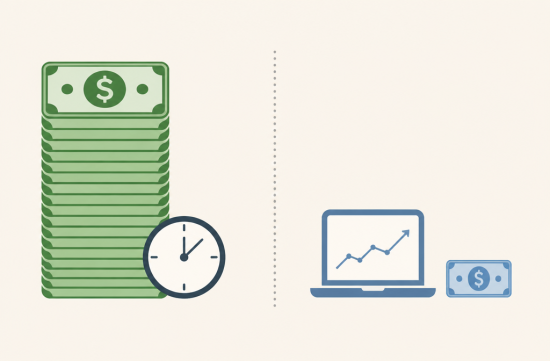
Whenever the topic of tutoring comes up, everyone lets out a sigh. However, these days, many families are switching from tutoring to free online courses, and there are frequent reports that their grades are actually improving. I was skeptical when I first heard this.
Let's start with some numbers. The average hourly rate for SAT tutoring is $62. Just the cost for one hour is already quite burdensome.
In expensive areas, it can go up to $170 per hour. In highly competitive urban areas, there are even tutors charging $300. A couple of hours can easily cost as much as a month's living expenses.
Regular subject tutoring isn't cheap either. Private tutoring ranges from $15 to $75 per hour, and with a company, it can go from $25 to $125. At this rate, just passing one subject can be a significant burden.
Attending twice a week for just a month can easily drain several hundred dollars. If this extends to a year, the numbers become truly frightening. During intensive summer sessions, it can cost even more.
That's why everyone is turning their attention to free online options. This trend has noticeably increased recently. Just looking at community posts, there are many more reviews than before.
The most frequently mentioned resource is Khan Academy. It's a nonprofit educational site created by Salman Khan in 2008, and its operational direction has remained the same since.
Once you sign up, all math, science, and English lectures and practice problems are available. It costs nothing, and there are no ads. You can also access test preparation content all under the same account.
The AI tutor feature, Khanmigo, costs about $4 per month or $44 if paid annually. However, this is purely optional, and you can progress without it.
They have officially stated that they will keep the lectures and basic practice problems free. From a parent's perspective, there's no need to register a payment account.
There's also a similar platform called Schoolhouse. College student tutors provide free small group classes via real-time video. The structure is very similar to small group tutoring sessions.
In Arizona public schools, many use a program called IXL. The school provides accounts, so students can access it from home without needing to go through a new registration process.
They conduct skill tests quarterly, focusing on the areas that need improvement. Since the data shows where the weaknesses are, there's much less wasted time.
They say that struggling students receive more focused management by breaking down the steps. Since this is all funded by the school budget, parents incur no additional expenses.
At this point, the curriculum is already laid out without needing tutoring. There's no need to pay for a new one.
There are also cases where the effectiveness has been confirmed with numbers. This isn't just vague talk; the actual survey data makes it more credible.
According to Khan Academy's learning lab data, the percentage of students who fully grasped concepts without tutor support was 42 percent. That's not even half.
When free tutoring was added, this percentage rose to 58 percent. A 16 percentage point difference is definitely not a small number.
Of course, the less money spent means that parents have to take on more responsibility. This is where many hesitate.
It's ultimately up to the parents to check if their child is just logging in and goofing off, or if they are making real progress. This aspect definitely requires attention.
Tutoring at least checks attendance, but there are no safety measures in place here. So, during the initial adjustment period, it's better for parents to be nearby.
That's why many set up a schedule in advance. They pin down the days and times.
For example, they might decide that online classes will be held every Monday, Wednesday, and Friday from 7 PM to 8 PM. This way, there's much less fluctuation. It becomes similar to the rhythm of attending tutoring.
They are essentially transferring the time wasted on commuting to tutoring into study time. The time spent picking up and dropping off is now dedicated to learning.
When you compare the two, the answer becomes clear. Let's do some calculations.
If you sign up for just one tutoring service at $200 a month, that adds up to $2,400 a year. For two subjects, it would be double that.
With that money, you could buy a tablet and still have plenty left over. The remaining funds could be used for savings or other activities.
Of course, free online resources aren't a cure-all for every subject. This is something we need to acknowledge honestly.
There are definitely areas, like essay editing or speaking practice, where having a person involved is essential for improvement. In these cases, free videos have clear limitations. Pronunciation correction is especially one of those areas.
It seems that the current approach is to fill in those gaps with tutoring while using free resources for everything else. It's about mixing rather than completely cutting out tutoring.
If it were me, I would first try out the free resources for three to four months, and only add tutoring for subjects that still aren't improving. It's safer to approach it step by step rather than going all in from the start.
This seems like a much more reasonable order than jumping straight into paying for tutoring. It saves money and reduces the chances of trial and error.
 SWATSquad






 Silent Sea |
 Pointy |
 Idaho's Sumi's House |
 holy cheese |
 Michigan Enthusiast |
 Who's watching? |
 AZ Road Master |
 Arizona Cowboy |

 TOTO Together |
  Augusta 90 |
  Project Tomorrow |
  DOCTOR MED |
  Say IT Now |
  Alpha and Omega World |
  Always Dreaming of Big Success |
  NEXT ROUND |
  Helpful Life Stories |
  Healthy Local Fresh Information |
  molten |
  Way to easy |
  intact |
  happy 9 |
  Park M.Y. |
  tredon |
  Poppin News |
  metsoo |
  dewyo |
  Casa Mia |
  Asparagus Blog |