
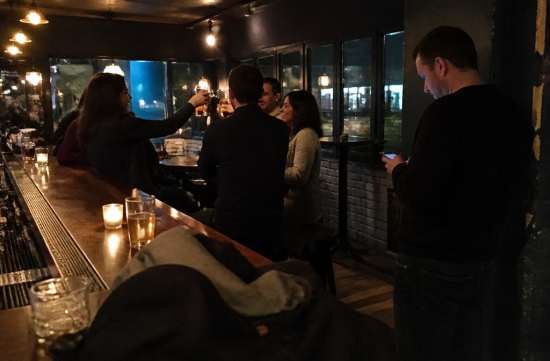
After four o'clock on a Friday, the atmosphere in American offices subtly changes. The sound of keyboards remains, but people's expressions relax a bit during this time.
Then someone approaches and quietly asks, "Are you going for a drink later?"
Unlike the scheduled gatherings in Korea, there's no predetermined date or assigned seating. It's just an impromptu event that appears and disappears on the day.
In fact, the concept of work gatherings is almost nonexistent in American workplaces. There's no culture of all employees regularly coming together to clink glasses.
Interestingly, what fills that void is the much more relaxed happy hour. Aside from the lack of obligation, the social calculations among people become even more complex.
Attendance at work gatherings is almost mandatory, so it's not noticeable when someone is absent. In contrast, happy hour is voluntary, making it clearer who didn't show up and why.
Whether someone received an invitation, whether they were invited but didn't go, or whether they weren't on the guest list at all—these three scenarios convey entirely different messages within the office.
Recent statistics reveal that the nature of these gatherings is changing. A Gallup survey published in 2025 found that 54 percent of American adults reported drinking alcohol, a significant drop from 62 percent in 2023.
This is the lowest figure in nearly 90 years of Gallup polling history, indicating that more people are choosing not to drink.
As a result, going to happy hour is no longer as natural a choice as it once was. The willingness to attend, rather than the alcohol itself, becomes a signal.
With remote and hybrid work complicating matters further, the situation has become even more intricate. Unlike the days when everyone saw each other daily, there are now only a few days when people gather in the office.
According to surveys, among hybrid workers, 39 percent come into the office three days a week, and 34 percent come in four days a week. This means there are days when they don't see each other at all.
As in-office days decrease, who you have lunch with and who you go to happy hour with becomes much more significant than before. When opportunities become scarce, their weight increases.
And this weight eventually connects to promotions, leading to the term politics. Ideally, evaluations would be based solely on merit, but reality is rarely that straightforward.
Researchers have long referred to these informal networks as the old boys' club. It describes a structure where people connected through academic ties or personal relationships share information and opportunities first.
One study found that when male leaders assess the potential of successors, personal compatibility plays a significant role. In contrast, this tendency was not as pronounced with female leaders.
Ultimately, whether someone frequently attends happy hour can seep into evaluations, regardless of their abilities. Unbeknownst to them, the list of those promoted may be narrowing.
So, is there no legal issue? A company not inviting a specific employee to happy hour does not, by itself, constitute a violation of the law.
However, since the 1971 Griggs v. Duke Power ruling, U.S. labor law has established the principle that even seemingly neutral practices can be problematic if they adversely affect a specific group. This is known as the theory of disparate impact.
Yet, applying this principle to informal exclusionary networks has proven challenging in court. One appellate court has even declined to accept related lawsuits, stating that it's difficult to define informal practices as a policy.
Thus, this issue remains one that must be addressed through company culture and individual behavior rather than the law. Those who miss out because they have to pick up a child or don't drink still quietly suffer the consequences.
But is attending every time the solution? Not necessarily. A casual comment made in a relaxed setting can sometimes come back to haunt one's reputation the next day.
So, if I were in that situation, I would have a different approach. Just showing my face for a moment and quietly slipping away before the atmosphere gets too intense feels much safer.
These days, it's become common to order sparkling water or non-alcoholic drinks at happy hour without anyone batting an eye. With nearly half of people choosing not to drink, this trend is only natural.
If happy hour feels burdensome, substituting it with a short coffee chat or a lunch for two isn't a bad idea. You don't necessarily need a noisy bar to bridge the distance between people.
Ultimately, what matters is not whether the venue is a bar or a conference room, but how much genuine conversation takes place in that short time.
As the days grow longer with the changing seasons, people's expressions soften, and I realize how a few brief exchanges can linger. The warmth between people is ultimately defined not by formality but by moments.
What remains in place of the disappearing work gatherings is a much more delicate task of measuring distances between people. The absence of established rules can often feel more challenging.
Still, I believe these relaxed settings are better than forced gatherings. Just being able to go when you want and leave when you want is a breath of fresh air.
However, to maintain my own rhythm within this loose politics, I need to be aware of the unspoken calculations that lie beneath that freedom.
 coastalfoxwalker1984


 coloradoman |
 pintos |
 mapsina |
 Mr. Largo |
 Victory 1988 |
 namico |
 Delicious Food Finder |



 Belgray Miscellany |
  molten |
  Way to easy |
  intact |
  Always Dreaming of Big Success |
  happy 9 |
  Park M.Y. |
  tredon |
  Poppin News |
  metsoo |
  dewyo |
  Casa Mia |
  Asparagus Blog |
  dorange |
  hiddenkong |
  some fame |
  Godory Life |
  Lime Juice |
  French fries |
  Rynex |
  Caribbean |