
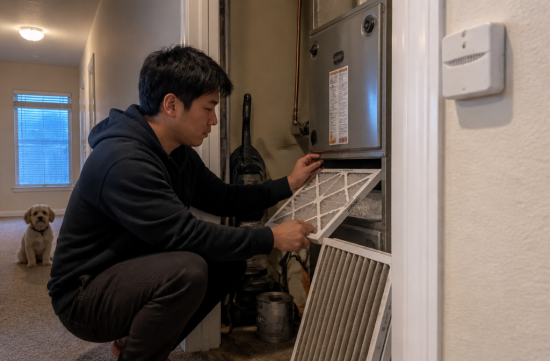
A few days ago, the morning air suddenly turned cold, and I turned on the heater for the first time this year. But after a few minutes, I noticed a burning smell spreading throughout the house.
Honestly, I was a bit startled. My dog, who was sleeping on the sofa, also lifted his head and sniffed, which made me more concerned.
Someone shared a similar experience in the blog comments. They said they couldn't sleep all night because of the burning smell when they first turned on the heat, so I decided to clarify this issue properly.
To cut to the chase, most of the time, it's normal. Dust accumulates inside the furnace, especially around the burner and heat exchanger, when it hasn't been used all summer.
When you turn on the heat, that dust comes into contact with hot components and burns. This creates a smell similar to burning dust from blankets, which can feel like it's spreading throughout the house as the dust in the ducts heats up all at once.
According to various heating companies, this dust smell usually dissipates within 30 minutes to an hour after starting, and at most, it should be gone within one or two hours.
So the key is the type of smell and its duration. If it's a dust smell, you can just open a window slightly for ventilation while you wait. I took my dog to another room during the first operation because I thought he might be uncomfortable since his sense of smell is much more sensitive than mine.
Also, check the filter while you're at it. A clogged filter can hold onto smells for a long time, so it's best to replace it according to the manufacturer's recommended schedule.
The problem arises when the smell is different. A smell like melting plastic or burning wires is a completely different matter from dust.
Such smells could indicate motor overheating or wiring issues. It's best to turn off the heat immediately and call a professional technician for inspection. Continuing to run it thinking it's fine is the most dangerous choice.
Even if it was a dust smell, if it continues for several days, it's hard to attribute it solely to dust. In that case, it's also safer to get it checked.
The most concerning smell is that of rotten eggs. Natural gas is odorless, but gas companies add a compound called mercaptan to help detect leaks.
Intermountain Gas, which supplies gas to southern Idaho, advises everyone, including pets, to leave the house immediately if they smell this odor.
They also instruct to call 911 and the company's 24-hour emergency number, 800-548-3679, from a safe location far from the house.
It's also best to avoid turning lights on or off inside the house. Even a small spark can be dangerous. If the smell is uncertain or ambiguous, it's much better to go outside and make the call.
There's also a danger of having no smell at all. That's carbon monoxide.
The CDC lists gas or oil-burning furnaces as household appliances that can produce carbon monoxide. The problem is that it has no color or smell, so you can't detect it with your nose.
The typical symptoms identified by the CDC include headaches, dizziness, weakness, nausea, vomiting, chest pain, and confusion. It can be easily overlooked as it resembles cold symptoms.
Especially when you're asleep, it can become dangerous before you even notice the symptoms. That's why detectors are essential. Take a moment to check if you have one near your bedroom and on each floor.
If everyone in the house has a headache after turning on the heat, and it improves when you go outside, suspect carbon monoxide. Don't ignore if your pet seems unusually lethargic or wobbly.
If you feel unwell, go outside for fresh air and call 911. If symptoms persist, be sure to consult a doctor, and take your pet to the vet.
Managing detectors is simpler than you might think. The CDC recommends replacing carbon monoxide detectors according to the manufacturer's instructions or every five years.
They suggest checking the batteries when you change your clocks in the spring and fall, and this year, daylight saving time ends on Sunday, November 1. Marking that day as a check-up day will help you remember.
The CDC also recommends having gas appliances like furnaces and water heaters inspected annually by a qualified technician. Now is the perfect time to schedule an appointment before it gets really cold. If it breaks down in the middle of winter, the wait time will be longer, and the house will be cold, which is really frustrating.
To summarize, a dust smell that dissipates within one or two hours is normal.
Burning plastic or electrical smells mean you should turn it off and get it checked, while a rotten egg smell means you must evacuate immediately. Even if there's no smell, make sure to have a detector.
If it were me, I would change the filter before the first operation, press the test button on the detector, and then turn it on while keeping the windows open. I did that this weekend, and it only took ten minutes, but it definitely put my mind at ease.
When the cold wind starts blowing, the house should be the warmest place. I hope the person who sent in the story and everyone reading this can spend this winter comfortably and warmly.
 PineYogaMat


 sun walker |
 Let's Be Like a Salt-like City Person |
 Springs Korea |
 US Legal Consultation on Trials |
 Study Abroad Life Know-How Tips |
 Idaho's Sumi's House |

 208 Master |

 Korean Boo |
 MintO |
  My Town My Way Blog |
  New Mexico Friends MAX |
  Hajiwon Blog Hair Salon |
  Wicked - Fireyo |
  Seattle - Emerald City |
  new noah |
  xylora |
  Anjollinya Blog |
  total solution |
  Vacation on Hawaii |
  valtri |
  August Snowman |
  Way to easy |
  Pirate Ship Popcorn Maker |
  USA Business News |
  Samsung My My |
  bubblo |
  tartbear |
  Washington Monument |