
Last weekend, I went for a short hike on the slopes of Owyhee Mountain. On the way down, I spent some time watching a flock of sheep slowly moving beyond the ranch fence, and suddenly, the Basque Block on Grove Street in downtown came to mind.
Living in Boise, you hear the word Basque more often than you might expect. It appears on restaurant menus, festival posters, and signs with street names.
But why did people from the Pyrenees between Spain and France gather in this inland desert city? This has been a question I've wondered about since I first arrived here.
The answer is surprisingly simple. It was sheep.
Starting around 1890, Basque people began to arrive in Idaho. Initially, some came to look for gold and silver, but many soon took up shepherding jobs.
These immigrants, who had neither money nor education, took on jobs that others were reluctant to do. After all, guarding sheep alone in the mountains for months wouldn't appeal to everyone.
As Idaho's sheep farming industry grew, job opportunities increased. Those who arrived first communicated with relatives and friends back home, leading to a chain of immigration where one village would call the next.
After spending a few days camping in the mountains, I find myself missing human voices. So, I can imagine how desperately those shepherds needed a place to stay when they came down from the mountains in winter.
What filled that need were boarding houses. The Basques who settled here opened boarding houses, where the shepherds who came down for the winter stayed.
By around 1920, there were nearly ten Basque boarding houses in Boise. One historian summarized that the shepherding jobs brought Basques to Idaho, and the boarding houses provided them with a place to stay.
I really like this explanation. Just having a job isn't enough for people to put down roots. There needs to be a space to eat and chat together.
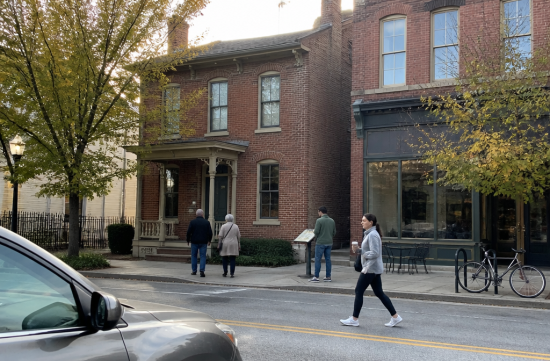
If you go to the Basque Block, traces of this history still remain. The Cyrus Jacobs House, built in 1864, is known as the oldest brick building still standing in Boise.
Originally, it was the home of a merchant who later became the mayor. From 1910, Basque families began renting it, and in 1928, the Ubeurua family bought it and operated it as a boarding house until 1969.
This house was listed as a national historic site in 1972 and is now a key exhibit at the Basque Museum. Looking at the narrow rooms under the low ceilings, you can get a rough idea of what winters were like for the first-generation immigrants.
Two houses down, there is a hotel-style boarding house built by the Anduiza family in 1914. It even has an indoor fronton, which is a Basque ball court.
This building was used as an office for a while before being restored back to a court in the early 1970s. In 2003, it was also designated as a national historic site.
As the boarding house era came to an end, the community began to create its own focal point. In 1949, an organization called Euskaldundak was formed, and that same year, the Basque Center was established.
This center is still the heart of the San Inazio Festival held every summer. In 1960, the Oinkari Dance Group was formed to pass on traditional dances to the next generation.
The flow of immigration didn't end all at once. During the Franco dictatorship from 1939 to 1975, the Basque language and culture were suppressed, and some people crossed over during this time.
Thus, the Boise Basque community is not the result of a single generation but rather the outcome of multiple waves of immigration. People who temporarily came and settled, and those who had no choice but to leave their hometowns, met in the same block.
Different sources provide varying numbers regarding the size of the community. This is because the criteria for counting Basques differ, so while the term "largest in the U.S." is often used in travel articles, it's hard to confirm definitively.
However, one thing is clear. The Jaialdi Festival, which started in 1987, is held here every five years and is introduced as the largest Basque festival in the United States.
The 2020 event was canceled due to COVID, and last year, it was held again from July 29 to August 3, 2025, after a decade. I still vividly remember the downtown area bustling with red scarves for several days.
As a Korean, this story feels very relatable. We have also gathered together around churches, Korean markets, and small restaurants to establish our community.
I believe the reason the Basque community has endured for over a century is not due to flashy policies but rather the family, neighbors, and traditions they have consistently maintained. In a time when everything changes quickly, there is much to learn from them.
The Basque Block is easy to explore on foot from downtown. Visiting the museum first and then enjoying a plate of croquettes at a nearby restaurant makes for a perfect half-day outing.
Next month, I plan to sign up for the museum boarding house tour again. This time, I want to slowly explore those narrow rooms while thinking about the flock of sheep I saw in the mountains.
 ParisBag


 Noodle Noodle |
 Twist Kim |

 U.S. Weather Bureau News |
 Community Cross |

 Conflite Teacher |

 A landlocked state |


 208 Master |

 Idaho's Sumi's House |
 Fragile Me |
 Rowland Mama |
 foxtree |
 bayaa |
 loveyom |
 Coastal city |
 Spaghetti Flying Religion |
 My Town My Way Blog |
 holy cow |
 endone |
 starline |
 Where is a really nice neighborhood? |
 Real Estate |
 Forest Gump |
 Real Estate Investment Korean American |
 Dollydori, Lover of Movies |
 dmzline |
 travelo |
 American Food Information & Calories |
 Splendid Mission |