

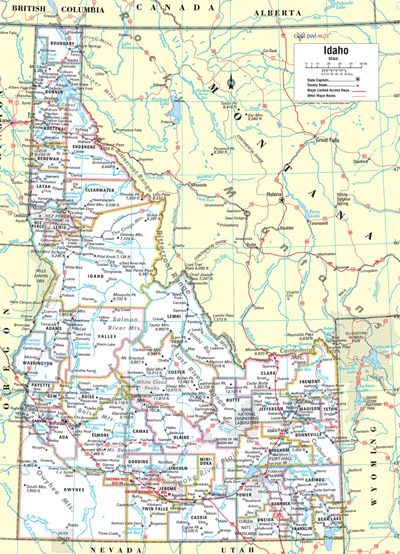
When looking at Idaho on the map, you can naturally feel why the phrase 'the scale is different' comes to mind.
Compared to Korea, Idaho's area is almost twice that of South Korea. South Korea's size is about 100,000 km², while Idaho is around 210,000 km². But what about the population? South Korea is packed with over 50 million people, right? Idaho has just a little over 2 million. So, while the land is double, the population is about 1/20th, which gives you a clear sense of how spacious it is.
To the west, it borders both Washington and Oregon, to the south it touches Nevada and Utah, and to the east, it extends to Wyoming and Montana, creating a grand border structure that shapes Idaho's outline.
It is rare for a place in the Northwestern United States to connect so many states simultaneously, so Idaho has long been established as a hub for transportation and movement. During the westward expansion era, it served as a literal crossroads connecting the north and south, east and west, and even today, the state's role in highway networks and logistics is significant.
In particular, it opens the way to the Pacific Northwest to the west, connects to the Midwest over the Rocky Mountains to the east, and leads to the plains and mountainous areas to the south along desert and plateau routes. Thanks to these geographical features, even though the cities are not large, the logistics and transportation industries are strong, maintaining a vibrant economic flow that is not cut off from the outside.
Another interesting point is that, due to this vast boundary, Idaho is a state where cultural diversity and geographical contrasts are clearly evident. On one side, there are lush forests and the characteristic rainy landscapes of the Northwest, while on the other side, dramatic valleys and dry plateaus stand side by side. This creates a unique charm for travelers, allowing them to experience two or three completely different climates and landscapes within a single state.
Following these changes, one realizes that the name Idaho is not just associated with potatoes or small towns, but that it has been an essential axis in the larger picture of the western United States.
Idaho is relatively large in area but has a low population, giving it a strong sense of spaciousness overall. Cities like Boise and Meridian have rapidly grown in recent years due to an influx of migration, but just a little outside the city, you immediately encounter open farmland, prairies, and mountainous areas, resulting in a still low population density. Therefore, the pace of life is relaxed, and rather than the bustling atmosphere typical of large cities, a sense of leisure is a significant characteristic of Idaho.
Speaking of the Korean population, Idaho has a much smaller Korean community compared to other Western states like Washington, Oregon, and California. The ratio of Koreans to the total population is low, so it is more accurate to view it as a 'small-scale Korean community.'
In particular, Korean businesses, churches, and markets are concentrated in the Boise metro area, providing a basic living infrastructure, but since it is not large, the options are limited. However, because the community is small, there is an advantage of easily getting to know each other, and it creates an atmosphere where it is easy to seek help or connect during the initial settlement phase.
In recent years, due to the increase in IT jobs and remote work, young Korean and Korean-American families have been gradually moving in, and families with children are showing interest due to the quiet and stable educational environment.
The reason this change is not very noticeable is that Idaho itself is such a vast state with a low population density that even a slight increase feels insignificant in the spacious environment. Overall, it is a quiet state, but observing the quietly growing Korean population within it makes one feel that Idaho is no longer just 'completely empty land.'


 moo moo |
 ultron78 |
 garlic bread |
 Sugar Cream Door Bulletproof Noodles |
 urbanmint |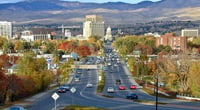
 A landlocked state |
 Korean Boo |
 208 Master |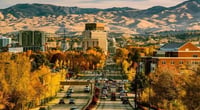
 US Regional Information Blog |
 Idaho's Sumi's House |
  Tonky |
  viroma |
  cookie |
  Live and that's it |
  Alright Twain |
  eatontown blog |
  HAWAII Korean Church News |
  Amore |
  linex |
  Balancework |
  laro90 |
  MEDBIO American Doctor Blog |
  SWAT TEAM BLK |
  DREAM BIG |
  frostbite |
  330 Forever My Love |
  El Dorado |
  dralix58 |
  Gorama Round |
  Skydiving |