

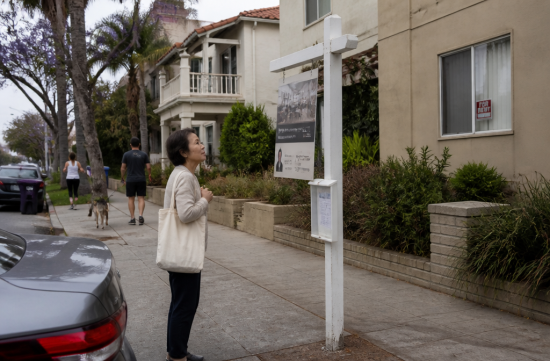
The Santa Monica market can be summarized as follows: home prices are holding steady or slightly increasing, while rents have been gradually decreasing throughout the year.
As of early November, I will compile data on sales, rentals, interest rates, and regulations in that order. The sales statistics are the most recent from September, while rental figures are available up to October.
First, let's look at sales. According to Houzeo's aggregation of California MLS data, the median sale price in Santa Monica for September was $1,989,500.
This is a 5.82% increase compared to a year ago. Considering that there were discussions of double-digit declines earlier in the spring, this is quite a rapid recovery.
However, it is premature to fully trust this number. Redfin's data shows that the same median sale price for September is slightly lower than last year, indicating conflicting trends.
Santa Monica is not a neighborhood with a high volume of transactions. The median price can fluctuate significantly based on how many single-family homes in the North of Montana area sell, so it's important to look at trends over several months rather than just one month's data.
The inventory situation is a bit clearer. According to the same data, there were 279 active listings in September, with a supply of 4.9 months.
Typically, when inventory exceeds six months, it favors buyers, while less than four months favors sellers. Currently, it seems to be in the middle, indicating a balanced market.
The average market duration was 57 days, and the sale-to-list price ratio was 99.52%. This means homes are selling close to their asking prices, but it takes nearly two months to do so.
The atmosphere is not like before, where multiple offers would flood in during an open house. Buyers now have room to negotiate repair costs based on inspection results.
Now, let's look at rentals. According to the November report from Apartment List, the median rent in Santa Monica for October is $2,348.
This is a 0.7% decrease from September and a 5.2% drop from a year ago. Cumulatively, rents have decreased by 1.4% from January to October this year.
During the same period, the overall LA Metro area had a median rent of $2,208 with an annual change of -0.1%. While the Metro area has remained relatively stable, Santa Monica has seen a noticeable decline.
Still, Santa Monica rents are 6.4% higher than the Metro average. Even though they have decreased, it is important to note that they cannot be considered cheap.
From a tenant's perspective, now is not a bad time to negotiate. If you are approaching a lease renewal, it may be worth bringing in comparable rates from the area to discuss adjustments in the increase or request a month of free rent.
Conversely, for those who invested for rental income, longer vacancy periods can be a burden. Whether to lower rents to fill vacancies quickly or hold out will depend on loan conditions.
There are also changes in rental regulations. The city's Rent Control Board has set the general increase rate for 2026 at 2.6%, effective from September 1.
Additionally, there is a $70 cap. Units with a maximum allowable rent above $2,674 cannot increase by the full 2.6% and are limited to a $70 increase.
You can check if your unit is subject to rent control and what the maximum allowable rent is by looking it up on the city website using your address. If you have received a notice of increase from your landlord, it is advisable to compare it.
On the November 3 ballot, there is also Measure GG, a charter amendment related to rent control. It includes adjustments to commissioner terms, inflation indexing for registration fees, and additional eviction reasons for designated low-income housing.
While this does not immediately change rents for general tenants, landlords with rent-controlled units should pay attention to the registration fee provisions.
Lastly, regarding interest rates. According to Freddie Mac's weekly survey, as of October 29, the average for a 30-year fixed mortgage was 7.24%, and for a 15-year fixed, it was 6.60%.
This is a slight decrease from last week's 7.32%, but compared to a year ago at 6.17%, it is over a percentage point higher. This difference is seen as the biggest reason suppressing buyer demand.
When purchasing a home close to $2 million, a 1% difference in interest rates translates to not just hundreds of dollars but thousands in monthly payments. Therefore, the experience of cash-heavy buyers versus those heavily reliant on loans can be vastly different.
In summary, the situations for buyers and renters are diverging. Buyers face high thresholds due to stable prices and rising interest rates.
On the other hand, rents have been weak for a year, giving tenants a broader selection. If you are currently contemplating whether to buy or rent, it may be less burdensome to wait on renting.
However, for those looking for good properties with a long-term hold in mind, the current less competitive environment may actually provide more negotiating power. Which option is better depends on individual financial plans and intended duration of stay.
The figures in this article are based on Houzeo's September MLS aggregation, Apartment List's November report, Santa Monica city announcements, and Freddie Mac's October 29 release. We will check again when the October sales statistics are released to see if the trends continue.
 StrawbHill
 TingHowUSA






 gentle |
 neapolis |

 moo moo |

 ultron78 |
 garlic bread |

 Soy Angelino |

 Conflite Teacher |

 Choco Choco Star |

 Famous Attractions in the United States |
 ssome |
 skykong |
 Shining Our Own World |
 gardener 007 |
 golfmaster |
 Nanana Nanana Nanana |
 Who's watching? |
 endone |
 RockStar |
 Casa Mia |
 You Only Live Once |
 Hardworking CPA |
 Joyce 77 |
 Runner Kim |
 My Town My Way Blog |
 My Miami Stories |
 Entip |
 Tony Park |
 Jean Claude Bundang Blog |
 DJ DC BLOG |