
Last weekend, I invited some friends over for a bulgogi party, and while marinating the meat, someone suddenly said, "Did you know a giant fossil was found around here a long time ago?" Everyone paused with their chopsticks.
I had only vaguely heard about it, so I looked it up that night. It turns out it was the story of the Cardiff Giant, one of the most notorious hoaxes in American history.
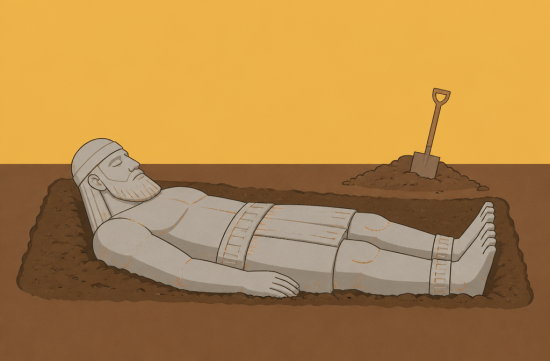
It was October 16, 1869. In a small town called Cardiff, just south of Syracuse, two workers were digging a well behind the barn of a farmer named William "Stub" Newell.
Suddenly, their shovel hit something solid. When they cleared the dirt, they found a stone figure lying down that was over 10 feet tall, or more than 3 meters.
One of the workers who discovered it reportedly shouted, "An ancient Indian was buried here!" Can you imagine how chilling that must have been?
The rumor spread incredibly quickly. Newell set up a tent over it and showed it for free on the first day, then started charging 50 cents for a 15-minute viewing the next day.
Even so, it attracted 300 to 500 visitors a day, which is astonishing. People were lining up to see a rock in a rural farm in 1869.
There was a reason for the excitement. In Genesis 6:4, it says, "There were giants in the earth in those days." Many people wanted to believe it was proof that giants really existed.
In fact, some pastors and theologians defended it as a real fossil. It made me think that the desire to believe can blind people, just like it does now.
So, where did this giant come from? The culprit was George Hull, a tobacconist from New York. He was also Newell's cousin.
Hull had a debate with a pastor named Turk at a Methodist revival in Iowa about the giant mentioned in Genesis. He was on the skeptic's side but felt completely overwhelmed.
That frustration sparked the whole scheme to show how easily people could be deceived. The level of planning was almost artistic.
In 1868, Hull dug up a block of plaster in Fort Dodge, Iowa, claiming he was going to make a Lincoln monument.
The block was transported by train to Chicago, where German stonecutters, including Edward Burkhardt, carved it into the shape of a giant. They even covered it with blankets to muffle the sound of the chiseling, which was quite meticulous.
To make it look old, they pounded the surface with iron needles and even rubbed it with sulfuric acid. Initially, it had hair and a beard, but they shaved it off after hearing that hair wouldn't fossilize.
The total cost for this was $2,600. Then, in November 1868, they secretly buried the giant on Newell's farm.
The most chilling part comes next. They buried it and waited almost a year. If it were me, I would have dug it up the following week, but I have to admit that kind of patience is impressive.
Of course, experts weren't fooled. Andrew D. White, the first president of Cornell University, pointed out that the well's location was suspicious.
Yale paleontologist Othniel C. Marsh declared it "a definite hoax." Plaster dissolves in water, so it couldn't have been underground for hundreds of years, and the tool marks were too fresh.
Meanwhile, the giant's ownership was sold to a group of businessmen led by David Hannum, and the exhibition location was moved to downtown Syracuse. This is where the story gets even funnier.
The king of show business, P.T. Barnum, tried to buy the giant but was refused. So, Barnum secretly made a mold and created a plaster replica, claiming it was the real thing in New York.
A fake replica of a fake became more popular than the original fake. I burst out laughing while sipping wine at this point.
The famous saying "There's a sucker born every minute" is said to have originated here. Although it's commonly attributed to Barnum, records suggest it was Hannum who said it while looking at Barnum's audience.
Hannum sued Barnum, and the judge's response was priceless. He ordered that the giant be brought to court to testify that it was real.
Ultimately, Hull confessed everything to the press in December 1869. By February of the following year, both giants were declared fake in court.
So, where is the original fake now? It was purchased by the Farmers' Museum in Cooperstown in 1947, and it still lies there today.
The item that Barnum claimed was a replica is said to be in a mechanical museum in Michigan. It's amusing that both the fake and its replica attract their own audiences; is this a happy ending?
I don't think this story is just a simple rural incident. People tend to open their wallets for stories they want to believe rather than for evidence. It's structurally similar to the fake news circulating on social media these days.
That said, I don't look down on the people from back then as fools. The joy of gathering together to see something fascinating and chat about it is part of what makes life enjoyable.
Next party, I plan to bring this story up as a side dish next to the bulgogi. And when the weather is nice, I want to take a drive with my friends to see the giant's face in Cooperstown.
 SbuxPaik


 hot chocolate |

 Chichiki Chicago Train |

 Noodle Noodle |

 Twist Kim |

 U.S. Weather Bureau News |

 namico |


 Belgray Miscellany |

 racuse |

 healthy |

 Static |
 Podongi Dad Blog |
 nexium |
 Washington Monument |
 dynamic |
 Key spots |
 berrypup |
 Yo Lock Me Up |
 Oh my Julia |
 bibigoo |
 silents |
 Team Korea Psychoanalysis Research |
 North Dakota Ragdoll Cat Owner |
 El Dorado |
 Cap Com |
 Trot King News |
 Blondee |
 some fame |
 rapidfire |
 walnutbo |
 Shinbaram Dr. Blog |