
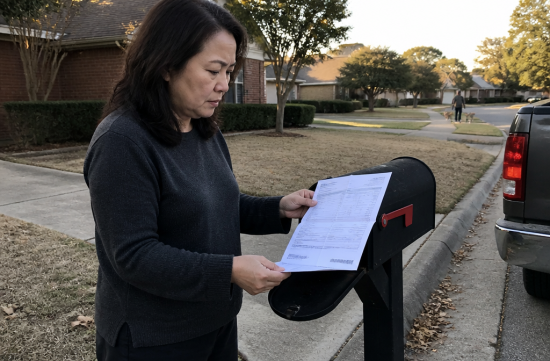
By mid-October, homeowners in the Dallas area will start receiving their property tax bills in the mail. The county tax office sends out the bills in October after each agency has finalized its budget and tax rates.
Last week, a friend brought their bill and mentioned that it hadn't decreased much from last year. Upon reviewing it together, we noticed that the homestead exemption was completely missing from the school district section.
This situation is more common than you might think. So, I've put together a checklist of things to verify as soon as you receive your bill.
First, let's look at the numbers. In the November 2025 referendum, a constitutional amendment was passed to increase the school district homestead exemption from $100,000 to $140,000.
According to the Texas Comptroller's guidelines, school districts must apply a $140,000 exemption to residential properties. This amount has been in effect since the 2025 tax year.
Homeowners who are 65 or older or have disabilities will see the additional school district exemption increase from $10,000 to $60,000. Combined, this means a total of $200,000 is exempt from school taxes.
One point that often confuses people is that the $140,000 exemption applies only to school district taxes.
Other entities, such as the county, city, and community college, set their own exemptions. Therefore, when reviewing your bill, you need to look at each entity's line separately.
For example, the city of Dallas offers a 20% homestead exemption. The exemption for those 65 and older or disabled has been raised to $175,000 starting in the 2025 tax year.
According to the city's announcement, combining the two exemptions means that homes valued at $218,750 or less will not incur city property taxes. I was a bit surprised to see that number.
However, even with the same Dallas address, circumstances can vary. The city of Dallas spans multiple counties, including Dallas, Collin, and Denton, so the appraisal district you apply to can change based on your home's location.
The same goes for school districts. Even within the same city, the tax rates and exemption structures differ depending on whether it's Dallas ISD, Richardson ISD, or Plano ISD.
Now, here's the order of verification for your bill. First, check the exemption amount listed in the school district exemption box.
If the exemption box is empty or the number is small, it means the homestead has not been registered. If the taxable amount is nearly the same as the appraised value, that's another signal.
If you're 65 or older, you should also check whether the additional exemption and school tax ceiling are both recorded. There are many cases where people miss out because they didn't apply after their birthday.
Next, visit the appraisal district's website. If you're in Dallas County, you can search for your address on the DCAD site to see the list of registered exemptions.
If you find that you're missing an exemption, you can submit Form 50-114, the application for a residential homestead exemption. For those 65 or older or disabled, you can check the appropriate box on the same form.
There's no need to give up just because the deadline has passed. According to Section 11.431 of the tax code, late applications are accepted within two years from the delinquency date.
Property taxes are due by January 31, and from February 1, they are considered delinquent. This means that for the 2025 tax year, you can retroactively apply until January 31, 2028.
For the 2026 tax year, the same calculation applies, allowing applications until January 31, 2029. However, the longer you wait, the longer the refund process will take, so there's no reason to delay.
If you've already paid taxes, you can receive a refund after approval. However, processing speeds vary by county.
There's one more hidden benefit to the homestead exemption. Registered residential properties have their appraised value increases capped at 10% per year.
If the exemption is missing, you won't receive this cap either. The difference can be significant, especially in neighborhoods where home values are rising quickly.
In my experience, the common reasons for missing exemptions are similar. They include the first year after purchasing a new home, changes in ownership after refinancing, or applying under only one spouse's name.
Be especially cautious if you've purchased a new home. Many people assume that the title company will handle everything at closing, but the exemption application ultimately needs to be submitted by the homeowner directly.
If your driver's license address differs from your home address, your application may be rejected. If you've moved and haven't updated your license address, make sure to take care of that first.
If you believe the amount on your bill is incorrect, it's best to contact the appraisal district first rather than the tax office. While the tax office calculates taxes, the exemption registration falls under the appraisal district's jurisdiction.
Since the specific conditions can vary by county and agency, if you're unsure, I recommend calling the relevant appraisal district for confirmation.
If it were me, I would check at least one line in the school district section as soon as I received the bill. If the $140,000 exemption is missing, that's a paperwork issue, not a tax rate issue.
Paperwork issues are something I can fix. Just checking once before the end of January payment deadline will give you much more peace of mind.
 GoingOnce






 garlic bread |
 Sugar Cream Door Bulletproof Noodles |
 urbanmint |
 |
| 
 Premium Gas Camp |
 xylora |
 Aura-Infused WACAM |

 Dallas Fort Worth DFW |
 wendra |
  sunrise |
  ultron78 |
  uplifted |
  Folding Instructions |
  same same life |
  USA Hyundai Kia |
  morvex37 |
  BOL SA RAM |
  TOUCHE NEWS |
  Small Business Information USA |
  draxen |
  gallery |
  milkyotter |
  Zoom Zoom Zoom |
  Minnesota Lakes and Clouds |
  noraro |
  tervox95 |
  vale vale |
  yentra |
  Golden life |