
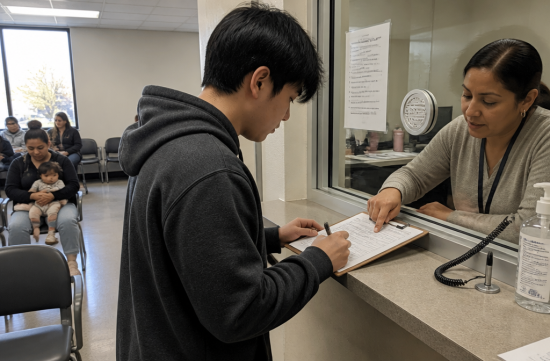
On January 1, 2026, this single date completely changes the rules for health coverage in California.
Recently, I've been hearing people say, "I applied for Medi-Cal, but I heard it only covers emergencies." At first, I thought there was a mistake with the paperwork, but it turns out the system itself has changed.
So this time, I organized the information based on official documents rather than just my impressions. I cross-referenced the state health department (DHCS) guidelines, county announcements, and this year's budget-related reports.
To get straight to the point, starting January 1, 2026, adults aged 19 and older classified as having "unsatisfactory immigration status" will no longer be able to enroll in full-scope Medi-Cal, which is funded by the state government.
This includes adults with incomplete documentation. Some immigrants who do not meet the federal criteria for full-scope eligibility are also grouped in this category.
So, does this mean that if you apply now, you won't get anything? Not exactly. New applicants can receive restricted scope Medi-Cal, commonly referred to as emergency Medi-Cal.
This restricted scope covers emergency care, pregnancy-related services, and some nursing facility care. However, routine check-ups and chronic disease management are excluded.
There are exceptions, of course. Children under 18 and pregnant individuals are not included in this freeze.
Those who already have full-scope Medi-Cal will not lose it immediately. As long as they complete the annual renewal within the deadline, their coverage will remain intact.
The detail I find most important is the 3-month grace period. This regulation states that if coverage is interrupted for any reason, you can re-enroll within 3 months to restore it.
Conversely, if you miss a single piece of mail and 3 months pass, you will be treated as a new applicant. This means you will be downgraded to restricted scope.
Therefore, it's crucial not to delay the renewal paperwork. If your address has changed, it's best to update it with the county first.
The timeline for dental services has also changed. The original plan was to eliminate routine dental benefits for this group of adults starting July 1, 2026.
However, in the state budget agreed upon at the end of June, this cut has been postponed by a year to July 1, 2027. Emergency dental treatment will continue to be covered after that.
There is also a premium. The 2025 budget has set a monthly fee of $30 for those aged 19 to 59 starting in July 2027.
However, during this year's budget discussions, proposals for increases have emerged, and the amounts vary across reports. Therefore, it's safest to confirm the exact amount through DHCS announcements before implementation.
There is also a movement to lift the freeze. A bill called SB 1422 has been introduced to restore full-scope coverage starting January 1, 2027, but I have not been able to check the current status.
So what options are available right now? Based on LA County, here's a summary.
First, there's the Ability-to-Pay program from the county health department (DHS). This is a discount program for county residents who do not qualify for Medi-Cal or Medicare, and the former ORSA has been merged into this.
The DHS guidelines state that residency status is not considered when applying for ATP. There is also a note that the county does not report patient information to immigration authorities.
For reference, the previously widely used My Health LA program ended on January 31, 2024. If you go looking for old information, it will be a wasted trip.
Second, there are federally funded community health centers. These places are required to operate a sliding fee scale based on income.
Third, in emergencies, restricted scope Medi-Cal is still operational. If you suddenly become ill, I believe you should not avoid the ER due to cost concerns.
If your medication or treatment plan changes, do not make decisions on your own; be sure to consult with a doctor or pharmacist. Especially if you are on medication, it's best to ask before coverage changes.
Honestly, I understand this decision when I look at the financial numbers. Since it's a program funded solely by the state budget, it was the easiest item to cut in the face of a deficit.
However, frequently changing the rules is not ideal. The dental cut has been postponed by a year, and the premium amounts are fluctuating, making it difficult for people to plan.
I believe that whether the government expands or reduces coverage, the rules should be predictable. This way, individuals can choose alternatives in the market.
If it were me, I would prioritize renewal if I currently have full-scope coverage, and if not, I would first look into ATP and local community clinics.
This is a field likely to change again, so be sure to check DHCS and county announcements every few months. I will also reorganize the information when new data comes out.
 Hennesix







 United States Army |
 premium |

 The Emperor Must Grow |

 squidogame |
 daddyyo |

 productionblog |

 Angeles Choi |


 Healthy Local Fresh Information |

 U.S. Military Recruitment Information |
 Korea Forever |
 wavey |
 Valley Bang |
 Enjoying Samba at Home |
 Goroke Geureoke News |
 clarion |
 almondo |
 monkey |
 umbrellafruit |
 Porynix |
 San Gabriel Mountains |
 creamcat |
 victoria jung |
 Peter Pan Pet |
 Archaic Kim |
 Washington Denzel DJ |
 Fong Mr |
 vanillastorm |
 espressotop |
 raviont |