
Next Wednesday is Veterans Day, so I took a walk toward the National Mall during lunch. Right next to the Lincoln Memorial is the Korean War Veterans Memorial, where statues of soldiers in ponchos stand.
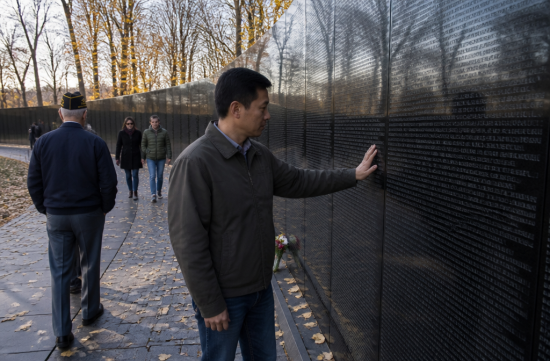
In the past, I would just take a photo of the statues and be done, but these days I always make sure to take another lap. It's because of the black granite wall that has been added next to the statues, the Wall of Remembrance.
This wall was officially dedicated on July 27, 2022. It was the 69th anniversary of the armistice agreement, and many veterans and their families gathered for the event that day.
The wall bears the names of 36,634 U.S. soldiers who died in the Korean War. Next to them are the names of 7,174 KATUSA soldiers.
Together, that makes 43,808 names. When you read the number, it just seems like a large figure, but seeing the names densely engraved on 100 granite panels gives it a completely different feeling.
Honestly, I was a bit surprised at first. I didn't expect to see so many Korean soldiers' names on a monument in the middle of America.
KATUSA stands for Korean Augmentation to the United States Army. These are Korean soldiers who were assigned to U.S. units and fought alongside them.
Among Korean men who have served in the military, KATUSA is often joked about as a cushy position. But standing in front of this wall, that joke fades away. The number 7,174 is not something to laugh about.
These were people who fought while listening to commands in a foreign language and wearing unfamiliar uniforms. I find it quite meaningful that their names are lined up next to those of U.S. casualties on the same wall.
This wall didn't just appear overnight. In October 2016, President Obama signed the bill for the construction of the Wall of Remembrance, and the construction began in March 2021.
The total cost of the project was $22 million, most of which was covered by the South Korean government and the Ministry of Veterans Affairs.
This part made me a bit emotional. The country that once received help has now become a country that builds monuments alongside the country that helped.
The memorial park originally opened in 1995. So it took 27 years for the names to be engraved. The phrase that has been there since then is "Freedom Is Not Free."
It feels like that phrase has finally been completed with this wall. Now we can see specifically who paid that price, as their names are visible.
There are a total of 19 statues. When paired with the granite wall, that makes 38, which is famously interpreted as a reference to the 38th parallel.
But if I stop here, it would just be a warm story, so I need to mention something uncomfortable as well.
In January 2023, the New York Times reported errors in the names on the wall. They analyzed that there were 1,015 names with misspellings.
There were also points raised that 245 names included those who died in accidents unrelated to the war. Conversely, there were claims that names that should have been included were missing.
The list of names was provided to the memorial foundation by the U.S. Department of Defense. Ultimately, it was a data management issue. I understand that organizing records over 70 years old is not easy, but it's still disappointing.
If a single cell is wrong in an Excel sheet at work, you just send a corrected version the next day, but this is engraved in stone. The scariest part is that this is data that can't be undone with Ctrl+Z.
Since then, a bipartisan investigation has begun in Congress, and South Korean veterans authorities have also stated they will correct the errors. However, I have not yet seen an official announcement confirming how many panels have actually been corrected.
I believe the government should take full responsibility for fixing these issues. A memorial is not just a project that ends with budget execution; it is a promise made to the families of the fallen.
Still, there is absolutely no reason to hesitate to visit this wall. In fact, the more people go and see it, the more attention these issues will continue to receive. When interest wanes, corrections tend to be delayed as well.
If I may offer a tip, visiting around sunset is better than during the day. The light hits the granite at an angle, making the engraved names much clearer.
If you go with a child, pick a name and read it together. There will come a moment when the Korean War in textbooks suddenly becomes a personal story. There is no better field trip for history learning than this.
If you have a veteran in your family or among your acquaintances, it's also a good idea to look up their name beforehand. With 100 panels, if you try to find a name randomly on-site, you might get quite lost. I remember wandering around for a while when I first went.
This Veterans Day, I recommend standing in front of this wall for just 10 minutes instead of attending a parade. I believe that is the most sincere way to express gratitude, more than any grand event.
If you remember even one of the 43,808 names and come back, that walk will have been well worth it.
 SuchAHeel




 Glow Yo |
 Michigan Enthusiast |
 xylora |

 Tan Zoo |

 hot chocolate |
 washington mom |



 El Dorado |

 Washington Monument |
 Holey Moley |
 clarion |
 almondo |
 monkey |
 umbrellafruit |
 Porynix |
 San Gabriel Mountains |
 creamcat |
 victoria jung |
 Peter Pan Pet |
 Archaic Kim |
 Washington Denzel DJ |
 Fong Mr |
 vanillastorm |
 espressotop |
 raviont |
 Illinois alpaca |
 Purple Moons, |
 Ted 600 |
 jaxter |
 garlic bread |