
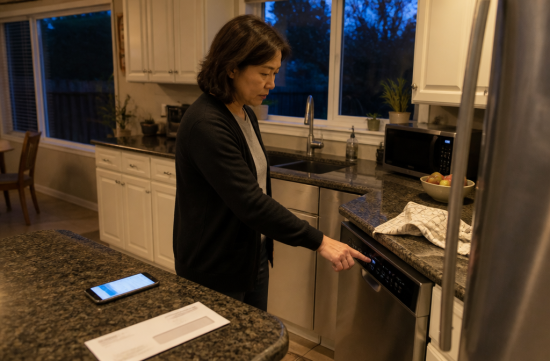
When I came into the kitchen on Sunday morning, I found that only the microwave clock was an hour ahead. My phone adjusted automatically, but the oven and washing machine timers stayed the same.
This year's daylight saving time ended at 2 AM on Sunday, November 1. We turned the clock back one hour to 1 AM.
But wait! You can't just turn back the clock and be done with it. If you use a time-of-use rate plan, there's something you need to check this week.
The time-of-use rate plan, known as TOU (Time-of-Use) in English, means that the cost of electricity varies depending on when you use it.
Most people in this area are SCE (Southern California Edison) customers, and many are on the TOU-D-4-9PM rate plan. As the name suggests, the most expensive time is from 4 PM to 9 PM.
SCE's rate schedule divides the year into two seasons. Summer runs from June to September, and winter runs from October to May.
This means that the rate season switched to winter on October 1, and now the clocks have changed too. With these two changes, it's time to adjust your daily routine.
Let's summarize the winter schedule. Both weekdays and weekends have the cheapest super off-peak rates from 8 AM to 4 PM.
From 4 PM to 9 PM is mid-peak, and from 9 PM to the next morning at 8 AM is off-peak. Even though the name changes to mid-peak in winter, it still represents the expensive time of day.
I won't write down the exact rate because I've found different numbers in various sources, and rates are adjusted every year.
The most reliable way to check the exact rates is through SCE's website or your own bill. Your bill is the definitive source, not someone else's blog numbers.
Now, the real issue is the timers. The rate schedule is written in clock times like 4 PM and 9 PM.
But what happens if the clock inside your devices is an hour off? A dishwasher set to run after 9 PM might actually run at 8 PM, during the expensive time.
The same goes for electric vehicles. If you say, "I set a charging reservation, but my bill went up unexpectedly," you should first check if the charging app's time zone is set manually.
So, I recommend taking a look around your house this weekend. Devices connected to smartphones usually adjust automatically, but mechanical timers that are set by buttons need human intervention.
There are more places to check than you might think. Look at the pool pump timer, sprinkler controller, and thermostat schedule first.
Next, check the reservation functions of your dishwasher, washing machine, and dryer. If you have an electric vehicle, you need to check both the car's charging reservation and the wall-mounted charger app.
Another thing to note is that the sun sets earlier in winter. These days, after daylight saving time ends, it gets dark around 5 PM.
This means that lighting, heating, and dinner preparation all tend to cluster during the expensive 4 PM to 9 PM window. Coming home from work, turning on lights, running the oven, and heating the house all happen right during mid-peak.
If you have solar panels, you need to be even more careful. With the sun setting early, there's almost no self-generated power after 4 PM, so you'll have to buy electricity from the utility during that time. If you have battery discharge settings adjusted for summer, check if they align with the winter schedule.
So, here's my approach. I schedule laundry and dishwashing for daytime or after 9 PM.
I warm up the house a bit before sunset around 3 PM, and after 4 PM, I lower the set temperature by a degree or two. The house retains some heat, so it doesn't feel as cold as you might think.
For dinner cooking, I've switched to using the stovetop or slow cooker during the day instead of the oven. It's a small habit, but over a month, it makes a difference.
Wait! Some areas are served by RCMU (Rancho Cucamonga Municipal Utility) instead of SCE. In this case, the rate structure is different from SCE.
RCMU has a separate PDF of their rate schedule on their city website. According to the January 2026 version, the residential basic allocation is 16.1 kWh per day in summer and 10.6 kWh per day in winter.
If you're confused about which utility company you're with, just look at the logo at the top of your bill to find out. The rate plan name is also listed on the bill, so check that too.
Take this opportunity to evaluate whether the rate plan itself suits your home. If you log into your SCE account, there's a feature to compare rate plans based on your usage patterns.
Electric bills can be burdensome for anyone, but households with less information tend to pay more. If you know seniors or neighbors who have recently moved in and find English instructions daunting, please share this article with them.
If it were me, I would start adjusting the timers one by one this evening. An hour's difference can significantly impact your bill over a month.
 MoonSoga






 content |

 Carolina border |

 Que Buena |
 juicylol |

 Mr Song Song |

 CA Real Estate |

 some fame |

 US Embassy |

 Lifestyle Information Search USA |
 San Gabriel Mountains |
 clarion |
 almondo |
 monkey |
 umbrellafruit |
 Porynix |
 creamcat |
 victoria jung |
 Peter Pan Pet |
 Archaic Kim |
 Washington Denzel DJ |
 Fong Mr |
 vanillastorm |
 espressotop |
 raviont |
 Illinois alpaca |
 Purple Moons, |
 Ted 600 |
 jaxter |
 garlic bread |