
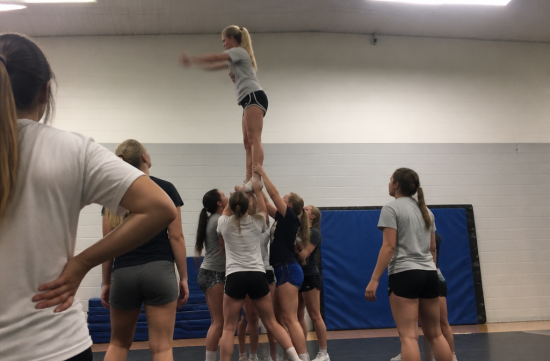
These days, with the football season underway, high school cheerleader videos keep popping up on my timeline.
However, what I saw was completely different from what I expected. Instead of scenes of girls holding pom-poms and waving their hands with smiles, there were tumbling moves where people were thrown into the air and caught.
It was hard to tell if this was cheering or gymnastics.
Then suddenly, a thought from somewhere came to mind. There was a critique that cheerleading is ultimately a product of outdated gender roles, where women are positioned to look pretty while highlighting male athletes.
After hearing that, I became curious and looked up some records.
The results were unexpected. The origins of cheerleading trace back to Princeton University in the 1880s, where it was an activity performed entirely by male students.
The cheer that originated from the Princeton stands in 1884 is recorded as the first cheer in America, and it began to take on an organized form as it moved to the University of Minnesota.
So, for the first 25 years, the position of cheer captain was solely held by men. Women began to gradually join in around the 1920s.
There was a specific event that solidified the current predominance of women in cheerleading. That event was World War II.
As male college students went off to war, female students filled the void, and even after the war ended, that structure remained.
Now, it seems that the majority of participants are women, indicating a complete shift from the original setup.
Speaking of gender ratios, I looked up some current statistics.
Currently, about 96 percent of cheerleaders in the U.S. are female, and if we look only at the elementary and middle school levels, the predominance of women has actually become even more pronounced.
However, when it comes to the college level, the situation changes slightly. In the 2021-22 season, among the 15,238 participants in NCAA cheer teams, 2,738 were male, which is about 18 percent.
This suggests that as the proportion of tumbling and stunts increases, male participation also rises, which in a way resembles the trend when male students were cheer captains at Princeton.
At this point, the premise that cheerleading was originally a woman's domain starts to crumble. It seems more like a result created by the coincidence of war rather than a tradition.
So where does the current controversy over sexism stem from? I looked into it further.
The core issue was whether this is considered an official sport or not.
In 2012, the U.S. Court of Appeals ruled in a case involving a college in Connecticut that competitive cheerleading did not yet have the organizational structure and regulations to be recognized as an official college sport.
The college had replaced its women's volleyball team with a cheer team, and the question was whether this could be seen as fulfilling Title IX requirements for providing athletic opportunities for female students.
The court ruled that it did not. The reasoning was that the scoring system for competitions was not standardized, and recruitment and facility support were not as systematic as for other sports.
However, looking at injury statistics, the story changes a bit.
A study conducted by a research institute at the University of North Carolina from 1982 to 2007 found that 65.1 percent of serious injuries in high school sports occurred in cheerleading.
During the same period, sports like gymnastics and track and field did not even reach double-digit numbers, indicating a significant gap.
It feels somewhat strange that an activity that carries such risks does not receive formal recognition as a sport.
The criteria for recognizing a sport also vary by state.
According to a survey by the National Federation of State High School Associations (NFHS), as of the 2021-22 school year, about 30 states recognized competitive cheerleading as an official sport.
California, where I live, is one of them. The California Interscholastic Federation (CIF) adopted competitive cheerleading as an official sport starting in the 2017-18 school year, following Governor Jerry Brown's signing of the relevant bill.
So while the federal court found it lacking under Title IX, many states already treat it as an official sport. The answer varies depending on the perspective.
From my perspective, I believe this issue is more about standards than a battle between sexism and tradition.
By classifying based on actual data such as injury rates, training intensity, and competition regulations, and providing support accordingly, the discussion feels like it gets sidetracked when it is pushed into an ideological framework.
Of course, I do not deny the critique that there were times when women were treated as mere tools for cheering. However, trying to explain the current issues of risk and treatment solely through the lens of outdated gender roles does not seem to be an accurate diagnosis.
While I was researching, I also found some practical information that could be helpful.
The USA Cheer organization has developed a safety management training program that covers aspects like spotting techniques, progressive skill levels, and athlete readiness checks, and most colleges and state high school athletic associations require cheer coaches to complete this training.
If you know anyone planning to send their child to a cheer team, I would suggest subtly asking whether the coach has received this safety training.
One thing I definitely realized while researching is that in the future, when I see cheerleader videos, I will be more aware of how much training is required to perform those moves rather than just focusing on their pretty smiles.
 SoulWalker






 AH LALA |
 Victory 1988 |
 Panorama Kstar |
 Giant Squid and Sweet Potato Soup |
 Lol Life |
 productionblog |
 U.S. Military Recruitment Information |
 fernando park |

 lumora |
  Valley Bang |
  pravix22 |
  Cohesive Kong |
  werehere |
  problemo |
  galaxy88 |
  breezelove |
  Minnesota Sonata N |
  hazelnut |
  Korean News American Blog |
  Savion |
  pintos |
  Good Good |
  oh my salami |
  Lemonade Cider Planning Director |
  Way to easy |
  American Hardcore Band |