
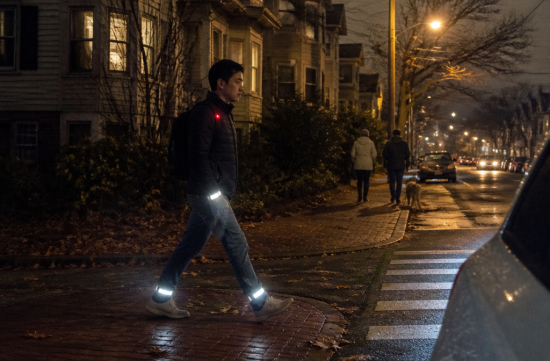
After finishing work, I downed an espresso and opened the café door, only to find it was already dark outside. When I checked the clock, it wasn't even five o'clock yet.
That's right, daylight saving time ended at dawn on Sunday, November 1st. Since that moment when I turned the clock back an hour, it feels like the entire evening has vanished.
Looking at the sunrise and sunset calendar, I found that the sunset on Friday, November 6th, is at 4:33 PM. If I go for a walk after dinner, it's basically the middle of the night.
The problem is the walking route. The streetlights in my neighborhood are sparse, and cars drive faster than you'd expect.
Last week, while crossing the street in a black puffer jacket, an SUV turning right stopped just inches from me. The driver's expression was even more shocked than mine.
It wasn't entirely the driver's fault. Dressed in black with black pants, on the dark asphalt, I was practically invisible.
That day, I went home and looked up some numbers. Honestly, it gave me chills.
According to NHTSA data, 77% of pedestrian fatalities in the U.S. occur at night. This is based on 2023 data.
Massachusetts is no different. A report from the pedestrian organization WalkMassachusetts, using MassDOT accident data, states that out of 354 traffic fatalities in the state in 2025, at least 76 were pedestrians.
It's reported that 68.7% of those pedestrian fatalities occurred during dark hours. At this point, walking at night feels like a completely different game.
Another concerning statistic from the same report is that 43.4% of the deceased pedestrians were over 65 years old. When I think about my parents or the elderly in my neighborhood going for evening walks, it hits close to home.
So, I decided to choose reflective gear carefully. But there's a common misconception here.
Fluorescent colors and reflective materials are completely different things. Fluorescent yellow and orange glow due to ultraviolet light, making them visible during the day or at dusk.
At night, with almost no ultraviolet light, the advantages of fluorescent colors diminish significantly. What you need in the dark is retroreflective material that sends the light from car headlights back toward the driver.
Check if the product description mentions retroreflective. It looks like silver or gray strips, and when you take a photo with your phone's flash on, it shines bright white. I recommend testing this method when buying in stores.
So where should you attach them? There's an interesting study on this.
Researchers from QUT in Australia experimented with attaching reflective materials to joints like ankles, knees, wrists, and elbows. This is called biomotion, and it suggests that when the brain sees moving joint lights, it immediately recognizes it as a person.
In results involving cyclists, drivers recognized people wearing reflective gear on their joints from three times farther away than those wearing just reflective vests. I felt a bit embarrassed for relying solely on a vest.
In a similar pedestrian study, it was found that even thin reflective strips only 0.75 cm wide were effective. This means you don't need to have thick and flashy gear.
NHTSA also summarizes that a moving pedestrian with retroreflective material on their limbs is much more visible at night. However, they honestly add that there hasn't yet been a study proving how much these devices reduce accidents.
So, reflective gear is a tool that gives drivers more time to notice you. It's not invincible armor.
Ultimately, my setup consists of two ankle reflective bands, one wristband, and a small clip light that blinks front and back.
The ankle bands offer the best value. They move up and down while walking, providing the biomotion effect.
I attached the clip light in blinking mode to the strap of my bag on the back. With white light in front and red light in back, it makes it easy for oncoming and following cars to see the direction. Since reflective materials only shine when they receive light, having at least one self-lighting item gives me peace of mind.
For those walking dogs, please attach a reflective product to the leash or collar as well. If only the person is visible and not the leash, that's also dangerous.
Just as important as the gear is the habit. Don't assume that a car has seen you and cross; double-check if you made eye contact with the driver.
Lower the volume on your earbuds and keep your phone in your pocket while walking. I'm still only halfway there myself. It's hard to break the habit of walking with a game soundtrack playing.
When crossing the street, choose crosswalks and well-lit intersections whenever possible. If you suddenly dart out between parked cars, the driver has almost no time to react.
Be extra cautious on rainy days. Wet roads can blur headlights, significantly impairing the driver's visibility.
Honestly, I worried that wearing reflective bands might look a bit silly. But thinking back to that SUV last week, looking silly is a hundred times better.
If it were up to me, I'd buy two ankle bands and a blinking light before getting a fluorescent vest. Since the sun sets around 4:30 PM now, let's all grab some light before heading out. An espresso can wake you up, but reflective bands can alert drivers to your presence.
 silverroadwalker1915
 OceanBuddy



 Caribbean |
 tredolo |

 Anjollinya Blog |

 Kitchen Ideas |

 Spaghetti Flying Religion |

 juicylol |

 tiramisu |

 The Gelaton |
 Investment Information News Update |

 clarion |
 almondo |
 monkey |
 umbrellafruit |
 Porynix |
 San Gabriel Mountains |
 creamcat |
 victoria jung |
 Peter Pan Pet |
 Archaic Kim |
 Washington Denzel DJ |
 Fong Mr |
 vanillastorm |
 espressotop |
 raviont |
 Illinois alpaca |
 Purple Moons, |
 Ted 600 |
 jaxter |
 garlic bread |