
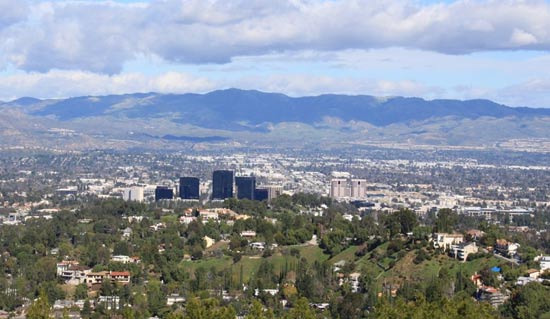
The economic structure of San Fernando is quite different from what people commonly think of as a "wealthy suburb of LA."
Here, the economy is not driven by large corporate headquarters or high-rise office towers, but rather by industries closely tied to daily life and small businesses that actually drive the local economy. According to Data USA statistics for 2024, the total number of employed individuals in San Fernando is about 12,100. While the scale is not large, the industrial composition is quite realistic. The largest industry is construction, employing around 1,497 people, followed by healthcare and social services with 1,438, and manufacturing with about 1,323. This means that rather than being a white-collar financial city, it is a place where labor and service-based economies are at the center of life.
Notably, the high proportion of construction jobs reflects the characteristics of the San Fernando area. The entire LA metropolitan area is constantly undergoing remodeling, home renovations, and commercial construction, and San Fernando has a significant number of small to medium-sized construction companies, subcontractors, equipment suppliers, and skilled labor. In fact, this area has a strong blue-collar self-employment economy in fields like HVAC, electrical work, plumbing, interior design, and auto repair. These are also the most accessible fields for middle-class immigrants in the U.S.
The high proportion of jobs in healthcare and social services is also striking. This is largely influenced by aging populations and the growth of immigrant communities. Rather than being centered around large hospitals, the local economy is significantly supported by clinics, rehabilitation centers, senior care, and home care services. In fact, the entire San Fernando Valley is one of the areas where the proportion of healthcare workers continues to increase.
In terms of salary levels, the highest-paying industry is information and communication, with an average annual salary of about $108,000. The public administration sector is also relatively stable, with salaries around $67,000. However, within San Fernando itself, many high-income IT professionals often commute to other areas rather than working in the city. San Fernando plays a strong role in housing and daily life, while high-paying jobs tend to move to Burbank, Glendale, Downtown LA, and the Westside.
Looking at local businesses makes the character of the city even clearer. Notable examples include healthcare institutions like Northeast Valley Health, manufacturing and aerospace companies like Pico Digital Inc. and AIRO Industries, and retailers like Superior Grocers. Particularly, AIRO Industries is a company that provides aircraft design, engineering, and repair services, showcasing a slice of the manufacturing ecosystem in San Fernando Valley. While it may appear to be an ordinary industrial complex from the outside, inside, a manufacturing-based economy involving aircraft parts, machinery production, logistics equipment, and electronic assembly is continuously thriving.
The scale of commercial space is also larger than expected. Commercial space is about 2.4 million square feet, while industrial space is around 5 million square feet. Considering that San Fernando is a small city, this represents a fairly high industrial density. However, most of it is not large global corporate campuses but rather a distribution of small to medium-sized manufacturers, warehouse logistics companies, automotive-related businesses, and wholesalers.
Ultimately, the core of San Fernando's economy is its small business sector. This area is characterized more by a "immigrant self-employment economy" than by a U.S. corporate-centered economy. In fact, there is a high proportion of Hispanic and immigrant-run small businesses, and many family-operated businesses. Practical local economies such as restaurants, auto repair shops, construction subcontracting, markets, cleaning services, and logistics sustain the city. The city government also pays attention to supporting small businesses and revitalizing local commerce.
However, viewing San Fernando as a standalone city can lead to an underestimation of its economic scale. The actual economic zone is connected to the entire San Fernando Valley. By broadening the perspective slightly, one can see the media and entertainment industry in Burbank, the manufacturing and tech industries in Northridge and Chatsworth, and large educational institutions like California State University, Northridge. Within this vast valley economic zone, San Fernando can be seen as a city that relatively supports working-class living economies and labor-based industries. While it may not have a glamorous city image, it is much closer to a realistic urban structure that supports the northern LA living economy.
 TwinEggUSA
 ChiliTunaYawn




 Tesla X |
 Another Eden Channel BLOG |
 Victory 1988 |
 Smile Face |
 Helpful Life Stories |
 productionblog |
 All About Real Estate Information in the USA |
 fernando park |
  Valley Bang |
 U.S. Military Recruitment Information |
  Coastal city |
  meonetoo |
  Winter bear |
  Peach Jam Eating Laughter |
  Nando Raldo |
  American Man in a Mask |
  wendra |
  silver |
  bada2002 |
  horizon |
  Nanana Nanana Nanana |
  victoria jung |
  Kkikki Ppappa Shout Out Loud |
  Lululala |
  Toaster Pizza Magic Show |
  Utah, the Most Livable State |
  nortrix |
  Mau Nui |
  novapixel |
  fixed |