

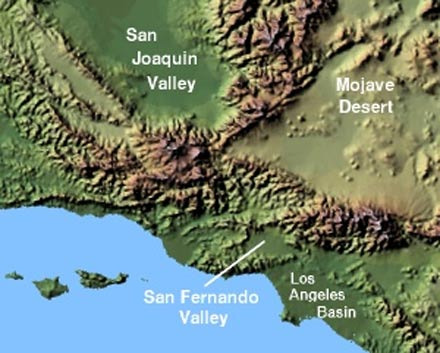
Considering the location of San Fernando, it is correct to say that the true value of this city comes from its accessibility rather than its internal features.
Within a 50-mile radius, completely different cities and living environments are available, allowing for entirely different lifestyles depending on how one utilizes their living space.
About 25 miles to the north is Santa Clarita. This area is known for its planned residential communities and well-organized family living environments.
The most famous spot here is Six Flags Magic Mountain. It is known as the theme park with the most roller coasters in North America, and it is quite impressive in size when you visit. From San Fernando, taking I-5 North, you can arrive in about 20 to 25 minutes depending on traffic. Even on weekends, it is relatively accessible, making it a popular choice for family outings and visitors.
If you head west, the atmosphere changes completely. After about 35 miles, you reach Malibu Beach. Taking the 101 Freeway and then descending onto Pacific Coast Highway leads to a typical California coastal drive.
This area is more about "the scenery itself being the destination" rather than just a tourist spot. Particularly, El Matador State Beach is famous for its cliffs and rocky terrain, making it a popular photo spot, and there are also beach lines frequented by surfers. On a nice day, this stretch is considered one of the best driving routes in the LA area.
Further up, you will find Oxnard and Ventura, which serve as the ferry departure point for Channel Islands National Park. This area is frequented by those who enjoy nature-based travel rather than typical tourism.
The east and south are entirely urban living areas. Within about 20 miles, you have downtown Los Angeles, with Burbank, Glendale, and Pasadena right next to it. This radius includes major cultural and tourist infrastructures like the Los Angeles County Museum of Art, Getty Center, Griffith Observatory, and Dodger Stadium. In simple terms, cultural activities, workplaces, shopping, and entertainment are all concentrated in this direction.
Conversely, if you travel about 50 miles southeast, you reach the Inland Empire area centered around Ontario and Riverside. This area has a strong economy based on logistics, warehousing, and manufacturing, which presents a different industrial structure compared to downtown LA.
To the northeast lies the San Gabriel Valley, which includes areas like Arcadia, Rosemead, and Rowland Heights, where Chinese and Korean communities are densely populated. This area has a strong Asian food culture, markets, and living infrastructure, making it a very important living hub for specific demographics.
In summary, while San Fernando may seem like a quiet, small-scale city on its own, it is entirely different when viewed within a 50-mile radius. To the north is a family-oriented new town, to the west is a coastal resort, to the south is the urban center, to the east is an industrial and logistics area, and to the northeast is the Asian community.
And the key point is that all these directions are connected by freeways. Ultimately, it is accurate to view San Fernando as a central position in the northern LA living area, as it is in a location where "you can go anywhere."
 MisunSlice
 TONCOFFEE
 GimmeHeart



 Sugar Cream Door Bulletproof Noodles |
 urbanmint |
 |
| 
 Premium Gas Camp |
 CA Real Estate |
 productionblog |
 All About Real Estate Information in the USA |
 fernando park |
  Valley Bang |
 U.S. Military Recruitment Information |
  Coastal city |
  meonetoo |
  Winter bear |
  Peach Jam Eating Laughter |
  Nando Raldo |
  American Man in a Mask |
  wendra |
  silver |
  bada2002 |
  horizon |
  Nanana Nanana Nanana |
  victoria jung |
  Kkikki Ppappa Shout Out Loud |
  Lululala |
  Toaster Pizza Magic Show |
  nortrix |
  Mau Nui |
  novapixel |
  fixed |