
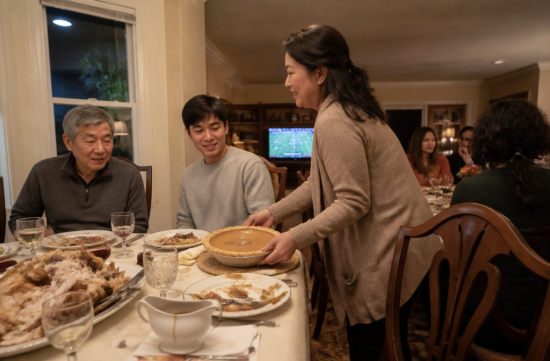
The midterm elections have just concluded. And this year's Thanksgiving is on November 26, which is less than three weeks away.
Imagine someone at the table saying, "Did you see the election results?" The atmosphere shifts instantly, and I'm sure many of you have experienced that moment.
I had a similar experience a few years ago. It started as a joke, but before dessert was served, two people had already grabbed their coats and left. The rest of us just stared at the cold gravy.
This time, I want to discuss how to prepare with data and practical tips instead of relying on instinct.
First, let's look at the numbers. The American Psychological Association surveyed 2,083 adults from November 25 to 27, right after the 2024 presidential election.
Seventy-two percent of respondents said they want to avoid political discussions with family during the holidays. Only 32% looked forward to talking about politics.
Thirty-nine percent reported feeling stressed just thinking about political discussions at gatherings. Additionally, 38% said they actively avoid family members with differing opinions.
Honestly, that 38% statistic surprised me. It means that nearly four out of ten people avoid family during the holidays.
However, the same survey found that 83% agreed that the holidays are a time to temporarily forget political differences. Everyone wants to avoid conflict.
For reference, I haven't found data for 2026 yet. Please keep in mind that the most recent available data is from this 2024 survey.
Ultimately, the issue is not about willingness but about method. So, how can we handle this? I'll outline the steps I've actually used.
First, if you're the host, set the rules in advance. Add a light note to the invitation saying, "This year, let's only talk about food and kids." If you post it in the group chat beforehand, everyone can prepare mentally.
This isn't censorship; it's a house rule. If you mention it in advance, if someone crosses the line on the day, you can smile and say, "But we agreed, didn't we?"
Second, prepare about three alternative topics. Things like the best thing you did this year, a Netflix series you're into, or your travel plans for next year.
Political discussions usually pop up when there's a lull in conversation. The person who fills the silence sets the tone. I even jot down a few questions in my phone's notes.
Third, if the topic comes up, don't immediately counter. It's much better to respond with a question like, "What makes you think that?"
People tend to lower their voices when they feel heard. If you try to win an argument, the other person will do the same. Just remember that nodding doesn't mean you agree; that alone is half the battle won.
Fourth, find common ground. There are topics everyone worries about, like prices, kids' schools, and neighborhood safety, regardless of political affiliation. Shifting the focus from who's to blame to how we prepare at home makes the conversation much smoother.
I tend to be conservative on financial issues, but I quickly find common ground with my more liberal relatives when it comes to the burden of grocery prices.
Fifth, memorize an escape phrase. Something like, "Let's talk about this over coffee later; for now, let's enjoy the pie" is sufficient. Asking if there's anything you can help with in the kitchen also provides a natural exit.
Sixth, alcohol increases the chances of heated discussions. Once the wine has circulated a couple of times, it's a good idea to bring out a board game, turn on a football game, or suggest a neighborhood walk to change the atmosphere.
Seventh, be especially cautious in front of the kids. When adults mock each other, children learn that politics is about fighting. Conversely, if they see adults laughing off differing opinions, that becomes the best education.
And one more thing: let go of the goal of convincing the other person. Very few votes change in front of a turkey.
In the APA survey, 65% said political discussions wouldn't harm family relationships. This suggests that relationships are stronger than we think.
However, that strength can crack with just one shout. Especially in Korean families, there can be significant generational differences between parents and children, so one comment can easily escalate into a generational conflict. That's why preparation is necessary.
My stance is clear. The holiday table is not a debate forum, and political discussions should be scheduled separately. It's not about muddling through both sides having a point; it's about designating the right place and time.
In summary, here's the plan: set the rules in advance, have plenty of topics ready, ask questions instead of countering, and escape if it gets risky.
There are still nearly three weeks left. Prepare a line for the invitation, three alternative topics, and one escape phrase today. The atmosphere at the table can be maintained with surprisingly small preparations.
 RunHani







 Caribbean |

 tredolo |

 Anjollinya Blog |

 Kitchen Ideas |

 Spaghetti Flying Religion |

 northpeak |

 U.S. Weather Bureau News |

 swiftlane |
 Goroke Geureoke News |

 Korea Forever |
 wavey |
 Valley Bang |
 Enjoying Samba at Home |
 clarion |
 almondo |
 monkey |
 umbrellafruit |
 Porynix |
 San Gabriel Mountains |
 creamcat |
 victoria jung |
 Peter Pan Pet |
 Archaic Kim |
 Washington Denzel DJ |
 Fong Mr |
 vanillastorm |
 espressotop |
 raviont |