
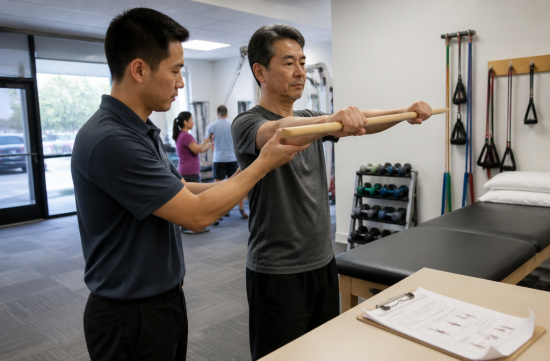
At a company dinner, a senior colleague sitting next to me mentioned that every time he puts on a shirt, his shoulder hurts and he can't rotate his arm back. When I asked if he had been to the hospital, he laughed it off, saying that frozen shoulder will heal on its own.
I had heard the same thing before, so when I got home that day, I did some research. To cut to the chase, the statement is half true and half false.
The formal name for frozen shoulder is adhesive capsulitis, which translates to 유착성 관절낭염 in Korean. In English, it is commonly referred to as frozen shoulder.
It is a condition where the tissue surrounding the shoulder joint, known as the joint capsule, becomes inflamed, thickened, and stiff. This causes pain, but more importantly, the arm cannot be raised above a certain height.
Although it's called frozen shoulder, it doesn't only affect people in their 50s. Various medical sources indicate that it commonly occurs between the ages of 40 and 60, and it is more prevalent in women than in men.
People with diabetes need to be particularly cautious. While the statistics vary from study to study, it is consistently noted that frozen shoulder appears at a significantly higher rate in diabetic patients compared to the general population.
Thyroid disorders or cases where the shoulder has not been moved for a long time after surgery or injury are also considered risk factors. If someone has been in a cast for a long time, it's worth considering.
So where did the saying that it will heal on its own come from? Frozen shoulder typically goes through a phase of increasing pain, a stiff phase, and a gradual recovery phase, which is why it tends to improve on its own.
The problem lies in the duration of this process. While the stages may vary slightly across different sources, it generally takes about 1 to 2 years, or even longer.
Imagine experiencing pain every time you put on a shirt, take your wallet out of your back pocket, or turn over at night for two years. Honestly, suggesting to just wait it out seems a bit irresponsible.
More importantly, not everyone fully recovers. A study published in the Journal of Shoulder and Elbow Surgery in 2008 tracked 223 patients with frozen shoulder and 269 shoulders for an average of 4.4 years after onset. While 59% returned to normal or nearly normal, 41% still had some form of symptoms remaining.
Fortunately, most of the remaining symptoms were mild, and only 6% experienced severe pain and functional decline. Additionally, those who had more severe symptoms initially tended to have worse long-term outcomes.
In summary, while many cases improve over time, the duration can be lengthy, and some may have lingering effects.
Another pitfall is that not all shoulder immobility is due to frozen shoulder.
Rotator cuff tears or calcific tendinitis can also cause similar pain and limited arm movement. However, these conditions require different approaches, and self-diagnosing and waiting could worsen the situation.
So what should you do? Here's the order I found through my research.
First, if shoulder pain persists for several weeks and your range of motion has decreased, see a primary care physician. It's crucial to rule out other causes through examination and, if necessary, imaging tests.
Second, if diagnosed with frozen shoulder, the usual treatment involves physical therapy and home stretching. During periods of severe pain, doctors may prescribe anti-inflammatory medications or corticosteroid injections.
Research indicates that procedures like corticosteroid injections or hydrodilatation, which involves injecting fluid into the joint capsule to expand it, can help with short-term pain relief. However, studies have shown that long-term outcomes are similar regardless of treatment, so it's important to discuss options with your physician.
Third, if you live in California, there's a helpful provision. Under state law, you can directly visit a physical therapist without a physician's prescription through direct access.
However, this is limited to either 45 days or 12 visits, whichever comes first, and after that, you'll need a signed treatment plan from a physician to continue. Even if the law allows it, your insurance, especially HMO plans, may require a referral, so it's wise to call your insurance company first.
Fourth, when exercising at home, the principle is to do so consistently within a pain-free range. If you completely avoid movement due to pain, it will become stiffer, and conversely, forcing movement can exacerbate inflammation.
There are many exercise videos on YouTube, but the intensity varies at different stages, so I believe it's best to learn directly from a physical therapist for the first few sessions to save time.
Lastly, this article summarizes what I've learned and is not a diagnosis. Please consult a doctor or pharmacist regarding symptoms, medications, or injections.
Personally, I find it disappointing that many people around me delay even basic medical consultations due to concerns about insurance or costs. For chronic conditions like frozen shoulder, I believe there needs to be a structure that allows for easy consultations early on.
If it were me, I wouldn't wait a year believing that it will heal on its own. I would first confirm whether it's truly frozen shoulder and choose to start physical therapy or exercise.
I plan to share this information with my colleague at the dinner next week. For those losing sleep over shoulder pain, don't wait too long.
 SushiParade






 United States Army |

 premium |

 The Emperor Must Grow |

 squidogame |

 daddyyo |

 monorama tone |

 Agenda Center |

 Sunny Fullerton |

 Con Cheese |

 Korea Forever |
 wavey |
 Valley Bang |
 Enjoying Samba at Home |
 Goroke Geureoke News |
 clarion |
 almondo |
 monkey |
 umbrellafruit |
 Porynix |
 San Gabriel Mountains |
 creamcat |
 victoria jung |
 Peter Pan Pet |
 Archaic Kim |
 Washington Denzel DJ |
 Fong Mr |
 vanillastorm |
 espressotop |
 raviont |