
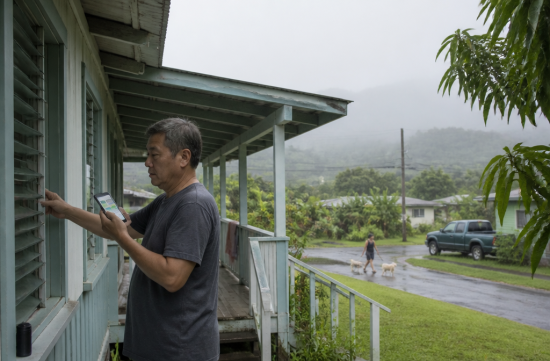
This morning, when I opened the window, the slopes of Mauna Kea were obscured by a haze. I thought it was fog, but my throat felt scratchy and my eyes were stinging. It was a day filled with vog, or volcanic smog.
There's a reason why such days have become more frequent lately. The eruption at the summit of Kilauea began on December 23, 2024, and has been intermittent ever since.
According to the USGS, the 55th lava fountain episode began at 3:19 AM on October 17. The maximum height reportedly exceeded 700 feet (220 meters). Just looking at the numbers, it's not something to take lightly.
First, let's clarify what vog actually is. According to the USGS, it is a hazy mixture of sulfur dioxide (SO2) gas and fine particles.
When SO2 emitted from a volcano undergoes chemical reactions in the atmosphere, it transforms into sulfate aerosols, or fine particles at the PM2.5 level. Therefore, we need to consider both the gas and the particles separately.
So why is the eastern side more problematic during winter? The key variable is the wind.
From May to September, the northeast trade winds blow 80-95% of the time. During this period, vog is pushed around the southern part of the island toward the Kona coast.
The problem arises when the trade winds weaken or cease. Such days are most common in winter, and when the Kona winds from the south blow, emissions can drift northward to neighborhoods like Volcano, Mountain View, and Hilo.
We are currently at the beginning of that season. After learning this pattern, I now check the wind direction before the temperature on my weather app.
The second thing to look at is real-time data. It's better to rely on numbers than just intuition.
There is the Hawaii Interagency Vog Information Dashboard, operated by the state government and relevant agencies. It consolidates vog and wind forecasts, health impacts, and response guidelines all in one place.
SO2 levels can be checked at hiso2index.info, and PM2.5 levels can be found on AirNow. The state Department of Health (DOH) also provides near real-time data on SO2 and particulate matter measurement networks.
One point that the DOH emphasizes repeatedly is that harmful air can appear very locally enough to affect health. Just because the readings in a neighboring area are fine doesn't mean our home is safe.
Now, onto practical advice. The DOH recommendations for days when levels rise are surprisingly simple.
Reduce outdoor activities and stay indoors. Close windows and doors, and set the air conditioner to recirculate mode instead of drawing in outside air.
If you use an air purifier, it should be one that reduces both PM2.5 and SO2. Many products only filter particles, so make sure the gas removal feature is specified in the product details.
There's a lot of talk about masks, but there's a significant misunderstanding here. The DOH has stated that common masks like surgical masks or bandanas do not provide effective protection against PM2.5 or SO2.
N95 masks can help with particles to some extent. However, according to state toxicologists, a more advanced respirator is needed to block SO2.
It's also important to remember that N95 masks may not fit children well. Those with respiratory issues might find it even harder to breathe due to the mask's resistance.
Therefore, I don't see masks as a catch-all solution. Managing indoor air quality is a much more reliable investment.
There are also lifestyle changes to consider. The DOH advises against smoking and exposure to secondhand smoke. Staying well-hydrated is also included.
For those with asthma, COPD, or heart conditions, it's recommended to keep their medications within reach. The same goes for contacting healthcare providers immediately if symptoms arise.
Choosing the right medications or equipment should be based on individual conditions, so consulting with a doctor or pharmacist is advisable. This is not a decision to be made based solely on online reviews.
If the air quality remains poor, temporarily relocating to a better area is also an option suggested by the DOH. Spending a few days in another neighborhood is not an excessive reaction.
When eruptions are accompanied by tephra or volcanic ash, care should also be taken with cleaning methods. It's advised to avoid sweeping or using blowers that can stir ash back into the air.
One last point: it's best to have an emergency plan in place ahead of time. Following the guidance of county and state emergency management authorities is fundamental.
In summary, it comes down to this: check the wind direction first, verify the dashboard numbers, and manage indoor air quality.
It's not a matter of waiting for the government to handle everything. The data is already available, and it's up to each individual to read it and take action.
If I were you, I would prepare an air purifier that filters out SO2 before this winter arrives. That's a much better investment than buying a few boxes of masks.
 SurviveToday
 LuckyStone77

 United States Army |

 premium |
 The Emperor Must Grow |

 squidogame |

 daddyyo |

 MeeSoo |

 Hawaii Maui Kahului |
 Hilo Cat |

 Puddle Puddle |

 HAWAII Korean Church News |

 clarion |
 almondo |
 monkey |
 umbrellafruit |
 Porynix |
 San Gabriel Mountains |
 creamcat |
 victoria jung |
 Peter Pan Pet |
 Archaic Kim |
 Washington Denzel DJ |
 Fong Mr |
 vanillastorm |
 espressotop |
 raviont |
 Illinois alpaca |
 Purple Moons, |
 Ted 600 |
 jaxter |
 garlic bread |