
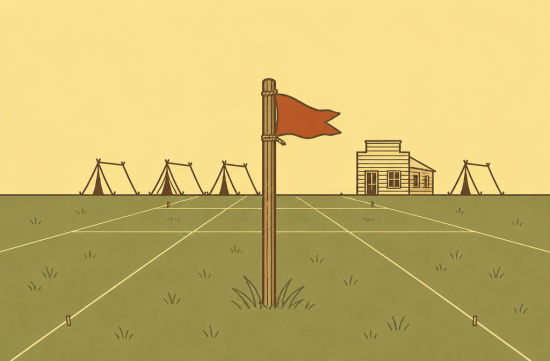
In the morning it was a grassy field, but by sunset it had become a city of 10,000 people. At first, it sounds exaggerated, but this actually happened on April 22, 1889.
Standing in front of the Land Run memorial sculpture next to the Bricktown canal brings this story back to mind. It features a statue of horses and wagons bursting forth all at once, and every time I see it, I wonder where that sense of speed comes from.
So this time, instead of just appreciating it, I decided to lay out the facts. When you look at the numbers, this event seems even stranger.
The stage was the Unassigned Lands, land that had not been allocated to any tribe. It was located right in the middle of present-day Oklahoma, covering over 2 million acres.
However, this land was not originally empty. It was land that the federal government had acquired from the Creek and Seminole tribes through a treaty in 1866 after the Civil War.
This part is not well represented in the memorial statue. I believe that discussing the Land Run solely in terms of pioneering spirit without this context is only telling half the story.
Starting in the late 1870s, people known as Boomers pressured to open this land. They repeatedly entered secretly to establish settlements, only to be chased away by the military.
Eventually, President Benjamin Harrison issued a proclamation on March 23, 1889. It stated that the land would open at noon on April 22.
It's surprising that the preparation period was less than a month. Nowadays, you wouldn't even finish an environmental review in that time.
The proclamation also included conditions. Anyone who entered the land before the designated time would lose their rights.
Despite this, some people snuck in early, and they were called Sooners. Ironically, the nickname for those who broke the rules has now become the name of the state and the university football team.
At noon on April 22, a gunshot rang out, signaling the start. The Oklahoma Historical Society estimates that 50,000 participants took part that day.
By sunset that day, over 10,000 people had settled in Oklahoma City and Guthrie. The U.S. Census Bureau also reports the same figures.
What I find most interesting is what happened next. A city was born, but there were no laws.
The federal government had allowed people in but had not prepared an administrative system. So the residents formed a temporary government to cope.
At the center of this was the Seminole Town and Improvement Company. This company was established on April 19, just three days before the Land Run, in Topeka, Kansas.
This means there was already an organization in place to design the city before the starting gun went off. Behind what appeared to be a pure race, there were quite calculated movements.
Competing companies also conducted their own surveys, and the results did not match. It was reported that the discrepancies became apparent when the surveying teams reached Main Street.
Ultimately, a compromise was accepted at a residents' meeting on April 27. However, disputes over lot jumping, where people claimed others' land, continued for a long time in court.
The formal law came into effect on May 2, 1890, when the Organic Act was passed. Oklahoma Territory was established, and until local laws were created, Nebraska laws were borrowed.
Oklahoma City officially became a city on July 15, 1890. It took over a year after the city was formed for it to be legally recognized as a city.
For reference, most of the original records from the 1890 federal census were lost in a fire, but population counts by city remain.
There's one more number. According to the 1890 census, the population of Oklahoma City was 4,151.
A place that had over 10,000 people on the first day had less than half that number a year later. This suggests that many either failed to secure city lots, moved to surrounding farmland, or left altogether.
I believe this number represents the true face of the Land Run. The phrase "a city born in a day" sounds glamorous, but behind it were many who could not hold their ground.
Still, the city endured, and by 1900, the population had risen again to 10,037. After statehood in 1907, it even took the capital from Guthrie in 1910.
These days, when I see news about new city developments, this story seems to overlap. The approach of gathering people first and adjusting the systems later is fast but leaves costs behind.
That said, I don't intend to diminish that speed and energy. However, I believe that when commemorating, it's important to remember the original landowners and those who left as well.
The next time you visit Bricktown, take a moment to look at that statue slowly. If you think about what was behind those horses racing forward, the same sculpture will look quite different.
 NightWriter


 Glow Yo |

 Michigan Enthusiast |
 xylora |
 Tan Zoo |

 hot chocolate |

 Trustworthy Faces |

 cozywarm |

 US Regional Information Blog |
 Chimhanbang Korea ACU |

 hazelnut |

 Korea Forever |
 wavey |
 Valley Bang |
 Enjoying Samba at Home |
 Goroke Geureoke News |
 clarion |
 almondo |
 monkey |
 umbrellafruit |
 Porynix |
 San Gabriel Mountains |
 creamcat |
 victoria jung |
 Peter Pan Pet |
 Archaic Kim |
 Washington Denzel DJ |
 Fong Mr |
 vanillastorm |
 espressotop |
 raviont |