
Last week, someone I know complained that their cough hasn't gone away for three weeks. They've taken cold medicine and even received antibiotics from the doctor, but they feel even more tired.
The first thing I asked was just one question. Have you had a Valley fever test?
The answer was predictably, "What's that?" Even though they've lived in Tucson for a long time, it made me realize that many people are unaware of it.
The official name for Valley fever is coccidioidomycosis. Locally, it's often shortened to cocci.
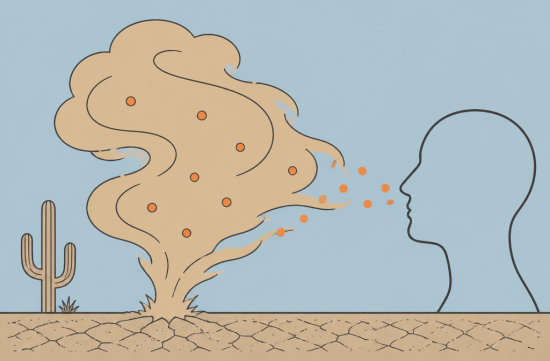
The cause is neither a virus nor bacteria, but a fungus that lives in the soil. When desert soil is disturbed by wind, construction, or gardening, spores become airborne, and inhaling them can lead to infection.
Fortunately, it's not a disease that spreads from person to person. You can't catch it just by being near someone who is coughing; the dust from the soil is the culprit. There's no need to wear a mask or eat separately just because a family member is infected.
The problem is that the symptoms are very common. According to CDC data, symptoms like fatigue, cough, shortness of breath, headache, night sweats, muscle aches, and rash are common.
Symptoms usually appear between one to three weeks after exposure to the spores. So it's easy to dismiss it as a bad cold.
Many people experience little to no symptoms or have mild cases. Conversely, some may suffer severely like with pneumonia or feel unwell for weeks. It's the same fungus, but it affects people differently.
I was quite surprised when I first saw this number. The CDC estimates that in areas like Phoenix and Tucson, nearly 15% to 30% of community-acquired pneumonia cases are due to Valley fever.
That means one in four pneumonia patients is affected. However, because testing is not commonly done, the actual numbers may be underreported, according to the CDC.
What's even more concerning is the treatment process. The CDC believes that 60% to 80% of Valley fever patients receive at least one prescription for antibiotics before getting an accurate diagnosis.
Antibiotics do not work for fungal infections. So, while time and money are spent, the underlying cause remains unchanged. Honestly, I found this part quite frustrating.
According to the Arizona Department of Health Services (ADHS) report for 2024, there were 14,763 cases statewide that year. In Pima County alone, there were 1,596 cases.
Experts believe that this increase is also due to more testing and awareness. So, while it's not something to panic about, it's clear that our area is a representative hotspot.
The timing is important too. According to health authorities, the highest number of cases in Arizona typically occurs between late October and December.
That's right now. It's the season when people go hiking because the weather is nice, tidy up their yards, and prepare for winter guests.
So how do you confirm it? Just looking at the symptoms makes it difficult for doctors to distinguish, so a lab test is necessary.
The most common test is a blood test that looks for antibodies. However, it can yield a negative result early in the infection, so a retest may be needed.
It can take several days to get results, and culture tests take even longer. Therefore, being proactive and requesting a test from the start can save time.
Here are the checkpoints I've summarized. If a cough or fatigue lasts more than 2-3 weeks. If it doesn't improve with cold medicine or antibiotics.
If you experience night sweats or develop a red rash on your legs. If you've recently inhaled a lot of dust. If any of these apply, be sure to mention them during your appointment.
If you're worried about your English, you can memorize this one sentence: "Could this be Valley fever? Can I get tested?"
The CDC also advises that pneumonia patients who live in or have traveled to endemic areas consider getting tested for Valley fever. It's not strange at all for patients to bring it up first.
Remember that the incidence is higher in those over 60. If your parents have been coughing for a long time, it gives you another reason to check in. When you call to ask how they're doing, make sure to bring up their cough.
On dusty days, it's helpful to sprinkle a little water on the soil before doing yard work. On windy days, it's better to keep windows closed and stay indoors.
Many people are surprisingly unaware that dogs can also get it. If you have a dog that loves to dig and seems lethargic and coughs, ask your veterinarian about it.
I always worry that this information reaches immigrants or those with limited English skills later. Just knowing to request a test can make a big difference.
This article is for general information only and is not a diagnosis. If you have symptoms, be sure to consult a doctor or pharmacist.
If it were me, I wouldn't dismiss a persistent cough this season. Do you see Tucson desert dust a little differently now?
 TexasMan








 Top Beaches |

 Diana Blues |

 Dragon Lee |

 Churros Train Conductor |
 Tora Tora |
 Arizona Cowboy |


 Project Tomorrow |

 TOTO Together |

 AZ Road Master |
 Vasila's Newlywed Blog |
 merry merry |
 Hoorah Ooorah |
 Fragile Me |
 Rowland Mama |
 foxtree |
 bayaa |
 loveyom |
 Coastal city |
 Spaghetti Flying Religion |
 My Town My Way Blog |
 holy cow |
 endone |
 starline |
 Where is a really nice neighborhood? |
 Real Estate |
 Forest Gump |
 Real Estate Investment Korean American |
 Dollydori, Lover of Movies |