
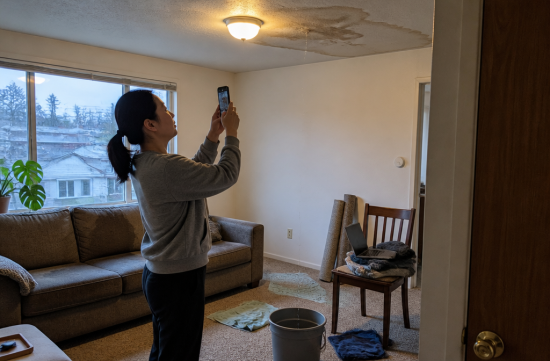
I once received a call about water pouring from the ceiling because the washing machine hose in the apartment above burst. It was a rental unit for a customer, and they reported that their mattress, laptop, and winter clothes were all soaked.
The first thing they asked was, "Is this covered by the landlord's insurance?" Unfortunately, the answer was no.
The landlord's insurance is meant to protect the building itself, meaning the structure like walls, floors, and roofs. It does not cover the tenant's furniture, electronics, or clothing.
That's why there is a separate product called renters insurance. The problem is that many people consider it just something "nice to have" and overlook it.
First, let's look at the costs. According to data updated by MoneyGeek in December 2025, the average cost in Tacoma for coverage of $50,000 in personal property and $100,000 in liability was $179 per year.
Divided by twelve, that comes out to less than $15 a month. The same data shows that the average for the entire state of Washington was $207 per year, and the national average was $242, making Tacoma relatively cheaper.
Of course, this is an average. Even within Tacoma, estimates can vary significantly based on zip code, building age, coverage limits, and deductibles.
In the same city, older buildings in high-cost areas and newer developments inland are assessed differently in terms of risk. Ultimately, getting a quote based on your specific address is the most accurate way to go.
So, what do you get for this money? The basic structure can be divided into three main parts.
The first is your belongings. If your furniture or electronics are damaged due to fire, theft, or plumbing leaks, you will be reimbursed within the coverage limits.
The second is liability coverage. If a friend slips and gets injured while visiting, or if water from your bathtub overflows and damages the ceiling of the apartment below, this part covers those costs.
In fact, I believe this liability coverage is more important. You can replace damaged belongings if you are careful, but the cost of damage caused to others can be unpredictable.
The third is additional living expenses if your home becomes uninhabitable. If you can't return home due to a fire or significant leak, it will cover hotel costs or temporary housing expenses up to a certain limit.
The customer I mentioned earlier had to be out of their home for over ten days during repairs. Without insurance, they had to pay for that lodging and dining out, and when you add the cost of replacing soaked furniture, it exceeded a month's rent.
However, just signing up doesn't mean everything is covered. There are definitely exclusions in standard renters insurance.
Earthquake damage is generally not covered. If you live in the Puget Sound area, it's worth looking into a separate endorsement for this.
Damage from natural flooding is also excluded from standard insurance. You need to obtain separate flood insurance for renters through the National Flood Insurance Program (NFIP).
Backflow from sewers is often not covered either. If you live in a basement or semi-basement unit, seriously consider adding this as an endorsement.
Speaking of flooding, there's one more thing. The SB 6237 bill passed by the Washington State Legislature this year requires landlords to inform tenants about flood risk areas.
This law is set to apply to rental agreements signed after December 31, 2026. However, it's best to check the final implementation and details directly on the state legislature's website.
The question of legal obligation often comes up. There is no state law in Washington that mandates renters insurance for tenants.
However, it's common for landlords to include insurance requirements in the lease agreement. In the contracts I've reviewed, there were often clauses requiring proof of insurance before moving in.
If it's written in the contract and you don't get insurance, it could be considered a breach of contract. So, be sure to read for such clauses before signing.
Another thing to consider when signing up is the reimbursement method. The Actual Cash Value (ACV) method pays out after depreciation, while the Replacement Cost Value (RCV) method pays based on the cost of new items.
When you think about a sofa you've used for five years, the difference becomes quite clear. Even if the premium is a bit higher, I would choose the replacement cost method.
Don't set the coverage limit too loosely. When you think about your furniture, clothing, kitchen items, and electronics, the total can be surprisingly high, and many people are shocked by the amount.
Make sure to compare quotes from two or three places. Even with the same conditions, the price differences between companies can be significant.
Many companies offer discounts if you bundle with your auto insurance. If you already have car insurance, asking that company first is usually the quickest way to go.
After signing up, take a moment to photograph all your belongings with your phone. Proving what you had in case of an accident can be more difficult than you think.
For the price of a few cups of coffee a month, you can cover thousands of dollars in risk. From my perspective watching the rental market for a long time, I believe this is one of the few fixed costs you shouldn't skimp on.
 LatteDreamer






 moo moo |

 ultron78 |

 garlic bread |

 Sugar Cream Door Bulletproof Noodles |

 urbanmint |

 explorer |

 phoenixia |

 endone |

 Mazinger Z Rocket Punch |
 Coastal city |
 Spaghetti Flying Religion |
 My Town My Way Blog |
 holy cow |
 starline |
 Where is a really nice neighborhood? |
 Real Estate |
 Forest Gump |
 Real Estate Investment Korean American |
 Dollydori, Lover of Movies |
 dmzline |
 travelo |
 American Food Information & Calories |
 Splendid Mission |
 sparklingo |
 Watch Walker |
 Soy Angelino |
 autumn |
 K-POP TV News |