
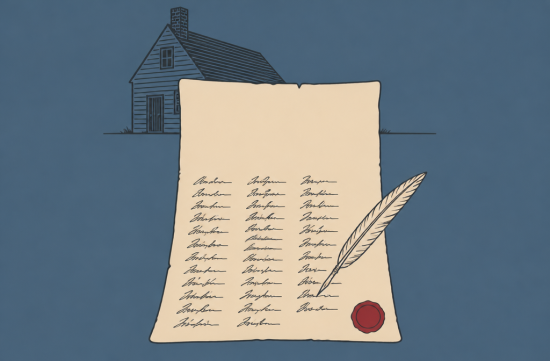
When you come out of Main Street station and walk just a few blocks, you'll find a street called Bowne Street. In the middle of that neighborhood, lined with bubble tea shops, Korean bakeries, and Chinese markets, stands a small wooden house.
The first time I passed by, I thought it was just an old house. But it turns out this house is one of the starting points of the story of religious freedom in America.
The story goes back to 1657. At that time, this neighborhood was not called Flushing but rather by its Dutch name, Vlissingen, and was part of the New Netherland colony.
The colonial governor was Peter Stuyvesant. He strongly suppressed worship outside of the Dutch Reformed Church and particularly viewed Quakers as a thorn in his side.
That year, a Quaker missionary named Robert Hodgson, who had come over from England, was arrested. The accounts vary slightly, but it is said that he was tried in Dutch, a language he did not understand, and received harsh punishment.
Stuyvesant did not stop there. He created laws that fined anyone who sheltered Quakers and incentivized townspeople to report on each other.
Honestly, reading this part gave me chills. Beyond the religious issue, the very structure that makes neighbors suspicious of each other is frightening.
Then, on December 27, 1657, the residents of Flushing gathered at the home of town clerk Edward Hart to sign a petition to the governor. This is known as the Flushing Remonstrance.
The number of signers is recorded as either 30 or 31, depending on the source. There are conflicting records about who drafted it, with some attributing it to Hart and others to Sheriff Tobias Feake.
What surprised me the most is that most of the signers were not Quakers.
Even though their own faith was not under attack, they stepped forward to protect the faith of others. In today's terms, they were true allies.
The content of the petition is quite bold. It includes statements asserting that love, peace, and freedom should extend to Jews, Turks, and Egyptians.
This means they believed that not only other sects within Christianity but even people of entirely different religions should be embraced. Considering it came from a 17th-century colonial rural town, it was truly progressive thinking.
The residents relied on a town charter they received in 1645, which guaranteed freedom of conscience, and the petition demanded that this promise be upheld.
The outcome was not a happy ending. Stuyvesant arrested those who delivered the petition and replaced the town officials.
However, the story continues a few years later. In 1662, John Bowne, the owner of that wooden house, was arrested for holding a Quaker meeting in his home.
Bowne did not pay the fine and did not admit wrongdoing. Ultimately, Stuyvesant exiled him to the Netherlands.
Here comes the twist. In 1663, upon arriving in Amsterdam, Bowne directly appealed to the Dutch West India Company, which governed the colony.
The company ultimately sided with Bowne and instructed Stuyvesant to cease religious persecution. Many believe that the reasoning was not purely based on a sense of human rights but also on the calculation that people needed to sustain the colony.
I actually appreciated that aspect. Tolerance does not only arise from grand philosophies but also from the reality that a society must function with diverse people living together.
Thus, the Flushing Remonstrance is often cited as a pioneering document that foreshadowed the First Amendment's religious freedom clause in the United States. It's more accurate to view it as a spiritual root rather than a direct legal connection.
The fate of the original document is dramatic as well. It was scorched in a fire at the New York State Capitol on March 29, 1911, and traces of that damage remain today.
The original is currently housed at the New York State Archives in Albany. Due to its fragility, it is rarely displayed.
However, if you visit Flushing, you can walk on the very ground where it stood. The Bowne House is believed to have been built around 1661, and its address is 37-01 Bowne Street.
This house has been used as a museum since 1947. Be sure to check the official website for operating hours and tour schedules before your visit.
If I were to visit, I would probably do it like this: have lunch on Main Street, see the Bowne House, and then take a leisurely walk to the nearby Quaker meeting house.
Today, Flushing is a neighborhood where you can hear Korean, Chinese, and Spanish all within a block. Knowing that there were people who signed to protect the faith of others here over 360 years ago makes me see the same streets a bit differently.
Living as an immigrant, there are moments when I feel like a minority. During those times, I wonder what it would have been like if no one had spoken up for me.
So the question this remonstrance leaves me with is simple: Even when it's not something I'm directly experiencing, can I still put my name on the line?
 Redwolf








 Noodle Noodle |

 Twist Kim |

 U.S. Weather Bureau News |

 Community Cross |

 Conflite Teacher |

 TwinBee |
 Vasila's Newlywed Blog |
 Mist inn |
 Living in the Eastern United States |

 American County Blog |
 ansdal |
 Vivid U.S. Regional Information |
 Arizona Cowboy |
 merry merry |
 Fragile Me |
 Rowland Mama |
 foxtree |
 bayaa |
 loveyom |
 Coastal city |
 Spaghetti Flying Religion |
 My Town My Way Blog |
 holy cow |
 endone |
 starline |
 Where is a really nice neighborhood? |
 Real Estate |
 Forest Gump |