
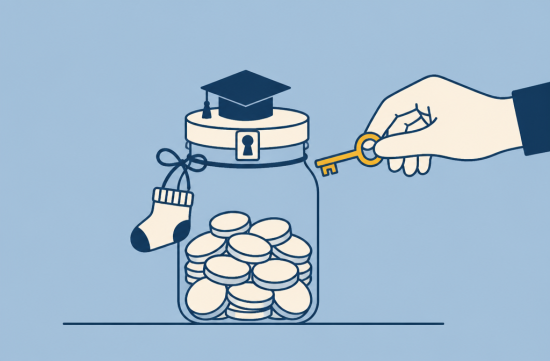
There is already money in your child's name, and if you miss it, you could really lose out.
Recently, while visiting a friend's house, the topic of CalKIDS came up. She mentioned that her second child was over a year old, and it was the first time she heard about having an account.
We looked it up together, and sure enough, there was money set aside for her child. When I got home that day, I also started to carefully gather official information.
CalKIDS is a college savings program run by the state of California in your child's name. It is part of the ScholarShare 529 program, managed by the ScholarShare Investment Board.
The key point is that the state creates an account without parents needing to apply separately. However, parents must register to confirm the account as theirs.
First, let's look at newborns. Eligible children born in California on or after July 1, 2023, will automatically receive $100 in their account.
Children born between July 1, 2022, and June 30, 2023, initially received $25. The amount varies based on the birth date, so check where your child falls.
But that's not all. If parents register the account online on the CalKIDS website, an additional $25 will be added.
Furthermore, if you open a new ScholarShare 529 account or link an existing account to CalKIDS, you will receive an additional $50.
So, for a child born after July 2023, the total can reach up to $175 when combining $100, $25, and $50. While it's not a huge amount, it's worth claiming with just a few clicks. Plus, this money can grow as a seed until your child is older.
Be aware of the registration timing. Newborn accounts can only be registered about 90 days after birth.
The requirements are surprisingly simple. You need the county where the child was born, their date of birth, and the 13-digit Local Registration Number from the birth certificate.
If you don't have the birth certificate right away, you can use the unique code from the CalKIDS informational mail that was sent to your home. If you mistakenly threw away that letter thinking it was junk mail, you can still use the birth certificate number.
When registering, you'll create an ID and password, which can be done as a parent or guardian. The registration itself is free, and there are no conditions to deposit your own money.
Families with school-aged children shouldn't overlook this either. Eligible low-income students in public school grades 1 through 12 automatically receive $500.
If confirmed as a foster child, an additional $500 will be added. If confirmed as a homeless student, another $500 will be added.
This means a single student can receive up to $1,500. The state determines eligible students based on school data.
To register a student account, you'll need the SSID, a 10-digit unique student number. It's on the report card, so if you can't find it, you can ask the school office.
So when and where can this money be used? It can be used for qualified educational expenses when your child later attends college or vocational training.
The funds are typically paid directly to the school your child attends. So remember, this is not money that parents can use for living expenses right now. Instead, it will grow through investments until your child is older.
The numbers are quite surprising. According to a press release from the governor's office this April, there are over 5.6 million accounts created, but only a little over 880,000 accounts are registered.
This means there are many accounts that have not been claimed by their owners. Our Korean families may be more likely to overlook the English informational mail.
There's one more benefit to registering. You can check your child's account balance online, giving you a starting point for planning their education savings.
If you're considering connecting to a 529 plan, check the account opening requirements and investment options on the official ScholarShare 529 website before making a decision.
Here's the order I recommend: Retrieve the birth certificate. Register on the CalKIDS site.
If you have the time, connect to the 529.
If you have a student at home, find the SSID on the report card and register on the same site. If you have multiple siblings, each child has their own account, so you need to check each one separately.
If it were me, I would do it right away tonight. It's a shame to put off something that can be done in ten minutes and then forget about it.
If you have friends with newborns, please share this article with them. I learned about this thanks to my friend, and I wanted to pass this information along to others.
In the next article, I will summarize some basic concepts to know when opening a 529 account. Stay tuned.
 SuperBoss






 Round and Round Children's Song Kingdom |

 new sugar |

 Way to easy |

 Magic Cabbage School of Martial Arts |

 Vacation on Hawaii |

 Community Cross |

 American History This and That |
 Finding Superfoods |

 Rowland Mama |
 Fragile Me |
 foxtree |
 bayaa |
 loveyom |
 Coastal city |
 Spaghetti Flying Religion |
 My Town My Way Blog |
 holy cow |
 endone |
 starline |
 Where is a really nice neighborhood? |
 Real Estate |
 Forest Gump |
 Real Estate Investment Korean American |
 Dollydori, Lover of Movies |
 dmzline |
 travelo |
 American Food Information & Calories |
 Splendid Mission |