
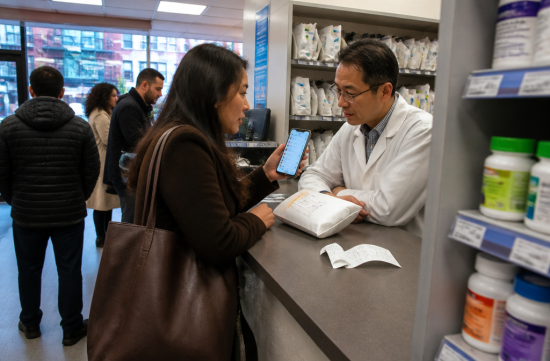
The other day, I went to my local pharmacy to pick up a prescription, and even with insurance, the copay was surprisingly high. I was about to pay when I decided to check prices at other pharmacies on my phone. The same generic medication was less than half the price at the pharmacy across the street.
Honestly, I felt a bit deflated. I'm someone who saves a few dollars on coffee by going to a local café instead of Starbucks, yet I had never compared medication prices before.
So, I did some research this time. I looked into why the same medication costs differently at various pharmacies and how to actually pay less.
First off, this isn't just something I'm experiencing alone. Consumer Reports conducted a survey in 2015, calling over 200 pharmacies to ask about the prices of five different generic medications.
In that survey, a month's supply of generic Lipitor was $17 at Costco, while it could go up to $150 at CVS. Same ingredients, same dosage, but nearly a nine-fold difference.
You might think this is an old survey, but subsequent studies showed similar trends. A 2019 study published in the Annals of Internal Medicine analyzed GoodRx price data from 16,325 zip codes.
The conclusion was that generic medications were most expensive at independent pharmacies and small chains, while large discount store pharmacies tended to be the cheapest. In contrast, the price differences for brand-name medications were much smaller across different types of pharmacies.
However, this study did not account for discounts like coupons or price matching. So, it's not safe to assume that local independent pharmacies are always more expensive. Some may match prices if you ask.
So, why do these differences exist? Each pharmacy has different agreements with insurance companies and the PBMs that manage drug pricing contracts, and they each set their own cash prices for uninsured customers.
This leads to a funny situation where the copay through insurance can actually be higher than the cash price without insurance. I learned this recently, and it turns out to be quite common.
In the past, there were contractual clauses that prevented pharmacists from disclosing this information, commonly referred to as gag clauses.
This was addressed at the federal level on October 10, 2018. The Patient Right to Know Drug Prices Act applies to general health insurance, while the Know the Lowest Price Act pertains to Medicare.
The important thing is that pharmacists can inform you of cheaper options, but they are not required to do so first. Ultimately, we need to ask.
New York has gone a step further. In 2019, the New York State Department of Financial Services (DFS) instructed insurers to ensure that copays do not exceed the retail price of medications, and it declared gag clauses illegal under New York state law.
Still, this doesn't automatically filter out all issues in practice, so asking at the checkout is the most reliable approach. I now ask, "How much is it if I pay cash without using insurance?"
From here on, I'll share the methods I've actually tried. The first is using price comparison apps. By entering the medication name, dosage, and quantity into apps like GoodRx, you can see discounted prices at nearby pharmacies.
The second is to try changing the quantity. Often, getting a 90-day supply instead of a 30-day supply can lower the price per pill. If it's a medication you take daily, definitely compare.
The third is to consider large store pharmacies. Pharmacies at places like Costco and Walmart tend to have lower cash prices for generics, so be sure to include them in your comparisons. Check with each store to see if their pharmacy is accessible to the public.
The fourth option is online pharmacies. Cost Plus Drugs, created by Mark Cuban, adds a 15% markup to the cost and charges separately for pharmacy fees and shipping.
The pricing structure is transparent, making it easy to compare. However, keep in mind that there's a wait time for shipping, so this method is better suited for long-term medications rather than those you need immediately.
And there's one important caveat to remember. Payments made with discount cards or cash typically do not count toward your insurance deductible or out-of-pocket maximum.
So, if you've had high medical expenses this year and are close to meeting your deductible, it might actually be better to pay through insurance. Cash prices aren't always the best option.
The same goes for Medicare beneficiaries. Medications purchased with cash outside of the plan usually don't count toward the plan's out-of-pocket calculations, so check with the plan when managing your parents' medication costs.
One more thing: if you use multiple pharmacies, your medications may not be monitored by a single pharmacist. There could be overlapping medications or combinations that shouldn't be taken together, so this is something to be very cautious about.
Always consult with your doctor or pharmacist before switching medications or pharmacies. Even if the ingredients are the same, differences in formulation or dosage can make price comparisons meaningless.
To summarize: check nearby prices with an app. Ask about cash prices at the checkout.
Compare prices for a 90-day supply. Consider your deductible situation.
After comparing this time, I found that my monthly medication costs have decreased significantly. It's much more effective than saving a few dollars on coffee.
If I were you, I'd search for at least one medication I take regularly using an app this week. It only takes five minutes, and you might feel a bit frustrated knowing how much more you've been paying.
 GrillStone100


 Top Beaches |

 Diana Blues |

 Dragon Lee |
 Churros Train Conductor |

 Tora Tora |

 vale vale |

 Exciting FM Radio |

 AAA |


 babybay |

 endone |
 starline |
 Where is a really nice neighborhood? |
 Real Estate |
 Forest Gump |
 Real Estate Investment Korean American |
 Dollydori, Lover of Movies |
 dmzline |
 travelo |
 American Food Information & Calories |
 Splendid Mission |
 sparklingo |
 Watch Walker |
 Soy Angelino |
 autumn |
 K-POP TV News |
 cortiva6 |
 Nevada Teppanyaki |
 aerion99 |
 Golado |