
Recently, while looking at a notice about heating costs posted on the apartment bulletin board, I thought I must have misread the numbers.
Upon checking, I found that households using natural gas for heating this winter are expected to pay an average of $931, which is $206 more than last year, a 28 percent increase, and I was truly shocked. This amount covers the heating costs from October to March, so even dividing it by six months, it's not a small sum.
They say wholesale prices have gone up, and the retail price of gas has jumped from $13.02 to $15.95 per thousand cubic feet, leaving consumers feeling unfairly burdened. Even if usage remains the same as last year, the bill amount automatically increases.
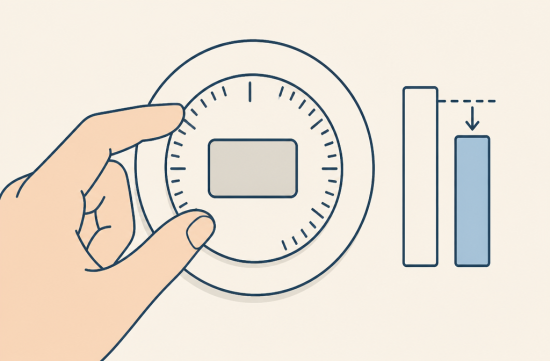
At this point, everyone starts fiddling with their thermostats, leading to the famous question: Does lowering the temperature by just 1 degree really reduce the bill, or does it just make us uncomfortable?
To get straight to the point, the U.S. Department of Energy has a calculation method. If you maintain a lower temperature for at least 8 hours a day, the official estimate suggests that you can reduce your total heating costs by about 1 percent for each degree lowered.
The key here is the condition of maintaining it for more than 8 hours; if you lower it briefly and then raise it back up quickly, this calculation does not apply. Ultimately, consistency is half the battle in saving money.
Simply lowering the temperature a bit before bed and then raising it right back up in the morning won't allow you to capture the full 1 percent savings.
When you convert this into numbers, it starts to make sense. Based on the average heating cost of $931, lowering the temperature by just 1 degree would save about $9 over the entire season.
If you lower it by 3 degrees, that's roughly $28, which may not seem like much, but it's enough to cover a few cups of coffee over the winter.
The Department of Energy goes a step further, suggesting that lowering the temperature by 7 to 10 degrees while sleeping or when you're out can save up to 10 percent annually.
This could mean savings of around $90, which is not insignificant. Setting the daytime temperature to around 68 degrees and significantly lowering it only at night or when you're out makes it quite manageable.
However, this percentage can vary depending on your location and climate.
In regions where winters are harsh, the heating system often runs continuously, so a 1-degree difference may yield a smaller percentage effect. Conversely, in milder winter areas, the percentage effect tends to be greater.
So, the 1 percent for each degree is just an average; there's no guarantee that your home's meter will reflect that exact number.
Still, the direction is clear, so I started a little experiment at home last week.
I subtly lowered the temperature by 1 degree and watched to see who would notice first, a somewhat timid challenge.
The result was that everyone went about their day in the same light clothing, and no one mentioned feeling cold.
At this point, I felt there was no need to make a fuss; I could keep it this way.
In addition to lowering the temperature, there are other things that can enhance the effect.
Blocking drafts from windows or door gaps can significantly change the perceived temperature, and simply adding an extra layer of thin clothing can help keep the indoor temperature 1 to 2 degrees lower.
Switching to thicker curtains and opening them during sunny days to let in sunlight can also make a noticeable difference in perceived warmth.
Using a humidifier can be surprisingly effective; even a slight increase in humidity can make you feel much warmer at the same temperature.
Closing the doors to unused rooms to reduce the heating area is also a pretty good method. However, completely turning off heating in rooms with pipes can risk freezing, so it's better to avoid that.
Using programmable or smart thermostats can automatically meet the 8-hour condition without you having to worry about it. Just set your sleeping and commuting times, and they will automatically lower and raise the temperature as needed, which is convenient.
Regularly changing the filters in your boiler or heater is also something to keep in mind. If the filters are clogged, no matter how much you lower the temperature, efficiency drops, and the savings you worked hard for can be offset.
If you're renting, it's worth noting that this savings will directly benefit your wallet, assuming you pay the utilities yourself.
If heating costs are included in your management fees, you may not feel the immediate impact, but a reduction in overall building usage will affect the increase in management fees next season.
In a year like this, where gas prices have jumped by 28 percent, this automation feels especially appreciated.
Honestly, when I first saw the numbers in the notice, I thought about just ignoring it, but after doing the math, my perspective changed a bit.
Seeing the amounts I could save by lowering the temperature by 1 degree, 3 degrees, and even 7 to 10 degrees overnight made it hard to find a reason not to do it.
After all, a difference of 1 or 2 degrees on the thermometer is something I can easily tolerate with a pair of thick socks.
If it were me, I would maintain the current temperature during the day, but definitely lower it before bed and add an extra blanket. There's no reason not to save that 1 percent while I'm asleep and won't even notice it.
 RubyNote


 Silent Sea |
 Pointy |
 Idaho's Sumi's House |
 holy cheese |
 Michigan Enthusiast |
 The Yellow |

 mygoddess blog |

 sweetvan |
 Living in America and Writing Essays |
  dorange |
  hiddenkong |
  some fame |
  Godory Life |
  Lime Juice |
  French fries |
  Rynex |
  Caribbean |
  Let's Be Like a Salt-like City Person |
  Belgray Miscellany |
  Augusta Univ |
  Round and Round Children's Song Kingdom |
  butter 90 |
  Lando Mao |
  Washington Denzel DJ |
  LIZ Legal Information Blog |
  vegas mom |
  Sandiego Auntie |
  Premium Gas Camp |