
When a thirty-minute meeting invitation suddenly appears on your calendar and both your manager and HR are present, it's a sign that something is off. If you hear the words that your position has been eliminated before you've even processed what's happening, it's completely normal to feel stunned.
However, if you let your emotions take over and make decisions on the spot, you may end up regretting it later.
So, on the day you receive a layoff notice, here's a checklist of things to take care of in order.
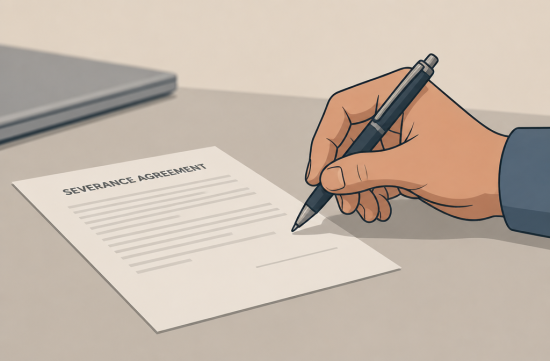
The first and most important thing to do is not to sign any documents right there.
Sometimes HR will present you with resignation papers and a severance agreement, suggesting that signing today will make things easier, but you should not fall for that.
If you are over 40 years old, federal law under the OWBPA guarantees you at least 21 days to review the severance agreement, and if it's a mass layoff, that period extends to 45 days.
Even after signing, you have the right to withdraw for seven days, and it's standard that the company does not pay severance until that period has passed.
While this clause is age-specific, signing immediately without consideration is detrimental to anyone.
Signing often means you forfeit your right to raise issues against the company, so it's perfectly fine to go home, read everything carefully, and make a decision later.
The second thing you shouldn't delay is applying for unemployment benefits.
Unemployment benefits take effect from the week you apply, so delaying even a day or two means money you won't receive.
Each state has different calculation formulas, leading to significant differences in the amount you receive weekly, and the payment period is usually capped at 26 weeks.
Unemployment benefits are available for those who are laid off due to company circumstances, so if it's a layoff, you are generally eligible to apply.
If you have the layoff notice or final employment verification from the company, it makes the application process much smoother, so keep those handy.
The third item to address is your health insurance, which you need to look into immediately upon receiving the notice.
The company or insurance department must send you a COBRA enrollment notice within 45 days of losing eligibility, and you have 60 days from receiving that notice to decide whether to continue coverage.
COBRA allows you to keep your existing insurance for up to 18 months, but you will have to pay the full premium without company support, which can be quite burdensome.
Therefore, it's advisable to compare COBRA with the ACA marketplace, as a special enrollment period opens for 60 days from the end of your employer-sponsored insurance, allowing you to switch plans.
Depending on your income level, you may qualify for premium tax credits, so it's worth calculating to see if the marketplace option is cheaper.
The fourth thing to check is whether the company followed the legal procedures required.
If a company with over 100 employees lays off more than 50 employees at a single location, they must provide written notice at least 60 days in advance under the federal WARN Act.
If this notification procedure was not followed, employees may have grounds to claim up to 60 days of pay and benefits.
Some states have their own WARN laws that are stricter than federal standards, so it's a good idea to look up and verify the notification periods and conditions.
Conversely, for individual terminations or small layoffs, it's important to know that there is no federal requirement for advance notice or severance pay, which can help avoid confusion. Severance is often determined by company policy or negotiation, and while some companies may offer a week's pay for each year of service, others may not offer anything at all.
The fifth thing to start on that day is organizing your documents and reviewing your finances.
Gather your final pay stub, any W-2s you've received, proof of employment, and information on how to handle your 401(k) account, as it can be difficult to get in touch with the company later.
Asking a manager or colleague for a recommendation or LinkedIn endorsement on the spot will make it much easier to obtain than waiting months to reach out.
Don't put off updating your resume and LinkedIn profile; it's better to do it within that week because the sooner you start your job search, the shorter your gap period will be.
Also, take this opportunity to review your living expenses and calculate how many months you can manage without income, which will help you make subsequent decisions with less urgency. Particularly, reviewing monthly subscriptions or unused memberships can significantly reduce your expenses for the next month.
Receiving a layoff notice is never pleasant, but if you follow these five steps in order, the following weeks will feel much less stressful.
Personally, I believe that if you can at least delay signing and apply for unemployment benefits on that day, the rest will naturally follow in a few days.
 TicDoctor





 coloradoman |
 pintos |
 mapsina |
 Mr. Largo |
 Victory 1988 |
 winter |
 Wenda |

 marketbox |
 My Love Bambino Alaview |
  Casa Mia |
  Asparagus Blog |
  dorange |
  hiddenkong |
  some fame |
  Godory Life |
  Lime Juice |
  French fries |
  Rynex |
  Caribbean |
  Let's Be Like a Salt-like City Person |
  Belgray Miscellany |
  sweetvan |
  Augusta Univ |
  Round and Round Children's Song Kingdom |
  butter 90 |
  Lando Mao |
  Washington Denzel DJ |
  LIZ Legal Information Blog |
  vegas mom |