

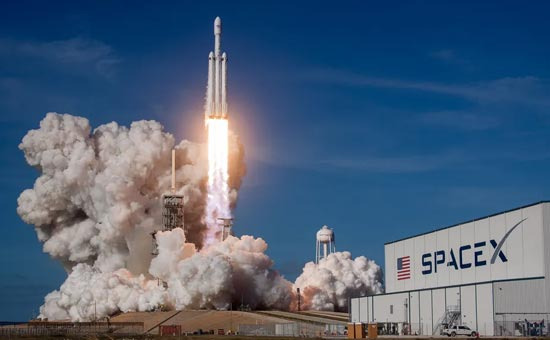
These days, news reports suggest that SpaceX's IPO could value the company at up to $2 trillion.
Do you have any idea how much $2 trillion is?
If we convert $2 trillion to Korean won, assuming 1 dollar equals 1,500 won, it's roughly 3,000 trillion won.
To put that in perspective, South Korea's annual national budget is about 650 to 700 trillion won, which means this valuation is equivalent to combining that budget 4 to 5 times.
It's also larger than South Korea's GDP (approximately 2,200 to 2,500 trillion won).
This means that the value of SpaceX alone is comparable to or greater than the entire South Korean economy.
However, is this just a bubble? Not necessarily. It feels more like a company that should have reached this level.
This is because SpaceX started the game differently from the beginning.
Most aerospace companies rely on government funding for research and move on to the next project when they fail.
But SpaceX has created a "money-making space" from the start.
A prime example is Starlink. This satellite internet business is not just a simple communication service.
It's an infrastructure that enables internet access from anywhere on Earth. This is not just a service; it's a "platform." It's already generating revenue and continues to expand.
Then there's Starship. This is on a whole different level. It aims to create a system that travels between "Earth-space-planets."
They are continuously launching, exploding, and rebuilding. This is the biggest difference from other companies.
Typically, when a company fails, it stops. SpaceX, however, moves faster to try again after a failure. This difference ultimately creates the gap.
The IPO discussion is also interesting. There are projections that they could raise up to $75 billion this time.
This would be the largest amount in history. With that money, they plan to create things like space-based AI data centers, lunar bases, and space factories. At this point, it feels more like a "national project" than a company.
From a cynical perspective, it seems that companies are doing what the U.S. government should be doing right now.
Companies are generating revenue and developing technology. That's why their valuation is rising to a national level.
So what about South Korea? With such high risks, it's hard to do. If you fail, it's over.
In this structure, it's difficult for a company like SpaceX to emerge in South Korea.
It's not a matter of technology. In a structure that doesn't allow for failure, such projects won't even get started.
Do South Koreans lack technology? No. Do they lack money? No.
The problem lies in the direction.
SpaceX has bet from the beginning that "if this succeeds, the world will change."
In South Korea, the starting point is "who will take responsibility if this fails?"
This difference creates the $2 trillion valuation.
Of course, SpaceX is not a completed company yet. Starship is still in the experimental stage, and some plans may be exaggerated.
But the important thing is execution. They are actually pushing forward continuously.
Ultimately, the reason this company is remarkable is that it has turned space exploration into a business.
This is not an easy task, which is why the valuation is reaching $2 trillion. It's a premium for having seized the future.
That's why I think SpaceX is an incredible company.
However, it's a bit frustrating that discussions about SpaceX often boil down to Elon Musk's achievements.
While he is indeed the founder and has set the direction, the actual work of building and launching rockets is done by thousands of engineers and employees.
The structure where the entire company's achievements are attributed to one person's brand feels uncomfortable and unsettling.
Ultimately, the core is technology and execution, but it seems that this is often overshadowed by the narrative of Musk being great.







 novapixel |
 NEXT ROUND |
 Encyclopedia of New York and Surrounding Areas |
 washington mom |
 California Dreamer |
 Alpha and Omega World |
 Yellow Snowman |

 holy cheese |
  newyorker 101 |
  coffeee |
  |
|  Christopher |
  sylven |
  Sammy Beach |
  Bliss O |
  blue ocean |
  greenlight |
  Watanaka Karametibaksa |
  castle |
  xelton52 |
  carefree |
  vrixen73 |
  AZ Road Master |
  Victory 1988 |
  summita |
  business lim |
  Colorado Lee |
  Make My Day |