

Living in the U.S., you might come across laws that make you think, "Is this really a thing?" One of those is Eminent Domain.
In Korean, it translates to the government's land expropriation rights, which means that the government can forcefully purchase privately owned homes or land for public projects.
The U.S. is known for valuing individual property rights highly.
It seems un-American at first glance that if I bought a house, I would have to give it up if the government says it needs it.
However, the government cannot just take any land it likes without reason.
Eminent Domain is based on the Fifth Amendment of the U.S. Constitution.
There must be a public purpose, such as widening roads, building railroads, or constructing schools and public facilities.
There is also an important condition: the government must provide just compensation to the homeowner.
The issue arises because the government's valuation of a home may differ from the homeowner's perspective.
For example, the government might appraise a home at $1.2 million, while the homeowner believes it is worth $1.5 million due to potential future developments.
Moreover, if the homeowner has lived in the house for 20 years, there are aspects that cannot be measured simply in monetary terms.
Thus, in actual Eminent Domain disputes, the argument often revolves around "the compensation offered by the government is too low" rather than "I will never give up my home."
People will question whether the appraisal was appropriate and if the land's value was accurately reflected.
A famous case that always comes up when discussing Eminent Domain in the U.S. is the 2005 Kelo v. City of New London case.
The city of New London, Connecticut, attempted to seize privately owned properties for an economic development project, leading homeowner Suzette Kelo to file a lawsuit in protest.
The controversy was particularly significant because it was not simply about building a highway or a school. They were asking homeowners to sell their properties for a pharmaceutical company's site.
Ultimately, the Supreme Court ruled that local economic development could be considered a public purpose in a broad sense.
This ruling sparked considerable backlash across the U.S.
People questioned how taking my home for private development, rather than for building a road, could be considered a public purpose.
Following this, several states moved to strengthen laws limiting this type of land acquisition.
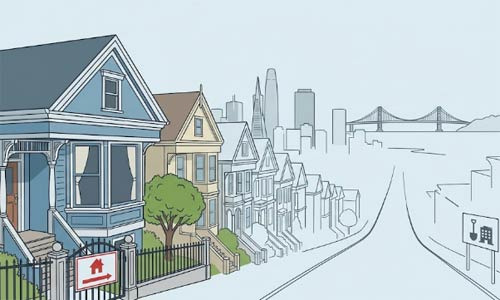
Living in San Francisco, it doesn't feel like such a distant issue.
It's a city with limited land, and there is a constant need for transportation infrastructure, roads, public housing, and various facilities.
Of course, it doesn't happen that a government official suddenly shows up and says, "You need to vacate your home by next week." There are legal procedures involving notifications, appraisals, and negotiations. Homeowners can contest the price offered by the government.
So, if you actually receive such a notice, it's important to be cautious about just signing because the government is offering money. In high real estate price areas like San Francisco, even a small difference in valuation can amount to hundreds of thousands of dollars.
The U.S. is a country that places great importance on protecting individual homes and properties. However, at the same time, in cases deemed necessary for the greater good of society, private land can be forcibly acquired.
There are instances where even though it's my home, I cannot do whatever I want with it.
It seems that the reason many people are surprised to learn about Eminent Domain, even after living in the U.S. for a long time, is precisely this.
 roadwalker
 StarryStory
 MakeMoney




 moo moo |
 ultron78 |
 garlic bread |
 Sugar Cream Door Bulletproof Noodles |
 urbanmint |
 Peter Pan Pet |
 Moscow Kim |

 Nuchuhan Exploration BLOG |
  productionblog |
  What can make money? |
  Oklahoma Hoya OK |
  prixon74 |
  Roman Pan |
  USALATU BLOG |
  Sunshine Blog |
  Minnesota Small Business |
  Strawberry Pancake Warrior |
  amolayo |
  korvon |
  Que Buena |
  virexo |
  silverpath |
  Komet Park |
  reliable |
  vexo90 |
  As Always Today |
  veltar87 |
  United States National Administrative Organization Stories |