
By mid-October, pumpkins start appearing in front of houses around the neighborhood. Seeing those pumpkins during my evening walks makes me feel a bit relaxed.
However, a few days ago, I ran into an elderly neighbor in front of my regular laundromat, and he mentioned that in the past, he couldn't sleep at this time of year because of the sirens all night long.
Hearing that brought back the name 'Devil's Night,' which is an old nickname for the night before Halloween in Detroit.
It wasn't always about arson from the start. It began with mischievous pranks like hanging toilet paper on trees and throwing eggs at other people's houses.
Records show that such Halloween pranks have existed since the 1930s. What started as harmless fun eventually escalated into real arson decades later.
The peak was in 1984. From October 29 to 31, a staggering 810 fires were reported.
This number remains in the report from the Centers for Disease Control and Prevention (CDC). I can't tell you how many times I looked at that number when I first read it.
People often say there were 800 fires in one night, but the truth is that this was the total over three days. Still, 810 fires in three days must have felt like hell for the firefighters.
Why this city, in particular? Many analyses suggest it was due to rising unemployment as the auto industry declined, leading to vacant homes in every neighborhood.
There were plenty of empty houses where no one would stop a fire from being set. The speed at which the city was emptying and the spread of the flames seemed to coincide strangely.
Of course, the city didn't just sit back. Starting in 1985, they increased fire and police patrols and launched response campaigns based on fire monitoring data.
In 1986, they even implemented a curfew for minors. Children were not allowed to roam outside freely around Halloween.
Whether it was effective or not, by the early 1990s, the number of fires had significantly decreased. Everyone must have thought it was finally over.
However, such stories often have a way of creeping back in. It's like falling back into the same dream just when you think you've woken up.
Then in 1994, fires surged again to 354 over three days. It was a wake-up call.
So, then-Mayor Dennis Archer introduced 'Angels' Night,' flipping the name to something more positive.
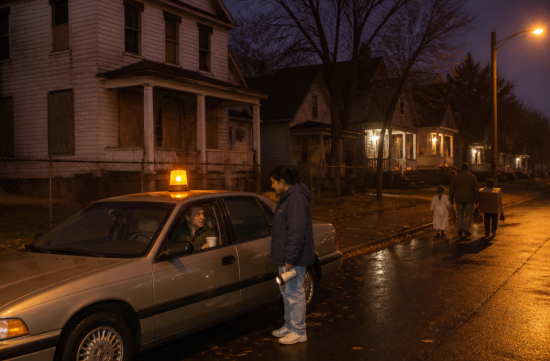
The key was the people. Residents took it upon themselves to patrol the neighborhood, watching over vacant homes and vehicles.
Records indicate that the person who first suggested this name was a resident involved in the vacant home cleanup movement. I like that it came from the community rather than the government.
Volunteers adorned their car roofs with orange lights and communicated with a command center via walkie-talkies or cell phones. A 1996 AP report stated that there were 26,000 volunteers.
Measures were also taken to prevent the sale of portable gas cans, along with strict curfews. As a result, the number of fires dropped to 158 in 1995.
From 354 to 158 is more than a halving. For me, the image of those orange lights lingers longer in my mind than the numbers.
It's a bit moving to imagine. On a cold October night, with breath visible in the air, neighbors must have been sipping coffee while parked in front of vacant homes with the radio playing softly.
Was the music coming from Motown or Detroit techno? I find myself smiling at such trivial scenes that pop into my head.
As time passed, the number of fires continued to decline. Every year after Halloween, the local newspaper would report how many incidents occurred, and those numbers began to feel less significant.
It's surprising to think that something becoming less significant could be such a welcome change. Ultimately, in 2017, Mayor Mike Duggan decided to retire the name Angels' Night.
Instead, the new name became 'Halloween in the D.' It transformed from a night of vigilance to a night of enjoyment.
Of course, the issue of vacant homes hasn't completely disappeared. Even now, as I walk through the neighborhood, I occasionally see houses with boarded-up windows.
However, it's clear that the way this city approaches that night has changed. It has shifted from a night of caution to a night where children go trick-or-treating.
I believe this story ultimately reflects the community. It was the people who stepped up to protect their neighborhood, rather than just increasing the number of police officers.
These days, our Korean neighbors also fill up candy baskets for the kids during Halloween. I think those small moments are perhaps built upon the memories of those nights.
This year, on the night before Halloween, I plan to take out my earbuds and listen to the sounds of the neighborhood. If I hear children's laughter instead of sirens, that will be enough for me.
It took over 30 years for Devil's Night to transition through Angels' Night to simply Halloween. Slowly, but surely, it seems this city has been changing, almost like a dream.
 LikeGalaxy




 Conflite Teacher |
 SEVEN SEVEN |
 Korean Mom |
 novapixel |
 Peter Pan Pet |
 tracker |
 juniper |
 oflare |
 amolayo |
  Sunshine Blog |
  Minnesota Small Business |
  Strawberry Pancake Warrior |
  korvon |
  Que Buena |
  virexo |
  silverpath |
  Komet Park |
  reliable |
  vexo90 |
  As Always Today |
  veltar87 |
  United States National Administrative Organization Stories |
  springwaltz |
  dense |
  Tiger Milk Foam Research Institute |
  Oreore Mushroom |
  optimistic |
  Good Good |