
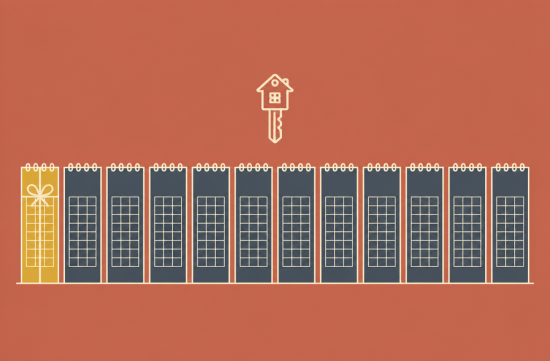
These days, when looking at new apartment listings in Burbank or Glendale, the phrase "first month free" appears quite frequently. It's natural for your eyes to be drawn to it, especially when moving costs can be significant. However, when you open the lease, you may find that the terms surrounding that free month are more complicated than expected.
First, let's touch on the market atmosphere. According to Zillow data, as of June 2026, 32.5% of LA rental listings are offering concessions. The national average was 39.8% this spring, so LA is slightly below that level.
At first glance, the numbers suggest it's a favorable time for tenants. However, keep in mind that the more appealing the benefits seem, the more conditions are likely attached.
The first question that comes to mind is probably, "So how much cheaper does it actually get?" To understand this, it's helpful to know the concept of net effective rent, or the actual monthly rent.
For example, let's say you have a monthly rent of $3,000 with a 13-month lease and one month free. The actual amount you pay is for 12 months, totaling $36,000, which averages out to about $2,769 per month when divided by 13.
What's important here is that the rent stated in the lease remains $3,000. The discount is simply noted as a credit, and the base amount itself hasn't been lowered.
So why does this difference matter? The answer comes into play when it's time to renew the lease a year later.
California's tenant protection law, AB 1482, caps annual rent increases at 5% plus the local inflation rate, with a maximum of 10%. As of August 1, 2026, the cap for the LA metro area is 8.7%.
However, Civil Code Section 1947.12 states that when calculating the base amount for increases, any discounts, incentives, concessions, or credits received by the tenant should be excluded. In simple terms, even if the first month is free and your actual burden is reduced, the increase will be calculated based on the full $3,000 rent.
The same provision requires that the base rent and concessions be clearly separated in the lease. So, make sure to check that these two lines are distinctly noted in your contract.
There's another easy-to-miss point here. AB 1482 does not apply to buildings that are less than 15 years old.
The issue is that significant concessions like a free first month often come from newly constructed rental properties. If you're dealing with such buildings, there may be no cap on increases when it comes time to renew.
Therefore, it's advisable to ask about the year the building was constructed during your tour. This one question can significantly change your scenario a year down the line.
The second thing to check in the lease is the concession recapture clause, often referred to as a recapture or clawback provision.
Many leases include a condition that if you do not complete the full lease term, you must repay the value of the free month. For those who may have job relocation possibilities, this clause can be a considerable burden.
The third point is when the free month is applied. You need to confirm whether it's deducted right away in the first month, or if it's applied in the last month or split throughout the lease.
If the free month is applied in the last month, you essentially lose the benefit if you terminate early. Even with the same "one month free" offer, having it applied in the first month is definitely more advantageous for tenants.
The fourth point is the lease duration. It's quite common for landlords to extend the lease term to 13 or 15 months while offering concessions.
Longer lease terms mean you're committed for a longer time. When calculating the net effective rent, make sure to divide by the actual number of months in the lease.
It's also good to check the deposit. Starting July 2024, California will generally limit security deposits to one month's rent.
The exception is for small landlords who own two or fewer rental properties, totaling four units or fewer, and even then, it's limited to two months' rent. If a large apartment complex is asking for more than one month's rent as a deposit, it's worth asking for justification.
Let's briefly look at regulations in the Burbank area. Starting in 2024, Burbank will implement its own tenant protection ordinance, requiring three months' relocation assistance for no-fault evictions.
The city council has been discussing a so-called soft cap that ties relocation assistance to rent increases exceeding 4% annually. However, the final implementation and specific conditions may change, so it's wise to check the current details on the city housing page before signing a lease.
In summary, here's the order of checks to make: Verify if the base rent and concessions are listed separately. Ask about the year of construction.
Check the recapture clause and when the free month is applied. Calculate the net effective rent based on the actual lease months.
Personally, I prefer a slight reduction in rent from the start over a free first month. A lower base amount means the increase after a year will also be smaller.
Simply asking the leasing office, "Can you lower the rent instead of offering concessions?" can open up negotiation possibilities. If the terms seem complicated, it's also a good idea to take the lease to a tenant advisory organization or expert for review before signing.
 TwoLaLa








 Sugar Cream Door Bulletproof Noodles |
 urbanmint |
 |
| 
 Premium Gas Camp |
 CA Real Estate |
 Yo Lock Me Up |
 California Information News |


 cherrydino |
  garlic bread |
  middlekick |
  Moscow Kim |
  nivex85 |
  quanta7 |
  Tomato Health Club blog |
  horse |
  Egg Steamed Pot |
  Helpful Life Stories |
  UNI Lover |
  zen zeng |
  oh my salami |
  wendra |
  coloradoman |
  business life |
  candytip |
  churrotop |
  swiftlane |
  allstar realty |