
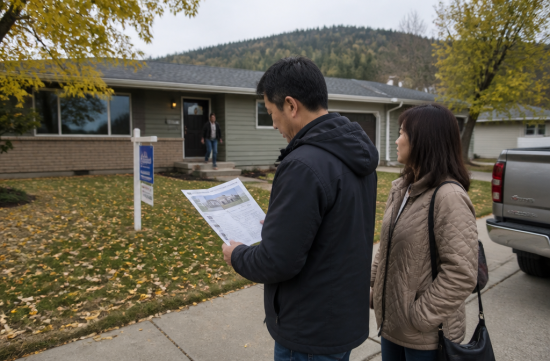
These days, the first question people ask when looking at homes is, "I heard the inventory is at its highest in 10 years, so it's a good time to buy, right?"
To put it simply, in terms of numbers for Rapid City, that statement is only partially true. Before making any moves based on just the headlines, it's wise to take a look at the actual statistics.
It is true that inventory has increased and there is more room for price negotiation. However, the phrase "the highest in 10 years" is not confirmed by the statistics for this area.
According to Realtor.com data from FRED, there were 724 active listings in the Rapid City metropolitan area in September.
But a year ago, in September 2025, there were 736 listings. This means there are actually slightly fewer than last year. The inventory steadily increased from 484 listings in February this year, but it has not set a new record.
Looking further back, the differences become clearer. In August 2016, there were 1,042 listings, and in July 2019, there were also 880 listings available.
So, a more accurate expression would be "the highest level since the pandemic." Considering it dropped to 98 listings in February 2021, it does feel like there has been a significant increase.
Nationwide, the trend is similar. According to the September report from Realtor.com, there were 1,161,615 active listings across the country, which is a 5.4% increase from a year ago.
However, the September figures from 2017 to 2019 were all higher than this. So, it would be more accurate to say it is "the highest since 2019" on a national level.
So, is it indeed more favorable for buyers? Here, you should consider two signals side by side.
The first is price. The median listing price in Rapid City for September was $417,450, down $21,675 from $439,125 a year ago.
This consistent decline from $449,900 in May over the past four months suggests it is not just a coincidence. Since the listing price is what sellers ask for, the actual sale price may go even lower depending on negotiation outcomes.
There has also been an increase in listings with reduced prices. In September, there were 280 price-reduced listings, which is more than the 228 from September last year.
Out of the total 724 listings, 280 have already been reduced in price, meaning nearly four out of ten listings have seen a price drop. I was a bit surprised by this number as well.
The speed of sales has also slowed down. The median days on the market in September was 64 days, longer than 59 days last year and 50 days in 2019. For sellers, this means they may have to show their homes for over two months, which can create urgency.
The second signal is interest rates. This is not good news for buyers. It is also an aspect that can be easily overlooked when just looking at home prices.
According to Freddie Mac, the average 30-year fixed mortgage rate was 7.40% as of October 8. A year ago, it was 6.30% during the same period.
After surpassing 7% at the end of September, rates have continued to rise, meaning that as home prices decrease, interest rates are taking back a significant portion of that decrease.
For example, even if you buy a house for $20,000 less, if interest rates rise by over 1 percentage point, your monthly principal and interest payments could actually increase.
Interestingly, there were 266 pending listings in Rapid City in September, which is more than the 234 from last year.
Nationally, pending listings have decreased by 4.1% compared to a year ago, indicating that there are still buyers interested in this area. This is why it is too early to call it a complete buyer's market.
So, my conclusion is this: while negotiating power has shifted to buyers, the cost of financing has become less favorable for them.
If you have a significant amount of cash or can make a substantial down payment, now may not be a bad time. It could be worth considering properties that have been on the market for a while and asking for price reductions and closing cost assistance.
On the other hand, if you rely heavily on loans, you should first calculate your monthly payments rather than just focusing on home prices. It's important to assess whether the total amount, including property taxes and homeowners insurance, is manageable compared to your current rent.
Another strategy could be to propose that sellers cover the cost of buying down the interest rate instead of just asking for a price reduction. The longer a property has been on the market, the more likely they are to accept such a proposal.
If I were to buy a house right now, I would focus on properties that have been on the market for over 60 days and prioritize negotiating terms over price.
And I would consider refinancing only as a bonus plan if interest rates go down. If I buy under the assumption that rates will drop, it could be difficult to hold on if my calculations go wrong.
Numbers can vary greatly depending on the neighborhood and type of home, and loan conditions differ for each person. Before making a final decision, I strongly recommend getting estimates based on your conditions from a local realtor and a loan officer.
There's no need to rush based on the claim of "the highest in 10 years." However, it is clear that a market has emerged where buyers can negotiate terms for the first time in several years.
 SilverTrail87







 moo moo |
 ultron78 |
 garlic bread |

 urbanmint |
 Dreams Come True as Desired |

 Dakota Man Blog Thanks |

 silverpath |
  Komet Park |
  reliable |
  vexo90 |
  As Always Today |
  veltar87 |
  United States National Administrative Organization Stories |
  springwaltz |
  dense |
  Tiger Milk Foam Research Institute |
  Oreore Mushroom |
  optimistic |
  Good Good |
  berion88 |
  bravo777 |
  skyblue |
  Project Tomorrow |
  apricotla |
  Soy Angelino |
  nati8 |