
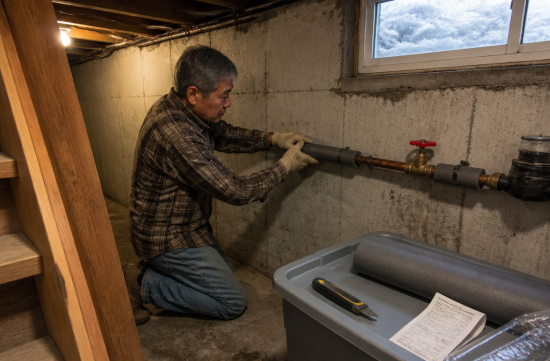
Those who have spent a few winters in Fargo know the feeling. When you turn on the faucet in the dead of winter and the water trickles out before stopping, it's a moment of panic.
That's a sign that the pipes are starting to freeze. If left unchecked, the ice will expand and burst the pipes, turning your home into a flooded mess when they thaw.
First, let's look at the numbers. According to a regional weather column summarizing the last 100 years, the average temperature on the coldest winter day in Fargo-Moorhead is around -27°F.
Converted to Celsius, that's nearly -33°C. So, saying it gets to -30°F is not an exaggeration.
The same data shows that it has dropped to -30°F 36 times in the last century. The official record for the coldest day was -48°F in January 1887.
For comparison, a study from the University of Illinois found that uninsulated attic pipes began to freeze at outdoor temperatures near 20°F.
This standard is originally meant for warmer southern regions. Remember that pipes on exterior walls can freeze at even higher temperatures due to drafts.
When I first looked into this market, people said frozen pipes were an issue for older homes. But that's not necessarily the case anymore.
Even new homes with pipes running through garages, exterior wall sinks, or basement crawl spaces are at risk. Ultimately, where the pipes are located is more important than the age of the house.
Now, let's go through the things to check in order. First is the location of the main valve inside the house.
If you're scrambling to find the valve after a pipe bursts, the damage will be much worse. Make sure everyone in the family knows where it is and practice turning it off.
Second is the outdoor faucet and garden hose. Remove the hose, turn off the indoor shut-off valve, and open the outdoor faucet to drain any remaining water.
If you have a sprinkler system, you need to drain it separately in the fall. Now, in mid-October, is the perfect time. If you wait until after the first hard freeze, it will be too late.
Third is insulating exposed pipes. Wrapping pipes in foam insulation in areas like basements, garages, and crawl spaces where heating is minimal will significantly reduce heat loss.
Fourth is the indoor temperature. Many people lower the temperature at night to save on heating costs, but the Red Cross recommends maintaining the same temperature day and night during extreme cold warnings.
Fifth is the cabinet doors under sinks. If your kitchen or bathroom is on an exterior wall, leave the doors open to allow warm air to reach the pipes.
If there are pipes running through the garage, make sure to keep the garage door closed. Even a brief moment of leaving it open can let in cold air quickly.
Sixth is letting water drip. If you leave the faucet connected to exterior pipes slightly open, just a trickle, it can help delay freezing by keeping the water moving.
When you compare two situations side by side, it becomes clearer: when someone is home versus when the house will be empty for a few days.
When you're home, following the above habits can usually prevent freezing. The problem arises when you travel to Korea or a warm state during the holidays.
The Red Cross advises not to turn off the heat and not to let the temperature drop below 55°F when leaving the house. Personally, I would also shut off the main valve and drain the pipes before leaving.
This is directly related to insurance. Standard homeowners insurance typically covers sudden pipe bursts, but there are often exclusions for homes that are vacant or where heating was not properly maintained.
In cases that have gone to court, the key issues were whether heating was maintained and whether the water was shut off and drained. So, be sure to read the freeze and vacancy clauses in your insurance policy before winter.
For renters, the situation is a bit different. The responsibility for heating and plumbing maintenance varies by lease agreement, making it hard to summarize.
Check your lease, and if you plan to be away, it's wise to inform your landlord or property management in advance. Also, check how far your renter's insurance covers damage to your belongings.
But what if the pipes do freeze? You can slowly thaw them by keeping the faucet open and using a hairdryer or electric heating tape, starting from the faucet end.
Never use a flame like a torch. If you're unsure where the freeze is or if water is already leaking, it's best to shut off the main valve and call a plumber.
If the meter or street-side pipes are frozen, some municipalities will handle it. The responsibility varies by area, so it's quickest to call your local water department to check.
The cost of repairing frozen pipes is not worth the hassle of taking a few hours to check the valve location and outdoor faucet. I recommend doing at least these two things this weekend.
 BrightTrail85








 moo moo |
 ultron78 |
 garlic bread |

 urbanmint |
 persiste |
 American National Singing Contest |
 buddydakota |
 North Dakota Ragdoll Cat Owner |
 silverpath |
  Komet Park |
  reliable |
  vexo90 |
  As Always Today |
  veltar87 |
  United States National Administrative Organization Stories |
  springwaltz |
  dense |
  Tiger Milk Foam Research Institute |
  Oreore Mushroom |
  optimistic |
  Good Good |
  berion88 |
  bravo777 |
  skyblue |
  Project Tomorrow |
  apricotla |
  Soy Angelino |
  nati8 |