
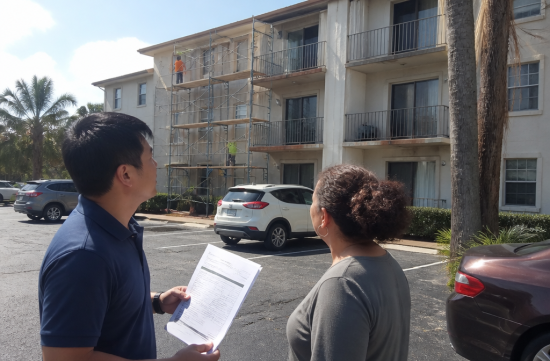
Many people looking for condos in Orlando often choose candidates based solely on price. During consultations, I frequently hear the question, "Isn't this price cheap?" I always advise them to first check the status of the reserve funds of the management association rather than just the price list.
The reason is that Florida condo laws have changed significantly in recent years. The starting point was the collapse of the Champlain Towers South in Surfside in June 2021. Since then, the state legislature has greatly strengthened building safety inspections and reserve fund regulations with SB 4-D in 2022 and SB 154 in 2023.
There are two key points. One is the structural safety inspection known as a milestone inspection. The other is the SIRS, or Structural Integrity Reserve Study.
SIRS applies to condo buildings with three or more habitable floors. It must be conducted at least once every ten years, and an engineer or architect must perform or verify the visual inspection portion.
The inspection targets include the roof, load-bearing walls, major structural components, fire safety systems, and more. The study results must include the remaining lifespan and replacement costs of each item, as well as a plan for how and when to accumulate those costs.
Many people overlook an important aspect here. In the past, it was common for owners to vote to waive or reduce reserve funds. However, starting with the budget for January 2025, it will no longer be possible to vote to waive or reduce the reserve funds for SIRS structural items.
What will happen to buildings that have hardly accumulated any reserve funds? In an attempt to cover the shortfall all at once, monthly management fees may increase, or special assessments may be issued, leading to significant one-time costs.
As the burden increased, the state legislature passed HB 913 in 2025. Governor DeSantis signed it on June 23, 2025, and it went into effect on July 1.
To summarize the main points of HB 913: the deadline for the first SIRS completion has been extended from December 31, 2024, to December 31, 2025. The cost threshold for determining reserve items has also increased from $10,000 to $25,000.
Another point is the provision for temporarily suspending reserve payments. Associations that have recently completed a milestone inspection can, with a majority vote, suspend reserve payments for up to two consecutive budget years. However, this provision only applies to budgets adopted by December 31, 2028.
Finally, associations can also meet their reserve obligations through loans or lines of credit, requiring majority approval from owners. This means they can spread out large amounts instead of collecting them all at once.
So, what has changed in 2026? The regular session this year ran from January 13 to March 13, and the bill SB 1498, which drew attention for reserve funds, was discarded in committee. Currently, the regulations reflecting HB 913 remain in effect.
In July, there were reports that the governor would announce additional reform directions by the end of the year. However, nothing has been confirmed by law yet, so we will have to wait for the results of next year's session.
In summary, the obligation itself remains unchanged, but there are now a few more ways for associations to share costs. Whether through suspension or loans, the fact remains that the money ultimately comes from the owners' pockets.
So, what should buyers look for to avoid special assessments? Let's go through the things to check before signing a contract.
First, the height of the building and the year of completion. If the habitable floors are less than three, it is not subject to SIRS. Conversely, if it is an older building with three or more floors, you must obtain the inspection results.
Second, confirm whether SIRS has actually been completed. Some associations have not finished even after the deadline. According to data from the state oversight agency DBPR, less than half of the targeted buildings completed their inspections by the original deadline of the end of 2024.
Third, compare the recommended reserve amount in the study with the actual reserve amount. The difference between the recommended amount and the current balance is the most direct signal. The larger the difference, the greater the likelihood of special assessments.
Fourth, request the minutes from the last 1-2 years of board meetings. This is where discussions about major projects like roof replacements, waterproofing of exteriors, and elevators will first appear.
Fifth, check whether the association has loans or lines of credit. If they have already done work with loans, the repayment portion is likely added to the management fees. You can separate how much of the monthly management fee is for operating costs and how much is for repayment and reserves in the budget.
Sixth, you should also check whether a resolution to suspend reserve payments has been passed. Even if the management fees seem low now, they will have to start accumulating again in two years, so you need to factor in the potential increase at that time.
Seventh, ask if there are any confirmed special assessments. It's safest to clearly define in the contract who will bear the costs between the seller and the buyer.
If you already own a condo, being involved in the board and general meetings is the most practical defense. Both suspensions and loans require owner votes, so your vote can actually change the outcome.
Personally, I see that the deterioration of building conditions is happening faster than the pace of regulatory changes. Buildings that have delayed reserves while waiting for laws to relax will ultimately receive larger bills.
If I were to buy a condo now, I would prioritize buildings with solid reserve statuses over price. Even if the monthly management fees are slightly higher, places with proper reserves will be less volatile in the long run.
The applicability of regulations and specific conditions may vary depending on the building structure and association situation. Before signing a contract, I recommend checking the original text of Florida Statute 718 and DBPR guidelines, and reviewing association documents with a real estate attorney or experienced agent.
 DreamCore77






 moo moo |
 ultron78 |
 garlic bread |
 Sugar Cream Door Bulletproof Noodles |
 urbanmint |
 FLORIDA Acus |
 Splendid Mission |
 Florida Gario |
 You Only Live Once |
 USALATU BLOG |
  Sunshine Blog |
  Minnesota Small Business |
  Strawberry Pancake Warrior |
  amolayo |
  korvon |
  Que Buena |
  virexo |
  silverpath |
  Komet Park |
  reliable |
  vexo90 |
  As Always Today |
  veltar87 |
  United States National Administrative Organization Stories |
  springwaltz |
  dense |
  Tiger Milk Foam Research Institute |
  Oreore Mushroom |
  optimistic |