
Last month, one night I turned on the water to take a shower, and I heard a "thud-thud" sound coming from the cold side. It was like the sound of water splashing when boiling in a pot. At first, I thought it was because the house was old, but it turned out that the culprit was the sediment that had built up at the bottom of the water heater.
While looking into this, I discovered that it's also connected to gas bills. Today, I'll summarize why removing sediment from the water heater can lead to lower gas usage, based on what I found out. No exaggeration, just the confirmed facts.
First, where does the sediment come from? Tap water contains minerals like calcium and magnesium. When the water is heated, these minerals separate and settle at the bottom of the tank.
The problem is that this doesn't stop after just one time. Since the water is heated daily, it builds up a little bit each day, and after a few years, a pretty thick layer forms at the bottom. The harder the water in your area, the faster this happens.
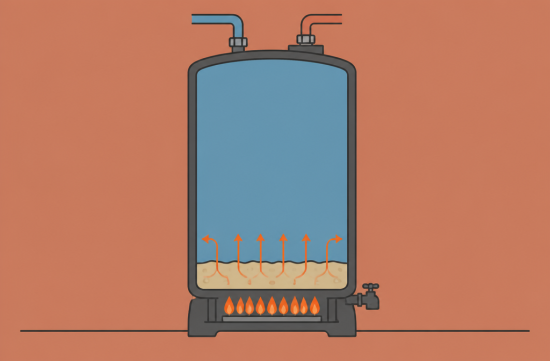
Gas water heaters have a burner located at the very bottom of the tank. The burner flame heats the bottom of the tank, and that heat is transferred to the water above. So, the condition of the bottom directly affects efficiency.
But what happens when sediment builds up at the bottom? This layer of sediment acts like an insulator between the burner and the water. The heat can't reach the water directly and gets blocked in between.
The result is simple. To heat the water to the same temperature, the burner has to stay on longer, which means it uses more gas. The numbers on your gas bill are slowly leaking from this issue.
The thud sound I heard is said to be caused by the water trapped beneath the sediment heating up and bursting. Hearing that sound is a sign that a significant amount of sediment has already built up.
There are many articles online claiming that efficiency can drop by several tens of percent due to sediment. However, I found that the numbers vary by source, and there's no official data to confirm them. So, I decided to trust the principle without focusing on the numbers.
Still, the share of energy used by the water heater in a home is not negligible. According to the Maryland Department of Housing, the federal Department of Energy states that hot water accounts for 18 percent of household utility costs. That's more significant than you might think.
So, how often should you remove the sediment? Opinions vary on this as well. The Energy Trust of Oregon says that most plumbers recommend draining and flushing at least once a year.
The city of Anaheim, California, advises draining about 1-2 gallons every six months using a bucket or hose. The city of Blaine, Minnesota, suggests every 1-3 years, depending on the model and water quality. Ultimately, it depends on how hard your water is.
If you're curious about the hardness of your local water, you can check the water quality report published annually by the water department. It's called the Consumer Confidence Report in English, and it includes hardness values. I don't trust the numbers on company advertising pages because they can be inconsistent.
The process itself isn't difficult. Based on the guidance from Blaine, I'll outline the steps. First, turn off the gas valve or switch to pilot mode.
Next, close the cold water valve that feeds into the tank. Connect a garden hose to the drain valve at the bottom, and place the other end somewhere safe where hot water can flow out.
Open the hot water faucet or pressure relief valve to allow air in, and then open the drain valve. Wait until the tank is empty; at first, cloudy water and white particles will come out. I was a bit surprised by that.
Once it's all drained, briefly open and close the cold water valve a few times to rinse out the bottom. When the water runs clear, close the drain valve and remove the hose. The next step is to fill the tank with water and turn the gas back on.
One thing to be careful about is that the water from the recently turned-off water heater is very hot. I turned off the gas a few hours in advance to let the water cool down a bit before doing this.
Another surprising piece of information came from the New Jersey Department of Health. They recommend that people over 50, smokers, those with weakened immune systems, or individuals with chronic lung diseases should not participate directly in the draining process. This is because tiny water droplets created by splashing can expose them to bacteria.
Also, if you haven't drained your water heater in a long time, the drain valve can cause problems. The city of Anaheim warns that if you don't do it regularly, sediment can prevent the valve from closing properly. If it's a tank that hasn't been touched in over ten years, I would just call a plumber.
Above all, it's best to check your water heater's manual first. The steps and precautions can vary slightly by manufacturer. If you don't have the manual, you can usually find it by searching the model number on the side sticker.
While you're draining the sediment, it's also a good time to check the temperature setting. The federal Department of Energy recommends setting the water heater temperature to 120 degrees Fahrenheit. Most homes find this temperature sufficient.
According to Maryland data, lowering the temperature by 10 degrees can reduce hot water costs by up to 5 percent. Since factory settings can sometimes be higher, it's worth checking.
However, the dial may not be accurate. So, it's advised to measure the temperature with a thermometer at the faucet farthest from the water heater. I also checked it at my kitchen sink and slightly adjusted the dial down.
Honestly, I hadn't done this since I bought my house. The water heater was just an object in the cold corner, and I didn't think of it as something to maintain. I felt a bit regretful.
After doing it, the thud sound has almost disappeared. I can't say exactly how much my gas bill has decreased yet since I've only received one bill since then. I plan to compare it with last year's bill when the next winter bill comes.
My conclusion is this: If you live in an area with hard water, make sure to drain it at least once a year and set the temperature to 120 degrees. It doesn't cost anything and can be done in half a day.
If you hear sounds from your water heater or if the hot water cools down faster than before, take a look at it this weekend. Saving even a little money could mean treating yourself to a warm plate of tacos.
 LeanTimeHeel






 gleeful |
 forevergee |
 mortrix |
 cherrydino |
 victoria 68 |
 fortbliss |
 Tomex Train Uncle |
 hexon |

 Spicy Immigration Life |
  Sunshine Blog |
  Minnesota Small Business |
  Strawberry Pancake Warrior |
  amolayo |
  korvon |
  Que Buena |
  virexo |
  silverpath |
  Komet Park |
  reliable |
  vexo90 |
  As Always Today |
  veltar87 |
  United States National Administrative Organization Stories |
  springwaltz |
  dense |
  Tiger Milk Foam Research Institute |
  Oreore Mushroom |
  optimistic |
  Good Good |