
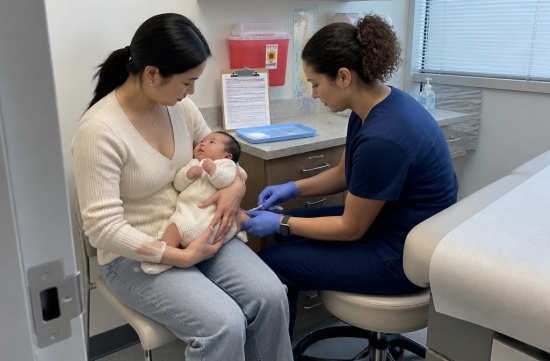
Last week during lunch, a junior colleague was deep in thought while looking at his phone. He mentioned that he had a baby in September and that the pediatrician brought up the RSV shot.
"Hey, this isn't a vaccine but an antibody. Do we really need to get it?" Honestly, I couldn't give him an answer right away. So that evening, I started looking up official information.
RSV is a respiratory virus that starts like a cold. While it might just result in a runny nose for adults, it's a completely different story for babies under one year old.
The CDC identifies RSV as the most common cause of infant hospitalization in the U.S. That's why they recommend taking special care of babies during their first winter.
There are two main ways to protect babies right now. One is a vaccine that the mother receives during pregnancy, and the other is the antibody shot given directly to the baby.
The maternal vaccine is called Abrysvo and is administered between 32 and 36 weeks of pregnancy. If the mother received it at least 14 days before giving birth, the baby typically does not need a separate antibody shot.
On the other hand, if the mother did not get vaccinated, or if it was less than 14 days before giving birth, or if the vaccination status is uncertain, the baby will be considered for the shot.
There are two types of antibodies for babies. One is Beyfortus (nirsevimab) from Sanofi and AstraZeneca, and the other is Enflonsia (clesrovimab) from Merck.
Unlike vaccines that stimulate the body to produce antibodies, both provide ready-made antibodies. This means protection starts immediately after administration, which is a significant advantage.
The target group is infants under 8 months old experiencing their first RSV season. The recommended administration period is from October 1 to March 31 in most areas of the continental U.S.
The baby of my junior colleague, born in September, falls right at the start of this season. Babies born during the season are advised to receive the shot within their first week, preferably around the time of discharge.
What about the effectiveness? When the CDC analyzed early data from the 2023-24 season, nirsevimab was found to prevent 90% of RSV-related infant hospitalizations.
I was a bit surprised by the numbers. It means that with just one shot, we can avoid many of those winter nights spent in the emergency room with a feverish baby.
What about the second winter? For infants between 8 and 19 months old who are at high risk, nirsevimab is administered again. Clesrovimab is only approved for the first season.
In early September, the American Academy of Pediatrics (AAP) expanded the criteria for high-risk groups. Babies born before 32 weeks, those with severe heart or lung diseases, neuromuscular disorders, or chromosomal conditions like Down syndrome were specified.
One thing to note is that there has been some confusion at the federal level regarding the vaccination schedule this year.
On January 5, the CDC changed the pediatric vaccination schedule, moving the RSV antibody from the "all children" category to the "specific high-risk groups" category. However, on March 16, a federal court in Massachusetts suspended the effectiveness of this revised schedule in a lawsuit filed by the AAP.
According to a July report from the Congressional Research Service (CRS), the recommendation for nirsevimab remains valid. However, the recommendation for clesrovimab, decided by ACIP in June 2025, is now subject to suspension, leaving the federal recommendation status ambiguous.
To be honest, I think this confusion is unnecessary stress for parents. It's not normal to have to check court rulings just to get a shot for a baby.
However, those living in California can worry a little less. Under state law (AB 144), health insurance regulated in California is required to cover RSV vaccinations based on recommendations from the California Department of Public Health (CDPH).
Last season, CDPH recommended one of the two products for infants aged 0-7 months and nirsevimab for high-risk infants aged 8-19 months. This recommendation operates independently of the federal ACIP decision.
Babies eligible for Medi-Cal or those without insurance can receive both antibodies for free through the Vaccines for Children (VFC) program. If you have employer insurance, it's best to check with the pediatric office about coverage beforehand.
You might be curious about side effects. According to CDC guidelines, the most common are pain or swelling at the injection site and rash, which usually resolve quickly.
Of course, every baby's health condition is different, so the final decision should always be discussed with a pediatrician. It helps to bring records of what the mother received during pregnancy for a smoother consultation.
I summarized it for my junior colleague like this: check the mother's vaccine record, if not vaccinated, schedule a pediatric appointment in October, and double-check insurance coverage at the office.
A few days later, my junior colleague said, "I got it, and the baby cried less than I expected," while showing me a picture. Seeing that face made me feel proud.
As for me? I would get it without hesitation. Safely getting through the first winter is the greatest gift for parents.
If you know any families who had a baby this fall, please pass this article along. I hope to reduce the number of families missing out on this information.
 MackerelFly








 Way to easy |
 Magic Cabbage School of Martial Arts |
 Vacation on Hawaii |
 morvex37 |
 Ari Songhan American Immigration Life |
 Nanana Nanana Nanana |
 West Kong |
 Information on All Regions of the United States |
 cathywhite |
 veltar87 |
  United States National Administrative Organization Stories |
  springwaltz |
  dense |
  Tiger Milk Foam Research Institute |
  Oreore Mushroom |
  optimistic |
  Good Good |
  berion88 |
  bravo777 |
  skyblue |
  Project Tomorrow |
  apricotla |
  Soy Angelino |
  nati8 |
  NE Hodori Preik |
  washington mom |
  celtics |
  Balancework |
  round1 |