
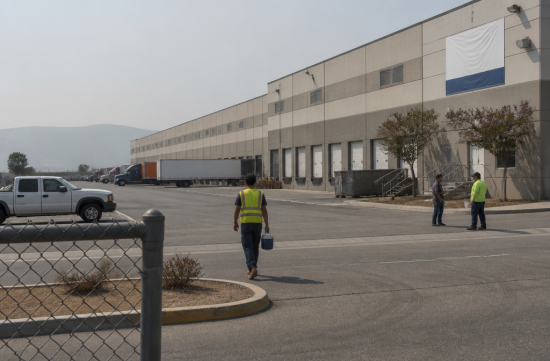
These days, whenever I meet friends, the topic of warehouses always comes up. Someone's nephew had their shifts reduced at a logistics center, and another place has completely closed down. Feeling uneasy about just hearing rumors, I decided to look up the numbers.
To get straight to the point, it is true that warehouse jobs in the Inland Empire are decreasing. However, the claim that "warehouses in Chino and Ontario have been closing one after another" is an exaggeration beyond what has been confirmed.
First, let's look at the big picture. According to local reports compiled from EDD data, 23,600 jobs were lost in the Inland Empire in January of this year, with 9,300 of those being in transportation and warehousing.
Of course, January is typically a month when staffing decreases after the holiday season. However, the issue is that this trend did not stop in January.
Between February and March, around 2,200 more jobs were lost in transportation and warehousing. The local analysis group IEGO reported that 26,000 jobs in this sector will disappear by the first half of 2025.
This is quite a significant reversal, especially considering that this sector had seen an increase of 47,000 jobs over the previous five years. Much of the growth during the pandemic is now being reversed.
What about our local area? According to the Q2 report from Kidder Mathews, the net absorption of warehouse space in the Chino and Chino Hills area was negative 762,686 square feet. This means that the amount of space vacated was significantly greater than the amount that came in.
In contrast, Ontario saw a net increase of 565,348 square feet in the same quarter. The direct vacancy rates are 4.6% for Chino and 6.8% for Ontario, which is not yet at a crisis level.
The overall direct vacancy rate for the Inland Empire is 7.6%, up from 6.6% a year ago. The average asking rent has decreased by 4.85% over the past year.
There are individual cases of closures as well. DHL Supply Chain closed its Ontario logistics center last year, resulting in a reduction of 346 employees, 222 of whom were in picking positions.
This year, news of layoffs has continued from nearby cities. Rialto's Geodis facility reported a layoff of 238 employees, and Fontana's CJ Logistics America warehouse reported 71 layoffs.
Wait! This part should not be overlooked. The article circulating online about "Chino Walmart logistics center laying off 953 employees" refers to an event from April 2023, so please check the date.
Why has this happened? The common reasons cited by reports include uncertainty in tariffs and trade policies, a decrease in port cargo volume, and automation.
When cargo at the ports of LA and Long Beach decreases, the goods coming to inland warehouses also decline. Additionally, with the increase in robotic picking, the same volume is being handled by fewer people.
So where have the jobs gone? As of January, the total number of jobs has increased by 15,100 compared to a year ago, with the healthcare and social services sector leading this increase with 25,600 jobs.
In August, the unemployment rate in the Inland Empire was 5.9%, up from 5.7% in July. Still, there was a report of an increase of 6,400 jobs combined in construction, finance, healthcare, hospitality, public services, and transportation.
In conclusion, rather than jobs disappearing entirely, the focus is shifting. The problem is that this transition does not happen automatically.
If a family member has received a layoff notice, there are a few things to keep in mind. California's WARN Act requires businesses of a certain size to provide 60 days' notice before mass layoffs or closures.
Make sure to get the notice date, last working day, and payment details in writing. It's also advisable not to delay applying for unemployment benefits after the last working day.
The WARN report list on the EDD website is accessible to everyone. It includes the company name, address, number of employees, and effective date, making it much more accurate than rumors.
Local America Job Centers also provide re-employment counseling and job training support. Eligibility requirements vary by individual, so it's best to check directly.
It's worth considering a shift in direction. Experience with forklifts or inventory management can also be applicable in manufacturing, materials distribution, and hospital supply management.
Some people are transitioning to truck driving, but this sector is also affected by cargo volume. If the reason for the reduction in warehouse staff is ultimately due to decreased cargo, then transportation is not a safe haven either, so it's wise to keep an open mind about different industries.
Personally, I don't view this trend too pessimistically. It could be a process of correcting the inflated aspects that arose during the pandemic. However, it weighs heavily on my heart that the burden of this cost is first falling on hourly workers.
From a household perspective, it's best to solidify finances during such times. If you have family in the warehouse sector, it's better to build up emergency savings and postpone large purchases.
If it were me, I would choose defense over offense right now. I believe that, in the long run, it would be more efficient to allocate policies towards retraining and industrial diversification rather than expanding unemployment benefits.
It's uncertain whether this landscape of endless warehouse roofs will continue. However, looking at the numbers has clarified the areas where we can prepare, rather than just feeling vague anxiety.
 StefRadish







 Banana Style Life |
 crystalo |
 Investment Beginner Company Information Encyclopedia |
 Always Dreaming of Big Success |
 happy 9 |
 Cap Com |
 DREAM BIG |
 Shoot Me |

 Way to easy |
  Chino Min |
  nexabyte |
  moonshine 7 |
  Sunset Oregon |
  victoria 68 |
  golfmaster |
  Montgomery Mom |
  squidogame |
  Noodle Noodle |
  Rhode Island Good People |
  Big North |
  Famous Attractions in the United States |
  Jin Soo V |
  Starbucks Reserve Roastery Closure |
  peppermint |
  Stable Co. |
  Purple Moons, |
  International Court |
  roma |