
Last weekend, while listening to a jazz trio performance at a café in Westport, I overheard a conversation at the next table among some seniors. They were discussing whether it was true that Ozempic would be cheaper starting next year. I went home and looked up the CMS data myself.
To cut to the chase, the numbers are correct. The price negotiated by Medicare for a 30-day supply of Ozempic is $274. However, this does not mean that this is the amount I will pay at the pharmacy, so I want to clarify that part as well.
CMS announced the results of the second round of drug price negotiations on November 25, 2025. The target is 15 drugs prescribed under Medicare Part D, with the effective date starting January 1, 2027.
The law refers to this price as the maximum fair price, abbreviated as MFP. This system started in 2023 under the Inflation Reduction Act (IRA), and this is the second round.
The most notable is the semaglutide class. Ozempic, Rybelsus, and Wegovy were negotiated as a bundle. The list price for a 30-day supply in 2024 was $959, but it will drop to $274, resulting in a discount rate of 71%.
This drug bundle accounted for over $15.1 billion in total spending under Part D in 2024. The number of beneficiaries who received prescriptions was 2.282 million. I was honestly a bit surprised by the numbers.
Let's go through the other drugs one by one. The inhaler Trelegy Ellipta for asthma and COPD will go from $654 to $175, and Breo Ellipta will drop from $397 to $67. Breo has an 83% discount rate.
There are also two more diabetes medications. Tradjenta will change from $488 to $78, and Janumet will go from $526 to $80. The 85% discount rate for Janumet is the highest on this list.
Linzess, used for constipation-predominant irritable bowel syndrome, will go from $539 to $136. Zyprexa, used for hepatic encephalopathy and diarrhea-predominant irritable bowel syndrome, will drop from $2,696 to $1,000.
For cancer medications, the amounts are different. The prostate cancer drug Xtandi is set at $7,004, and the breast cancer drug Ibrance is set at $7,871. The multiple myeloma drug Pomalyst is $8,650, and the blood cancer drug Calquence is $8,600.
The pulmonary fibrosis drug Ofev is $6,350, and the drug used for Huntington's disease and tardive dyskinesia, Austedo, is $4,093. The drug for bipolar disorder and schizophrenia, Brexpiprazole, is set at $770, and the psoriasis drug Otezla is $1,650.
That makes 15 drugs. The discount rates range from 38% to 85%. The smallest is Austedo's 38%.
According to CMS calculations, if these prices had been applied in 2024, Medicare net spending would have decreased by $12 billion, which is a 44% reduction. They estimate that beneficiary out-of-pocket costs will decrease by $685 million based on the 2027 standard benefit.
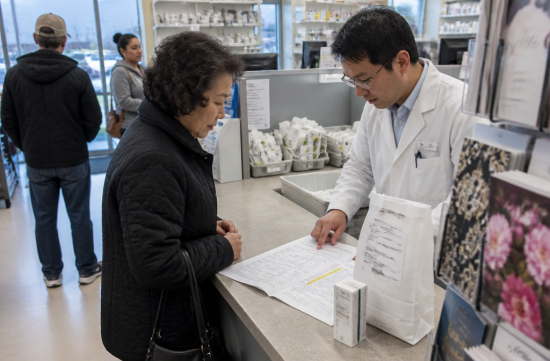
However, there is a part that can be easily misunderstood. The $274 is the price between Medicare and the pharmaceutical company. My copay or coinsurance is still determined by the Part D plan I am enrolled in.
Each plan has different classifications for drugs and whether they are flat-rate or percentage-based. Therefore, even for the same Ozempic, the amount I pay can vary depending on the plan.
Still, if the structure is percentage-based, there is a good chance I will see the effect of the lower benchmark price directly. The difference between 25% of the list price of $959 and 25% of $274 is quite significant.
We also need to look at the out-of-pocket maximum. The annual out-of-pocket maximum for Part D in 2026 is $2,100, but it will increase to $2,400 in 2027. Once the maximum is reached, the remaining drug costs covered for that year will be $0.
Weight loss purposes need to be considered separately. The negotiated prices for Ozempic, Rybelsus, and Wegovy are common, but prescriptions solely for weight loss are not necessarily covered under Part D. Wegovy is listed for patients with obesity or overweight who have cardiovascular disease indications.
Additionally, CMS is operating a temporary program called the GLP-1 Bridge from July 1, 2026, to December 31, 2027. If conditions are met, obesity treatment medications can be obtained with a $50 copay per month. The eligibility criteria are quite strict, so checking directly with the plan is the fastest way.
The most realistic checkpoint is the Medicare open enrollment period. It runs from October 15 to December 7 each year, so it starts next week. The plan chosen during this time will take effect from January 2027.
If you enter the medications you are currently taking into the plan finder tool on Medicare.gov, you will see the estimated costs by plan. In the Kansas City area, the plans in Missouri and Kansas differ, so comparisons should be made based on the state of residence.
For those who find English documents burdensome, there are state government free counseling services available. In Missouri, it is called CLAIM, and in Kansas, it is known as SHICK.
Changing medications or adjusting dosages is a separate issue from pricing. If the medication you are currently taking is on this list, be sure to consult with your doctor or pharmacist first to confirm whether you can continue using it.
Personally, I have some regrets about this announcement. The negotiated price came out higher than the $245 price for Medicare announced a few weeks earlier, which gives the impression that there are two different prices for the same drug.
Nonetheless, the fact that a drug with a list price of $959 is now set at $274 is undoubtedly a significant change. For medications that are taken regularly, like those for diabetes or asthma, the impact will be substantial.
If I were in your shoes, I would not automatically renew my current plan during this open enrollment period. I plan to input the drug list and check the costs based on 2027 at least once.
In response to the question I overheard at the café, I would say now that while the price is indeed going down, how much stays in my wallet is determined by the plan.
 MayoBike





 Old English |
 nixxon |
 LIZ Legal Information Blog |
 Karina's Blog |
 Jimbeam 88 |
 Kansas City Representative Singer |
 calvix |

 Rynex |
 Iri Jori Missouri |
  International Court |
  roma |
  horse |
  moodansa 77 |
  zymit |
  maplefox |
  Fun Flex Life |
  hopeful |
  Reeno |
  Coastal city |
  meonetoo |
  Winter bear |
  Peach Jam Eating Laughter |
  Nando Raldo |
  American Man in a Mask |
  wendra |
  silver |
  bada2002 |
  horizon |
  Nanana Nanana Nanana |