
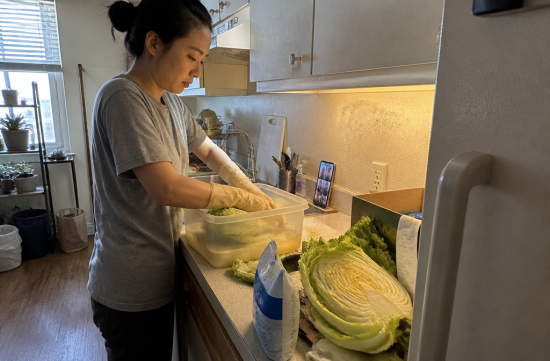
In October, I passed by the vegetable section at the grocery store and saw boxes of napa cabbage stacked up, which made me stop for a moment. Ah, the kimchi-making season is indeed upon us.
My mom in Korea talks about making kimchi every year, but I've never really done it properly here in the US. I've always just bought it from the store. So this year, I decided to at least try making a small batch.
First, let's talk about the timing for making kimchi in Korea. Generally, the best time is from late November to early December when the average daily temperature drops below 4 degrees Celsius.
For reference, what UNESCO recognized in 2013 as an intangible cultural heritage is not the food kimchi itself, but the culture of making kimchi. It's the process of making and sharing it that was acknowledged.
However, in Southern California, there are quite a few days in late November when it's warm enough to wear short sleeves. My conclusion was that there's no reason to strictly follow the Korean calendar.
Looking at the supply of napa cabbage, it's even more evident. Napa cabbage is essentially harvested year-round in California and Hawaii, so you can buy it anytime here.
The main production areas for California cabbage are the Central Coast, like Monterey, and the southern desert regions like Imperial and Riverside. Coastal areas reportedly plant and harvest year-round.
So when is the best time to buy? Napa cabbage prefers cool weather, so it's at its best in the fall when it's full and flavorful.
Therefore, in late fall, Korean markets often have sales on boxes of napa cabbage. From my perspective, the weekends between late October and November when box sales are happening seem to be the best time.
However, the sale dates can vary by store, so it's a good idea to check the weekly flyers in advance. It's also better for your mental health to avoid shopping during the week of Thanksgiving when it gets crowded.
The prices change weekly, so I won't specify an exact amount here. However, if you compare the flyers from two or three Korean markets in the same week, you'll see quite a difference; that's the easiest way to save money.
When choosing napa cabbage, pick one that feels heavy when you lift it. Avoid those with wilted outer leaves or a blackened base. If it's sold halved, look for one with a yellow and tightly packed interior.
Now, let's get to the main topic of making a small batch of kimchi. My guideline is about two to three heads of napa cabbage, which yields enough for two large containers. This is a realistic amount that I can handle in my apartment kitchen.
Buying by the box is cheaper, but honestly, for someone trying to make just two or three heads, one box is overkill. If you have a friend to do it with, buying a box and sharing is the most cost-effective option.
Salting is actually half of the kimchi-making process. The common method is to soak the napa cabbage in saltwater made with about 10% of the weight of the cabbage, and sprinkle a bit more coarse salt on the stem side.
The soaking time varies quite a bit by recipe. In Korea, it's said to be 6-7 hours in winter and 3-4 hours in summer.
In a warm indoor environment like Southern California, I think it's best to aim for the summer soaking time and check it periodically. When the stem bends without breaking, it's fully salted.
After salting, rinse the napa cabbage in cold water two to three times and make sure to drain it well. If you don't do this properly, the kimchi can end up too bland or have water pooling at the bottom of the container.
If you're short on time, buying pre-salted napa cabbage from a Korean market is also an option. It might cost a bit more, but it allows you to skip the most challenging step.
Also, buy some radish at this time. Korean radishes grow well in cool fall weather, so if you buy them now, they'll be firm and sweet.
The basic seasoning includes gochugaru (Korean red pepper flakes), minced garlic, ginger, fish sauce, glutinous rice paste, shredded radish, and green onions. If you're making a small batch, you can skip the oysters or fresh shrimp and it will still taste great.
The glutinous rice paste helps the seasoning stick between the leaves of the napa cabbage, so I recommend adding it even if it seems like a hassle. Just remember to let it cool completely before mixing it in.
The real advantage of making a small batch of kimchi is that the cost of failure is low. You can get the hang of it with two heads in the first year and increase the amount the following year.
Storage can be a bit tricky. There aren't as many homes in the US with kimchi refrigerators as you might think.
If you're putting it in a regular refrigerator, it's best to let it sit at room temperature for about a day to ferment slightly before putting it in. If the indoor temperature is high, it's good to reduce that time.
I recommend dividing it into several small containers. If you keep opening and closing one container, air gets in and it will spoil quickly. It's convenient to separate the containers for what you'll eat first and what you'll eat later.
The smell is also a concern. If you have roommates or neighbors, it's polite to wrap the container in a ziplock bag for extra sealing.
To summarize, aim for box sales of napa cabbage in late fall, start with two to three heads, and adjust the salting time according to the weather.
Perhaps the biggest reward is not the kimchi itself, but the time spent making it while video calling with my mom. I think that's where you can understand why UNESCO recognized it as a culture rather than just food.
I've set a date for the first weekend in November this year. I encourage you to try making a small batch too; it's more doable than you might think.
 ChzSlider








 hoosierdaddy |
 sun walker |
 Let's Be Like a Salt-like City Person |
 Springs Korea |
 US Legal Consultation on Trials |
 American History This and That |
 People Moon |
 Rowland Mama |
 Famous Attractions in the United States |
 Rhode Island Good People |
  Big North |
  Jin Soo V |
  Starbucks Reserve Roastery Closure |
  peppermint |
  Stable Co. |
  Purple Moons, |
  International Court |
  roma |
  horse |
  moodansa 77 |
  zymit |
  maplefox |
  Fun Flex Life |
  hopeful |
  Reeno |
  Coastal city |
  meonetoo |
  Winter bear |