
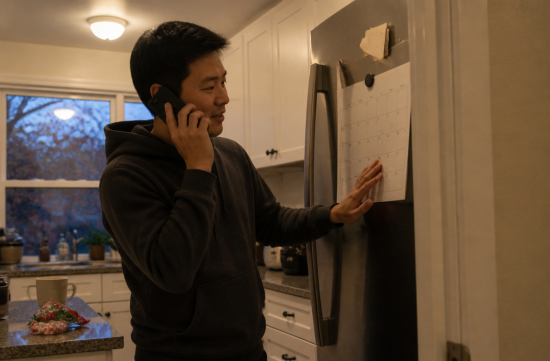
Last weekend, I received a call from my mom. After a few pleasantries, she got straight to the point: "When are you coming for Thanksgiving this year?"
It's still early October, but honestly, this question felt a bit scary rather than welcoming. I still remember the hurt feelings from last year's scheduling issues.
So this year, I decided to start planning early and properly. I'll share some thoughts I organized during that process.
First, I opened the calendar. Thanksgiving in 2026 falls on Thursday, November 26.
Christmas is on Friday, December 25, and New Year's Day is also on a Friday. This means we have two consecutive long weekends, which is a pretty good arrangement for planning.
The problem is that everyone knows this. AAA projected that 81.8 million Americans would travel more than 50 miles from home during last year's Thanksgiving period. This was the highest forecast on record for Thanksgiving.
They also estimated that 122.4 million people would travel during the 13 days from December 20 to January 1. Seeing those numbers made me chuckle. I finally understood why it took so long to cross a bridge.
Those living in this area know. The traffic congestion near the George Washington Bridge the day before a holiday is almost at a disaster level. So, scheduling dates is not just an emotional issue; it's also a traffic issue.
So where do hurt feelings come from? In my experience, it mostly arises from "not communicating in time."
Last year, I made plans with friends for year-end gatherings and informed my parents later. From their perspective, it felt like they were pushed down the priority list. It wasn't just about the schedule; it was about the order of communication that hurt their feelings.
There's an interesting statistic. According to a survey conducted by the Pew Research Center in the fall of 2023, 77% of parents with children aged 18-34 reported that their relationship with their children is very good or excellent.
However, only 59% of young adults felt the same way about their parents. There's quite a temperature difference regarding the same relationship.
73% of parents said they text their adult children several times a week. While parents feel close, their children are busy with their own lives, which seems to create this gap that surfaces during the holidays.
So, the first principle I set for this year is to "ask first." I will reach out to my parents before they ask me.
The second principle is to provide options. For example, I might say, "I'll come for Thanksgiving dinner on Thursday, and I'll stay overnight for Christmas Eve." This approach flows much more smoothly than a simple yes or no question.
The third principle is not to try to fill every day. Promising to spend the entire holiday at my parents' house is ultimately hard to keep, and if I can't keep it, it leads to more hurt feelings.
The fourth principle is to use a phone call instead of text. Discussing dates over text can come off as stiff and lead to misunderstandings. Hearing the same words in a voice sounds much less hurtful.
The fifth principle is to set a departure time in advance. Saying something like, "I'll leave after lunch on Saturday" helps avoid awkwardness when it's time to go. It also allows my parents to prepare themselves mentally.
If you have siblings, it's also a good idea to set a rotation in a group chat. For example, who will host Thanksgiving this year and who will host Christmas. If one person is always absent, it can build up unspoken tension.
If you have in-laws or a partner's family, it gets even more complicated. In this case, alternating years seems to be the cleanest solution. Having a set standard reduces blame on anyone.
It's also good to be honest about costs. Holiday airfare rises quickly, so siblings living far away should start looking for tickets around this time. If I inform my parents about this in advance, the complaints of "Why are you coming late?" will decrease significantly.
Food preparation should also be shared. I think it's time for my mom to stop doing everything alone, like making galbi jjim and turkey. I've already declared that I'll take care of desserts and drinks this year.
In fact, I plan to make peppermint chocolate bark myself. I can't guarantee the taste, but I can assure you of my effort.
And there's one more thing I want to say. It would be great if my parents could express their wishes clearly instead of saying something vague like, "Come if you can."
If they say something specific like, "I want everyone to have dinner together on Christmas," it makes it easier for the children to accommodate. If we beat around the bush, we just end up guessing each other's feelings.
If for some reason I can't make it this year, I think it's polite to suggest alternatives. Maybe visiting the following weekend or scheduling a video call during mealtime.
My conclusion is simple. Hurt feelings arise not from the schedule but from the order and timing of communication.
So now, in October, is the perfect time. With about seven weeks until Thanksgiving, try making that phone call this weekend.
I plan to call my mom again tonight. This time, I'll be the one to suggest the date first.
 HappyDuck


 hoosierdaddy |
 sun walker |
 Let's Be Like a Salt-like City Person |
 Springs Korea |
 US Legal Consultation on Trials |
 Dollydori, Lover of Movies |

 Anytime Journey |
 ringwinds |

 Living in America and Writing Essays |
  Starbucks Reserve Roastery Closure |
  peppermint |
  Stable Co. |
  Purple Moons, |
  International Court |
  roma |
  horse |
  moodansa 77 |
  zymit |
  maplefox |
  Fun Flex Life |
  hopeful |
  Reeno |
  Coastal city |
  meonetoo |
  Winter bear |
  Peach Jam Eating Laughter |
  Nando Raldo |
  American Man in a Mask |
  wendra |