
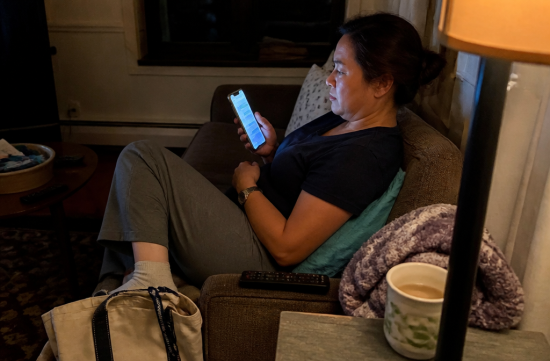
Last night at 9:30, I was lying on the couch with a heating pad on my back when my phone rang. It was a text from my boss, and the message was simply, "Can you modify just one page of the meeting materials for tomorrow morning?" Just that one line.
In that moment, my neck stiffened before my back did. Should I reply, or should I pretend to be asleep? In the end, I just stared at my phone screen until the heating pad had completely cooled down.
My body has a pattern: when I have a headache, my back hurts too, and when I'm stressed, my shoulders rise to my ears. That night, all three areas were sending signals at once.
So today, I decided to look into it. Is it really a problem if I don't reply to my boss's text after work?
First, let's address a common question. Is there a right to disconnect in New York, similar to France, where after-work contact is legally restricted?
The conclusion is that there is still no law in place. A related bill was introduced to the New York City Council in 2018, but it did not pass.
California also introduced a bill called AB 2751 in 2024, but it got stalled in the state assembly's budget committee. As of now, no state in the U.S. has implemented such a law.
There have been claims online that several states will start enforcing this from this year, but there is no official documentation to confirm that. It's best not to take such claims at face value.
This means that sending a text at night is not illegal. The issue arises when it comes to not replying.
New York is fundamentally an at-will employment state. Unless specified otherwise in a contract or union agreement, a company can terminate an employee relatively freely as long as it is not for a legally prohibited reason.
Legally, it is weakly protected against penalties for not replying. Honestly, this part was a bit disheartening.
However, there is a twist here. If you are a non-exempt employee, the situation changes.
The Fair Labor Standards Act (FLSA) states that any work done under circumstances that the company knows or should know about must be counted as working hours. This applies even if the company did not assign the task or if it is prohibited by company policy.
Very short tasks, lasting a few seconds or minutes, can be considered de minimis and may be exempt. However, if it happens every night, it is hard to view it as trivial according to labor law interpretations.
In simple terms, if a non-exempt employee is responding to their boss's texts every night, that counts as work they should be paid for. If they exceed 40 hours a week, they are also entitled to 1.5 times overtime pay.
On the flip side, if a company frequently texts a non-exempt employee at night, it can be quite burdensome for the company as well. Texts leave a record, so if there are disputes about working hours later, those records will be available.
What about salaried employees? Exempt employees are not subject to overtime regulations, so they have little protection in this regard.
However, not all salaried positions are exempt. As of 2026, the exemption criteria for managerial and administrative positions in New York City, Long Island, and Westchester are a weekly salary of $1,199.10 and an annual salary of $62,353.20.
The minimum wage in the same area has increased to $16 per hour starting this year. If your salary is below the exemption threshold but you are classified as exempt, it might be worth reviewing.
Even if your title is manager, if the actual work does not meet the criteria, you may not be exempt. This is something I worry about since it relates to a colleague of mine.
Additionally, it is prohibited by New York State labor law for a company to retaliate against an employee for raising issues about unpaid wages. Even in at-will employment, this aspect is separate.
So, what should you do in reality? Here's what I would do.
First, check whether you are classified as exempt or non-exempt on your pay stub or offer letter. Surprisingly, many people who have worked in the same office for years do not know this.
If you are non-exempt, keep a simple record of the time spent handling texts after work, noting the date, the time received, and how long it took. A screenshot is also a good idea.
Check if there are any regulations regarding after-hours contact in the company handbook. If there is a specified response time, that effectively becomes the standard.
Finally, having an open conversation with your boss has proven to be the most effective approach. Let them know that urgent matters can be handled by phone, and everything else will be addressed the next morning.
This morning, when I replied, I mentioned that, and surprisingly, my boss said, "Sure, I just send it when I think of it." I realized I had been stressing out for no reason.
Of course, every company and contract is different. If there are issues regarding classification or wages, consult the New York State Department of Labor or a labor law attorney.
In the end, I replied to last night's text at 8 AM with, "I'll fix it and send it now." Nothing came of it.
Today, instead of a heating pad, I plan to do some stretching and go to bed early. I'll leave my phone in the living room; that seems to be the most effective way to disconnect.
 lightyear

 Banana Style Life |
 crystalo |
 Investment Beginner Company Information Encyclopedia |
 Always Dreaming of Big Success |
 happy 9 |
 Yoyma |

 Misstic M |
 molten |
 flexible |
 Delicious Food Finder |
  peppermint |
  Stable Co. |
  Purple Moons, |
  International Court |
  roma |
  horse |
  moodansa 77 |
  zymit |
  maplefox |
  Fun Flex Life |
  hopeful |
  Reeno |
  Coastal city |
  meonetoo |
  Winter bear |
  Peach Jam Eating Laughter |
  Nando Raldo |
  American Man in a Mask |
  wendra |
  silver |