
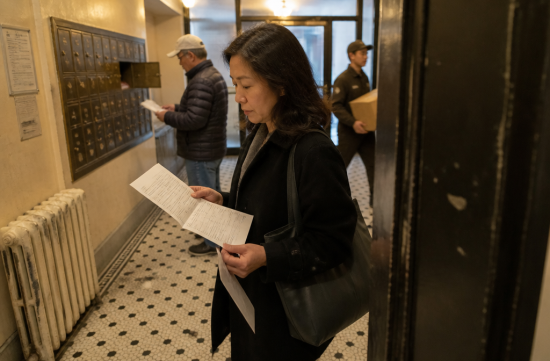
These days, the most common question I hear is, "I heard the rent is frozen, so our rent won't go up this time, right?" To answer that, it completely depends on the type of apartment and the lease start date.
Let's clarify the facts first. The New York City Rent Guidelines Board (RGB) voted 7 to 1 for a 0% rent increase rate on June 25, 2026.
The applicable leases are for rent-stabilized apartments that start between October 1, 2026, and September 30, 2027. Both one-year and two-year leases are at 0%.
The one-year freeze has occurred in 2015, 2016, and 2020. However, this is the first time in the board's history that a 0% increase has been applied to two-year leases, which has made it more newsworthy.
For comparison, last year's guidelines were a 3% increase for one-year leases and a 4.5% increase for two-year leases.
This means that even within the same building and the same rent-stabilized apartments, the increase rates differ based on whether the lease started on September 1 or October 1. If it started in September, it follows last year's guidelines; if it starts after October, it's 0%.
One point that confuses many is the signature date. The reference is not the day you sign but the actual start date of the lease.
Now, the most important question is whether my apartment is rent-stabilized. If the term is unfamiliar, think of it this way: it's an apartment registered with the state government where the allowable rent increase is set each year.
Rent-stabilized apartments make up a significant portion of the New York rental market. Most of them are in buildings with six or more units built before 1974.
Even new buildings can be rent-stabilized if they have received tax abatement programs. So, don't assume that new constructions are automatically excluded.
On the other hand, there are definitely apartments that are not affected by this freeze. Market-rate apartments, rent-controlled apartments, and most condos and co-op rentals fall into this category.
Market-rate apartments are simply regular rentals where the landlord and tenant negotiate based on the market rate. In this case, the recent decision does not apply directly.
Rent control is often confused due to the similar name; it is a separate system that applies to very long-term tenants. It operates independently of the RGB guidelines.
There are two ways to check this side by side. The first is your current lease documents.
If it's a rent-stabilized apartment, the lease or renewal documents often state that fact. Also, check if there is a rider attached to the lease.
The second is the state housing agency (HCR) records. You can request it by selecting "Am I rent stabilized" or "Apartment rent history" on the HCR online portal.
The rent history is a document that shows the registered rent records for that apartment. Keep in mind that the results will be mailed to the address of the apartment, so it may take some time.
If I were you, I would try both. First, get a sense from the lease wording, and if you're still unsure, finalize it with the HCR records.
It's also important to note that just because it's 0% doesn't mean the rent will never go up. Separate from the annual guidelines, MCI and IAI increases exist.
MCI refers to increases for major building-wide renovations, like boiler replacements, while IAI refers to increases for internal renovations in your apartment. If these items are attached, it's a good idea to request supporting documents.
Check the renewal timing as well. The landlord of a rent-stabilized apartment must propose a written renewal between 90 and 150 days before the existing lease expires.
If you have a lease starting after October and it includes an increase, first ask the landlord for justification. If that doesn't resolve the issue, you can file a complaint with the HCR.
Another point of confusion arises from the name. New York City has a separate program called the "Rent Freeze Program."
This is a city finance program commonly referred to as SCRIE or DRIE, which is different from the recent RGB freeze. SCRIE targets individuals over 62 years old, with a household income below $50,000, who pay more than one-third of their monthly income in rent.
This program, if approved, keeps the rent at a certain level, so its nature is different. If your parents live in a rent-regulated apartment, it might be worth looking into this as well.
From the market perspective, this decision is certainly a relief for tenants, but there is also considerable backlash from landlords. In fact, just before the vote, one board member resigned.
However, what tenants need to do is simple. Just confirm whether your apartment is rent-stabilized and whether your lease start date is after October 1. Those are the only two things you need to check.
If both apply, then this renewal is indeed at 0%. If either is unclear, I recommend pulling out the lease first and then checking the HCR records.
 EndureRL







 Sugar Cream Door Bulletproof Noodles |
 urbanmint |
 |
| 
 Premium Gas Camp |
 CA Real Estate |
 newyorker 101 |
 Things to Do to Buy a House |
 Lunch and Dinner Mexican Taco |
 Poppin News |
 Living in the Eastern United States |
  Purple Moons, |
  International Court |
  roma |
  horse |
  moodansa 77 |
  zymit |
  maplefox |
  Fun Flex Life |
  hopeful |
  Reeno |
  Coastal city |
  meonetoo |
  Winter bear |
  Peach Jam Eating Laughter |
  Nando Raldo |
  American Man in a Mask |
  wendra |
  silver |
  bada2002 |
  horizon |