
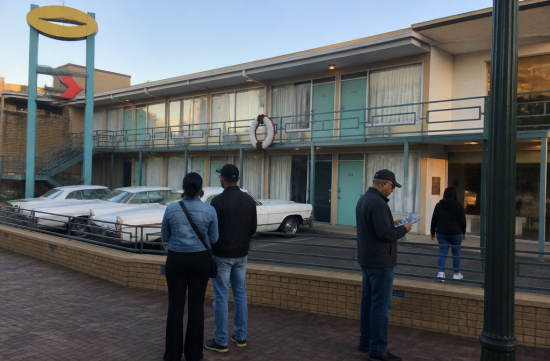
As you walk down Mulberry Street in downtown, an old two-story motel with turquoise doors suddenly appears. A large sign stands in front, and a white wreath hangs on one side of the second-floor railing. At first glance, it's hard to tell that this is a museum.
This is the Lorraine Motel. On April 4, 1968, Dr. Martin Luther King Jr. was shot on the balcony in front of room 306. It is now the National Civil Rights Museum.
Every time I see this building, I wonder one thing: how did the site of such a tragedy remain as a museum instead of being erased? Upon researching, I found that the story is much more complex than I expected.
The building's origins trace back to the Windsor Hotel in the 1920s. It was renamed the Markette Hotel in 1945, and that same year, African American businessman Walter Bailey purchased the property.
Bailey named it Lorraine after his wife Loree and the song "Sweet Lorraine." In 1955, a new two-story motel building with 16 rooms was constructed on the east side of the hotel. This is the part of the exterior we recognize from photographs today.
During the Jim Crow era, there were not many places for Black travelers to stay in the South. The Lorraine was listed in the Green Book, a guide for Black motorists. From a business perspective, it filled a gap created by discrimination.
Music history is also significant here. Nearby Stax Records housed artists who stayed at this motel, with names like Ray Charles, Aretha Franklin, and Otis Redding appearing on the guest list.
It is also well-known that Wilson Pickett's "In the Midnight Hour" was created in this motel room. The phrase "the city of blues and soul" is not just a label; it reflects the reality of the place.
Then comes the evening of April 4, 1968. Dr. King was shot while standing on the balcony, having come to support a sanitation workers' strike.
The tragedy did not end with one person. Co-owner Loree Bailey, who was at the front desk, collapsed from a stroke after hearing the gunfire and passed away on April 9, the day of Dr. King's funeral.
Walter Bailey decided not to rent out room 306 to guests anymore, leaving it as a memorial space. Room 307 was kept as a tribute to his wife. This must have been a difficult decision for a businessman.
However, as the neighborhood declined, the motel also fell into disrepair. In April 1982, Bailey was unable to repay a $140,000 construction loan, and the building was foreclosed.
Local leaders stepped in. The Martin Luther King Memphis Memorial Foundation bid $144,000 at auction to acquire the building. It's surprising how small that amount seems in retrospect.
The transition to a museum was not smooth. The last tenant, Jacqueline Smith, who had lived there for 11 years, refused to vacate.
She was forcibly removed on March 2, 1988. From that day, she began a one-person protest across the street.
Smith's argument was clear. She questioned how it made sense to evict a poor tenant while honoring someone who lived for the poor. She insisted that the funds should be used for housing and jobs. She continued this protest for over 30 years.
I believe that establishing the museum was the right decision. However, Smith's question cannot be easily dismissed. I think this city is still searching for answers about what to prioritize between preserving memory and the lives of current residents.
The museum opened on July 4, 1991, with an official dedication ceremony on September 28 of the same year. It had been nine years since the foreclosure.
In 1999, they acquired the Young and Morrow building across the street, which is where the boarding house identified as the shooter's location is located. In September 2002, a 12,800 square foot exhibition hall opened here.
In November 2012, the museum closed for renovations costing $27.5 million. It reopened on April 5, 2014, with over 40 video and oral history recordings and interactive exhibits added.
As someone in the tech field, I found this renovation particularly impressive. Instead of just putting a timeline on the wall, they allowed visitors to step onto a replica of the Montgomery bus and watch oral history videos. This shows that the way we convey memory must also be updated to fit the times.
Still, the focus of this place remains room 306. The final path of the exhibition leads to the glass window in front of that room. The bed, ashtray, and half-finished coffee cup are arranged just as they were on that day in 1968.
In the parking lot below the balcony, cars from that era are parked. They sit there without any elaborate staging, and perhaps that's why they seem to endure longer.
This museum is said to be among the top 5 percent of institutions certified by the American Alliance of Museums. It feels strange to think that a foreclosed motel went through a $144,000 auction to reach this point.
I would summarize this process in one sentence: it's a story of people who did not give up. From the owner who kept the room vacant to the foundation that bid at auction, and the tenant who continued to ask questions from across the street.
If you have guests, consider bringing them here before a barbecue joint. It's not far from the Mississippi Riverwalk, making it a great addition to a day trip.
Visiting hours and admission fees may change, so be sure to check the museum's official website before your visit. I would go around sunset and take one last look at that balcony before leaving.
 GameLife


 Sunset Oregon |
 daisypat |
 Anjollinya Blog |
 Anova US Beauty Information |
 anchor |
 lunarpath |
 greenloop |

 Choco Mint Creator |

 Chino Min |
  nexabyte |
  moonshine 7 |
  victoria 68 |
  golfmaster |
  Montgomery Mom |
  squidogame |
  Noodle Noodle |
  Rhode Island Good People |
  Big North |
  Famous Attractions in the United States |
  Jin Soo V |
  Starbucks Reserve Roastery Closure |
  peppermint |
  Stable Co. |
  Purple Moons, |
  International Court |
  roma |
  horse |