
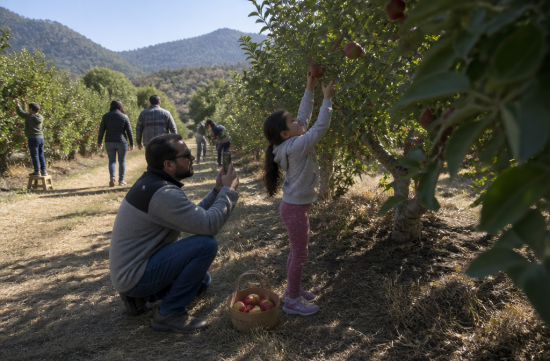
Last weekend morning, I drove east on the freeway to visit Oak Glen. As soon as I entered the parking lot, I was surprised. Minivans and SUVs were lined up, and every time a car door opened, kids would rush out.
Apples are stacked year-round at the local grocery store. So why do American parents drive for hours to go to an orchard in the mountains every fall? This time, I wanted to take a closer look at the reasons behind it.
Honestly, I was completely misunderstanding it at first. When I saw this scene for the first time after immigrating, I couldn't understand why people would pay to pick apples that were more expensive than at the grocery store. By Korean standards, it seemed like a losing deal.
I realized my thinking was wrong while I was in the orchard. A dad holding a basket smiled and said, "We're not here for the apples, really."
He meant they weren't there just for the apples. At first, I thought it was a joke, but after observing for half a day, I found that his statement was quite accurate.
First, let me tell you about this area. Oak Glen is a mountain village located 15 miles east of San Bernardino at an elevation of 4,734 feet. According to county records, a man named Enoch Parrish planted the first apple orchard here in 1876.
This area became a tourist destination in the 1940s. Several farms began selling not only apples but also apple pie, apple butter, and cider, turning it into a boomtown overnight.
Now, the county reports that over 300,000 visitors come each year. I was surprised by that number. It's quite impressive for a small mountain village.
So when did the "pick-your-own" culture start? Surprisingly, it traces back to the Great Depression.
In 1932, cherry farmers in Door County, Wisconsin, were informed that canning factories could only pay 1 cent per pound. It turned out to be more cost-effective to let the fruit rot on the trees than to pay for labor to pick them.
So farmers placed ads in newspapers and on the radio. They offered 1 penny per pound, but you had to pick them yourself.
The response was overwhelming. Records show that one orchard attracted 10,000 people from 130 towns that could be reached by car.
So, U-pick was initially not a romantic idea but a survival strategy. At this point, I nodded in agreement. It clearly showed American pragmatism.
This practice revived in the 1970s and 80s. Booker T. Whatley, an agricultural professor at Tuskegee University, actively promoted pick-your-own as a way for small farmers to survive.
His observations are interesting. He noted that customers came not just for the fruit but to enjoy the rural atmosphere. This was half a century ago, but it echoes the same sentiment as that dad's words last weekend.
The emotional connection Americans have with apples cannot be overlooked. Johnny Appleseed, whose real name was John Chapman, was born in Massachusetts in 1774 and died in Indiana in 1845.
In the stories, he is portrayed as a kind wanderer carrying a bag of seeds, but in reality, he was a meticulous businessman who bought and sold land to grow orchards. Most of the apples he planted were intended for cider rather than eating.
Regardless of the facts, American children associate apples with the pioneer era, fall, and family. I realized this is the power of culture.
Back to the scene. Walking between the trees, I noticed that parents weren't picking many apples. They were busy taking pictures of their kids struggling next to the ladder.
A girl about six years old brought over a worm-eaten apple and asked, "Mom, is this okay?" Her mom smiled and replied that it was still an apple.
This is a scene you can't learn from grocery store displays. They learn physically that apples grow on trees, have imperfections, and will disappear when the season is over.
I asked an employee at a nearby stand why so many people come only in the fall.
The answer was simple. "It's tradition; their parents brought them here, and now they bring their kids." It means they are bringing their children to the place their parents once took them.
I believe this is the key point. The U.S. is a country where people move frequently, so the concept of hometown is less pronounced than in Korea. Instead, annual events seem to fill that void.
Halloween pumpkin patches, Thanksgiving turkeys, and fall apple picking. The fixed dates and locations of these events help preserve family memories.
Let me share a failure of mine. The first time I came with kids from a family I knew, I insisted on filling the basket to get my money's worth.
The result was predictable. The kids got tired and whined after just 30 minutes, and half of the apples we brought home ended up being thrown away. The apples weren't the goal; I was the one focused on the apples.
So nowadays, I do it differently. I use a smaller basket, allow plenty of time, and finish with a slice of apple pie.
The reason American parents go to orchards every fall is ultimately to buy that day, not just the apples. I really like this culture. I encourage you to consider turning the steering wheel toward an orchard instead of the grocery store this fall.
 TransPanda





 daisypat |
 Anjollinya Blog |
 Anova US Beauty Information |
 anchor |
 Korea Tiger News |
 productionblog |
 All About Real Estate Information in the USA |
 fernando park |
 Valley Bang |
 U.S. Military Recruitment Information |
  Rhode Island Good People |
  Big North |
  Famous Attractions in the United States |
  Jin Soo V |
  Starbucks Reserve Roastery Closure |
  peppermint |
  Stable Co. |
  Purple Moons, |
  International Court |
  roma |
  horse |
  moodansa 77 |
  zymit |
  maplefox |
  Fun Flex Life |
  hopeful |
  Reeno |
  Coastal city |
  meonetoo |
  Winter bear |