
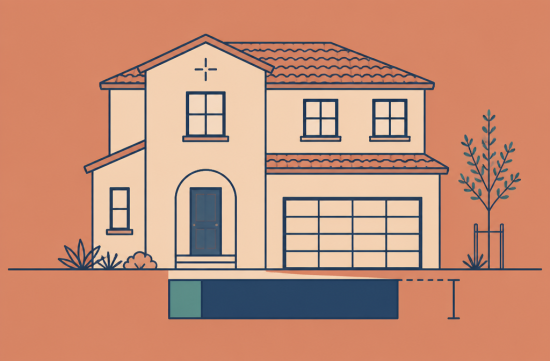
These days, people visiting new housing development model homes often ask a common question: "If Proposition 37 passes, can I buy a new home with just 3% down?"
To put it simply, the answer is, "If the conditions are met, it is possible, but it's not free." Let's go through the confirmed details step by step as we approach the November 3rd vote.
The reference materials are the official analysis from the Legislative Analyst's Office (LAO) and the 2026 income guidelines from the Department of Housing and Community Development (HCD). I will highlight areas where the implementation regulations have not yet been released.
The official name of Proposition 37 is the Loan Program for First-Time Homebuyers in the Middle Class. It allows the California Housing Finance Agency (CalHFA) to issue up to $25 billion in revenue bonds.
This money will fund a down payment assistance program called the "Middle-Class Homebuyer Loan." One loan can cover up to 17% of the home price.
The buyer must contribute at least 3% out of pocket. When you combine the 3% and 17%, that totals 20%, with the remaining 80% financed through a conventional mortgage.
To put it in numbers, for a new home priced at $800,000, the buyer's cash contribution would be $24,000, and the state program loan would be up to $136,000.
There is a common misconception here. The 17% is not a grant; it is a loan that must be repaid.
According to the LAO analysis, the homeowner's monthly payments are designed to cover the bond repayment and the program's operational costs. Therefore, the official assessment states that there are no direct costs to the state and local governments.
Ultimately, the monthly payment will be the sum of the first mortgage and the repayment of this second loan. You should calculate whether this total fits within your monthly budget before signing a contract.
The interest rate is still unknown. The bill requires CalHFA to keep the borrower's interest burden as low as possible, but the actual rate depends on the conditions under which the bonds are sold.
The California Budget Policy Center has also pointed this out. The interest rate will not be known before the vote, and the monthly payment could significantly reduce the benefits.
So, who can apply? You must be a California resident, and your household income cannot exceed twice the median income for your area.
According to the HCD's 2026 guidelines, the median income for a four-person household in Riverside County is $106,500. Simply doubling that gives $213,000, which is surprisingly generous, and I was a bit surprised myself.
However, the exact income table and household adjustment methods that will be used in the proposition will be determined during the implementation phase. It's safer to view the current numbers as a reference only.
It's also worth noting that you do not need to be a first-time homebuyer. According to the Budget Policy Center analysis, even if home prices rise later, you do not have to share that profit with the state government.
The biggest limitation is the condition of the home. It must be a newly built home or a newly constructed residence from a converted non-residential building, and you must be the first buyer of that home.
This means that existing homes, commonly referred to as resale properties, are not eligible. If your preferred neighborhood consists of older developments that are already built, this program does not apply.
There is also a price cap. The Budget Policy Center explains that it is roughly between $1 million and $1.5 million depending on the county, but the exact limit for Riverside County will need to be confirmed once the regulations are released.
There is also a provision for construction companies. Companies that adhere to higher labor standards can opt for what is called the qualified builder option, and in return, they will have more flexible rules regarding defect lawsuits.
This aspect is subtly important for buyers. When signing a contract, be sure to ask what options the builder used and how the defect repair process works.
Let's briefly summarize the pros and cons. Supporters argue that it helps the middle class, who earn too much to qualify for other assistance programs but struggle to save for a down payment.
Opponents criticize that it only increases debt while leaving the root causes of high home prices unchanged. There are also concerns that the state government could suddenly become a major mortgage lender.
The LAO also sees the effectiveness as uncertain. It is unclear how much investors will buy the bonds, whether the costs are better than other assistance programs, and whether new construction will actually increase.
For those looking at new developments, I want to add one more point. New developments often come with HOA fees or special taxes like Mello-Roos, which can significantly increase monthly expenses.
Here's what you can check right now. See if your household income is within the guidelines, and note the price range of the new developments you are interested in. Estimate the combined monthly payment of the two loans.
Even if it passes, the application window will not open immediately. CalHFA will determine the scale and timing of bond issuance, so it's best to wait for the official announcement while consulting with a loan officer in advance.
In my opinion, I would view this program not as a "way to buy a home cheaply" but as a "way to defer cash burdens." For those who want to move now rather than wait to save a 20% down payment, it could be a meaningful option.
Conversely, if you are primarily looking at existing homes or if your monthly payment capacity is tight, there is no rush. You can wait until the vote results and interest rate conditions are announced before making a decision.
 CrispyDetect







 Sugar Cream Door Bulletproof Noodles |
 urbanmint |
 |
| 
 Premium Gas Camp |
 CA Real Estate |
 Kathy's Blog |
 Investment Beginner Company Information Encyclopedia |
 Asparagus Blog |
 Information on All Regions of the United States |
 What can make money? |
  peppermint |
  Stable Co. |
  Purple Moons, |
  International Court |
  roma |
  horse |
  moodansa 77 |
  zymit |
  maplefox |
  Fun Flex Life |
  hopeful |
  Reeno |
  Coastal city |
  meonetoo |
  Winter bear |
  Peach Jam Eating Laughter |
  Nando Raldo |
  American Man in a Mask |
  wendra |
  silver |