
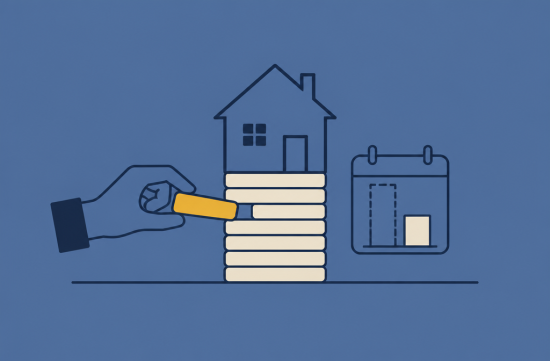
These days, I often receive similar questions from people who have sold their homes and moved to a new one. They ask if paying down their mortgage with the money from selling their previous home will lower their monthly payments.
To put it simply, if you just pay down the principal, your monthly payment remains the same. The loan will just be paid off sooner.
If you want to lower the actual monthly payment, there is a separate process you need to apply for, which is called recasting. Many people confuse it with refinancing, so today I want to clarify the differences between the two.
Recasting involves making a large principal payment, then recalculating the remaining balance over the remaining term. The interest rate and term stay the same, and only the monthly payment amount is recalculated.
This structure is also outlined in the Fannie Mae servicing guide. It states that after a significant principal repayment, the remaining balance, existing interest rate, and remaining term are used to recalculate the principal and interest, with only the monthly payment changing.
Looking at the numbers makes it clearer. Let's take a loan with a balance of $400,000, an interest rate of 6%, and a remaining term of 25 years as an example.
In this case, the principal and interest would be about $2,577 per month. If you pay down $50,000 and recast, the payment would drop to $2,255 based on a remaining balance of $350,000.
This means a reduction of $322 per month, and over the remaining term, you would save more than $46,000 in interest. The difference is larger than I expected when I calculated it.
So, how much does it cost? While it varies by servicer, processing fees generally range from $150 to $500.
Many places also set a minimum repayment amount. It's common to see thresholds of $5,000 or $10,000, and some, like Chase, do not charge fees or set minimum amounts for standard loans.
Refinancing, on the other hand, is a completely different story. Since you are taking out a new loan, it comes with appraisals, credit checks, and closing costs.
Closing costs are typically around 2% to 6% of the loan amount. This means that refinancing a $300,000 loan could cost between $6,000 and $18,000.
The current interest rate situation is also crucial. According to Freddie Mac, as of September 24, the average 30-year fixed rate was 7.03%, and the 15-year fixed was 6.42%.
Considering that the 30-year fixed rate was 6.3% at the same time last year, rates have actually gone up. It rose from 6.76% at the beginning of September to over 7% in just a few weeks.
So, if you currently have a rate in the low 6% range or lower, refinancing is likely to be a disadvantage. You would be giving up a lower rate for a higher one while also incurring costs.
This is where recasting shines. You can lower your monthly burden while keeping your existing interest rate.
However, not all loans qualify. Generally, conventional loans held by Fannie Mae or Freddie Mac are eligible, but FHA, VA, and USDA loans are typically not eligible for recasting, according to industry standards.
For jumbo loans, it varies by servicer, so some may allow it while others may not. Ultimately, it's best to ask your servicer directly for the most accurate information.
We should also address the downsides. If a large sum is tied up in your home, it can be difficult to access later.
If you need cash urgently later, you may have to look into a home equity loan, but no one can predict what the rates will be at that time. I do not recommend using emergency funds to recast.
Conversely, if you believe interest rates will drop significantly in the future, there's little reason to rush into a recast now. You could consider refinancing later while also reducing the principal.
So, I view the situation this way: If current rates are definitely lower than the market average, you have a lump sum available, and your monthly cash flow is tight, recasting is advantageous.
If current rates are higher than the market and your credit score has improved, it may be worth considering refinancing. The key is whether you can recoup the closing costs within a few years.
The application process is simpler than you might think. First, check with your servicer about the possibility of recasting, the minimum amount, and the fees.
Then, after making the principal payment and submitting the application, the new payment is usually applied within one or two billing cycles. If you are behind on payments, approval may not be granted, so it's important to keep your records clean.
One tip I can offer is to make sure to talk to your servicer before sending the principal payment. Some places will combine amounts paid within a certain period, but if you don't follow the correct order, it may only be processed as an additional payment.
When considering tax or investment implications, the best use of a lump sum can vary from person to person. Since it's a significant decision, I recommend consulting a financial advisor or tax professional.
In summary, in a rate environment around 7%, those with lower rates will find recasting to be a more beneficial choice. Each person should input their own numbers and make their own judgment.
 Trail85








 |
| 
 Premium Gas Camp |
 CA Real Estate |
 cheesepup |
 breezem |
 Alpha and Omega World |
 Yellow Snowman |


 hoosierdaddy |
  saffronroute |
  korvex93 |
  Mini Mee |
  Darnignac |
  vanilla |
  selvon |
  brownie |
  Star Blog |
  The Day the Sun Rises |
  sweetpop |
  California Kangaroo |
  zanero |
  station |
  Static |
  Star Way |
  American Blog Forge |
  MMORPG Games |
  Then you must be spring |
  Spicy Immigration Life |